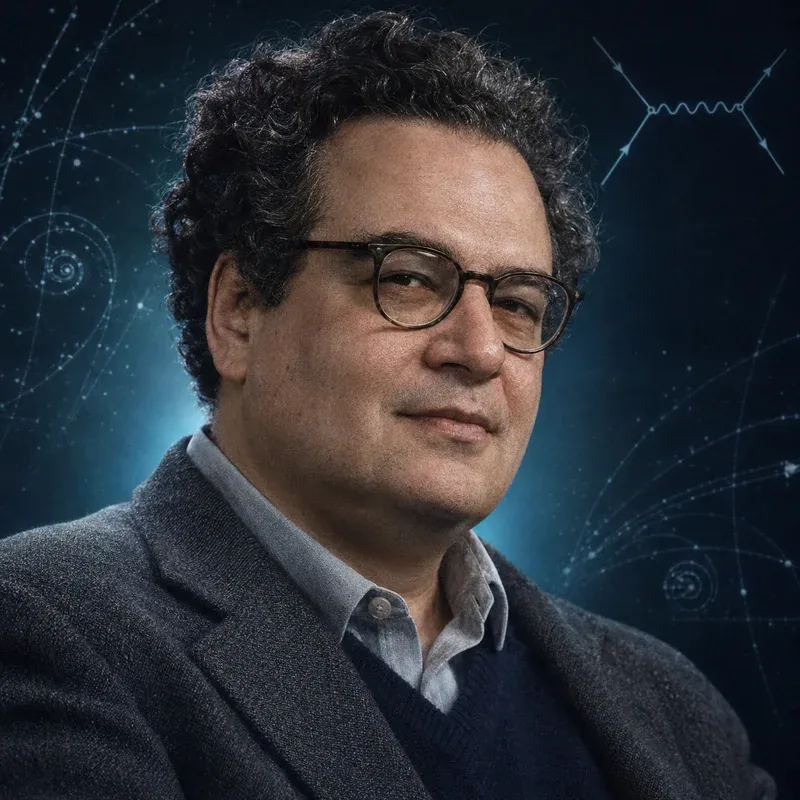
 Illustration
Mário Schenberg
With George Gamow, Schenberg proposed in 1940-41 the Urca process: repeated electron captures and beta decays in hot, dense stellar matter that carry energy away in neutrinos and antineutrinos, cooling the star. They suggested this neutrino energy loss could drive stellar collapse, an early link between neutrinos and supernovae.
- Nationality
- Brazilian
- Field
- theoretical physics, astrophysics
Early life and education
Mário Schenberg was born Mayer Schönberg on 2 July 1914 in Recife, Brazil, to parents of Russian-Jewish origin. Since his family could not afford study in Europe, he entered the engineering school in Recife in 1931 and later moved to the University of São Paulo.
The Urca process
In 1940 and 1941, working with George Gamow in the United States, Schenberg published two papers in Physical Review: 'The possible role of neutrinos in stellar evolution' and 'Neutrino theory of stellar collapse'. They considered hot, dense stellar matter in which a nucleus captures an electron and emits a neutrino, then beta-decays back and emits an antineutrino. The nucleus ends where it started, but each cycle sends away energy in two particles that escape the star unhindered.
Gamow named it after the Cassino da Urca in Rio de Janeiro, following Schenberg's remark that energy vanishes from the stellar core as quickly as money vanished at its roulette table. The two suggested that such rapid neutrino losses could remove the core's pressure support and trigger collapse, an early link between neutrinos and supernovae. The Urca process is now a standard ingredient of neutron star cooling and stellar energy loss: in the late stages of massive stars, neutrinos rather than light carry away most of the energy.
Other work
In 1942, with Subrahmanyan Chandrasekhar, Schenberg derived the Schönberg–Chandrasekhar limit: once hydrogen is exhausted in a star's core, an inert helium core can support the layers above it only up to about a tenth of the star's mass, beyond which it contracts and the star evolves quickly into a red giant. He taught at the University of São Paulo, supervised José Leite Lopes, and was president of the Brazilian Physical Society from 1979 to 1981. He was also a noted art critic. He died in São Paulo on 10 November 1990.
Known for
- Urca process (with Gamow, 1940–41)
Chronology
- 1940Urca process paper with Gamow
- 1941'Neutrino theory of stellar collapse'
Original papers
- G. Gamow, M. Schoenberg, The possible role of neutrinos in stellar evolution, Phys. Rev. 58, 1117 (1940)DOI 10.1103/PhysRev.58.1117
- G. Gamow, M. Schoenberg, Neutrino theory of stellar collapse, Phys. Rev. 59, 539 (1941)DOI 10.1103/PhysRev.59.539
Connected people
Frequently asked questions
Why is it called the Urca process?
Gamow named it after the Cassino da Urca in Rio de Janeiro. Schenberg had compared the way energy disappears from a stellar core through neutrinos with the way money disappeared at the casino's roulette table.
What is the Schönberg–Chandrasekhar limit?
The maximum mass, about a tenth of the total, that an inert helium core can have while still supporting the star's envelope. It explains the rapid transition of many stars from the main sequence to the red-giant stage.
On the timeline
Mentioned in 5 pages
Last updated: · Editorial standard
Cite this page
Text
Neutrino Atlas (2026). “Mário Schenberg”. Retrieved 22 November 2026, from https://neutrino-atlas.com/people/mario-schenberg/BibTeX
@misc{neutrinoatlas2026peoplemarioschenberg,
  title        = {Mário Schenberg},
  author       = {{Neutrino Atlas}},
  year         = {2026},
  url          = {https://neutrino-atlas.com/people/mario-schenberg/},
  note         = {Accessed 2026-11-22},
  language     = {english}
}