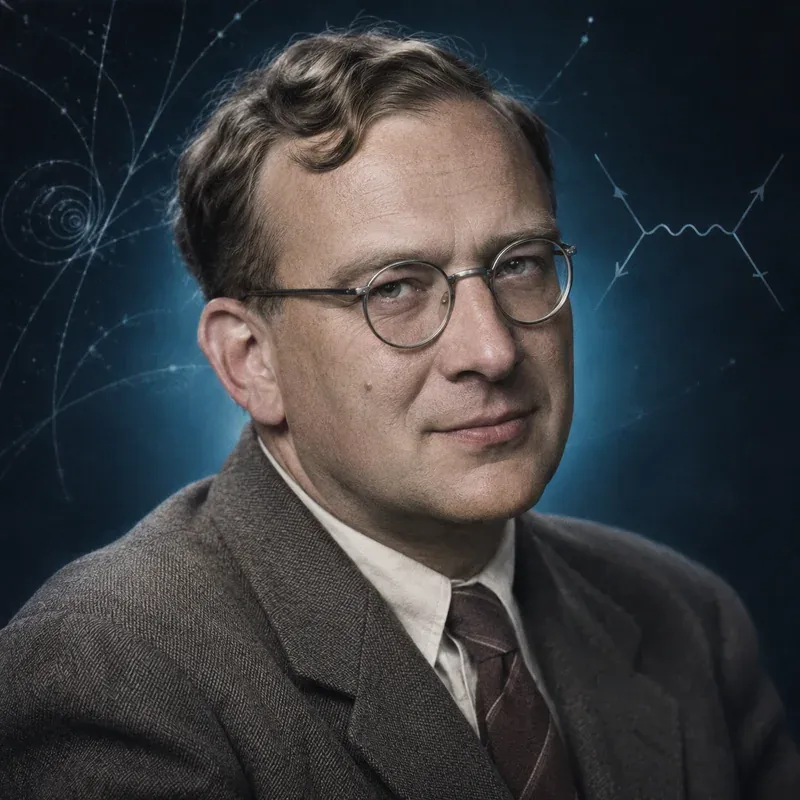
 Illustration
George Gamow
In 1936, with Edward Teller, Gamow extended Fermi's theory with the Gamow-Teller selection rules (spin-flip, axial-type transitions), essential for the later V-A structure of the weak interaction. With Mário Schenberg in 1940-41 he proposed the Urca process, in which stars lose energy by emitting neutrinos, and suggested it could trigger stellar collapse - the first recognition of neutrinos' role in stellar evolution and supernovae. He also wrote 'The reality of neutrinos' in the first volume of Physics Today (1948).
- Born
- 4 March 1904
Odessa, Russian Empire (now Odesa, Ukraine) - Died
- 19 August 1968
Boulder, Colorado, USA - Nationality
- Soviet-born American (US citizen 1940)
- Field
- theoretical physics, astrophysics, cosmology
- Institutions
- University of Göttingen, Niels Bohr Institute, Cavendish Laboratory, George Washington University
Early life and education
George Gamow (Georgy Antonovich Gamov) was born on 4 March 1904 in Odessa in the Russian Empire. He studied in Odessa and from 1923 at the University of Leningrad. In 1928, during a stay in Göttingen, he explained alpha decay as quantum tunnelling: an alpha particle escapes a nucleus by passing through an energy barrier it could not climb classically. The result made him internationally known at 24.
Gamow then worked at Niels Bohr's institute in Copenhagen and at the Cavendish Laboratory in Cambridge under Ernest Rutherford before returning to Leningrad. In 1933 he was permitted to attend the Solvay Conference in Brussels together with his wife and did not return to the Soviet Union. He became professor at George Washington University in Washington, D.C., in 1934, and in 1956 moved to the University of Colorado in Boulder, where he died on 19 August 1968.
Key contributions to neutrino physics
Gamow's first contribution concerned the structure of beta decay. Enrico Fermi's 1934 theory allowed only transitions in which the spins of the electron and neutrino pair up to zero, so the nucleus keeps its spin. Some observed decays changed the nuclear spin by one unit and did not fit. In 1936 Gamow and Edward Teller, his colleague at George Washington University, added a second type of interaction in which the electron–neutrino pair carries away one unit of spin. These Gamow–Teller transitions, alongside Fermi transitions, describe all allowed beta decays. When the weak interaction was finally understood in 1957–58 as V−A, the Gamow–Teller part turned out to be the axial-vector component.
His second contribution linked neutrinos to the life of stars. In 1940, with the Brazilian physicist Mário Schenberg, Gamow proposed the Urca process: in a hot, dense stellar core a nucleus captures an electron and emits a neutrino, then beta-decays back while emitting an antineutrino. The nucleus returns to its original state, but each cycle carries energy away in neutrinos that escape the star unhindered. Gamow named the process after the Cassino da Urca in Rio de Janeiro, where money disappeared at the gaming tables as invisibly as energy disappears from the star. In 1941 the two authors argued that such neutrino losses could cause the collapse of a stellar core. It was the first recognition that neutrinos govern the late evolution of massive stars, an idea central to modern theories of neutron star cooling and the supernova mechanism.
In 1948, still eight years before the neutrino was detected, he wrote 'The reality of neutrinos' for the first volume of Physics Today.
Cosmology and other work
Gamow is also one of the founders of hot Big Bang cosmology. With his student Ralph Alpher he developed the theory of element formation in the hot early universe; the 1948 paper appeared under the names Alpher, Bethe and Gamow, with Hans Bethe added as a pun on the Greek alphabet. This line of work led to Big Bang nucleosynthesis, in which the neutron-to-proton ratio, and therefore the helium abundance, is set by weak interactions with neutrinos. His popular books, such as the Mr Tompkins series, earned him UNESCO's Kalinga Prize in 1956.
Known for
- Gamow–Teller selection rules (1936)
- Urca process: neutrino cooling of stars (with Schenberg, 1940–41)
- Alpha-decay tunnelling theory
- Hot Big Bang (Alpher–Bethe–Gamow)
Chronology
- 1928Quantum-tunnelling theory of alpha decay
- 1936Gamow–Teller selection rules
- 1940Urca process with Schenberg
- 1948Alpher–Bethe–Gamow paper; 'The reality of neutrinos'
Original papers
- G. Gamow, E. Teller, Selection rules for the β-disintegration, Phys. Rev. 49, 895 (1936)DOI 10.1103/PhysRev.49.895
- G. Gamow, M. Schoenberg, The possible role of neutrinos in stellar evolution, Phys. Rev. 58, 1117 (1940)DOI 10.1103/PhysRev.58.1117
- G. Gamow, M. Schoenberg, Neutrino theory of stellar collapse, Phys. Rev. 59, 539 (1941)DOI 10.1103/PhysRev.59.539
- G. Gamow, The reality of neutrinos, Physics Today 1 (3), 4 (1948)DOI 10.1063/1.3066092
Connected people
Frequently asked questions
What is the Urca process?
A cycle of electron capture and beta decay in a hot stellar core that leaves the nuclei unchanged but emits a neutrino and an antineutrino each time, so energy drains from the star. Gamow and Schenberg proposed it in 1940; it is a key cooling mechanism for neutron stars.
What are Gamow–Teller transitions?
Beta decays in which the emitted electron and neutrino together carry one unit of spin, so the nuclear spin changes by one. Gamow and Teller introduced them in 1936 as a complement to Fermi's original theory.
Did George Gamow win a Nobel Prize?
No. His best-known honour is the Kalinga Prize for the popularisation of science (1956).
On the timeline
Mentioned in 16 pages
Lessons 1
Milestones 3
Last updated: · Editorial standard
Cite this page
Text
Neutrino Atlas (2026). “George Gamow”. Retrieved 22 November 2026, from https://neutrino-atlas.com/people/george-gamow/BibTeX
@misc{neutrinoatlas2026peoplegeorgegamow,
  title        = {George Gamow},
  author       = {{Neutrino Atlas}},
  year         = {2026},
  url          = {https://neutrino-atlas.com/people/george-gamow/},
  note         = {Accessed 2026-11-22},
  language     = {english}
}