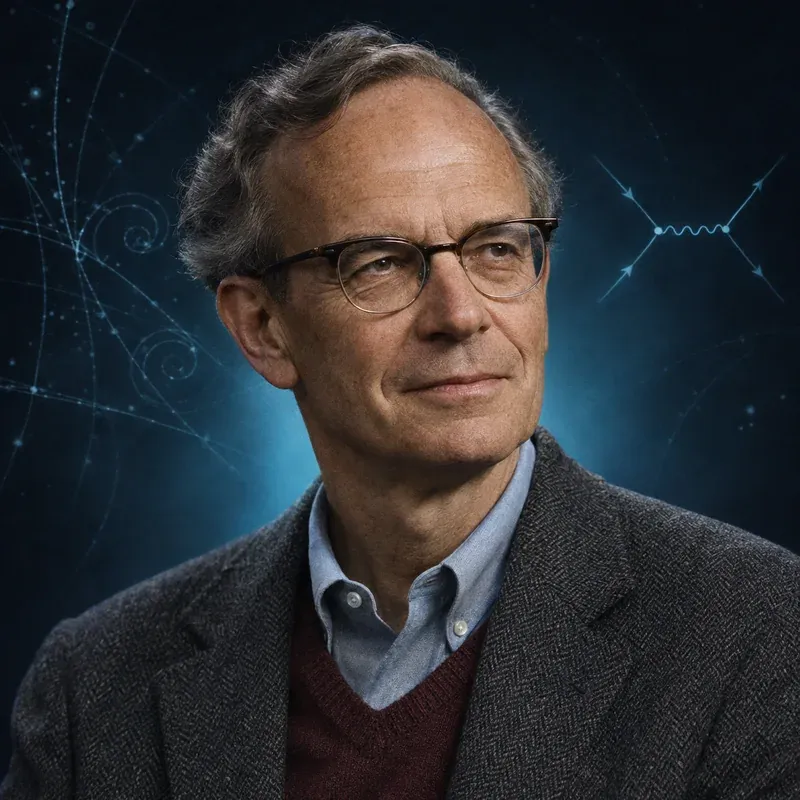
 Illustration
Charles L. Critchfield
As a student of Gamow, Critchfield proposed the proton-proton reaction p + p -> d + e+ + neutrino as a stellar energy source and worked out the proton-proton chain with Hans Bethe in 1938. This chain produces the dominant flux of solar neutrinos (pp, pep, Be-7 and B-8 neutrinos).
- Nationality
- American
- Field
- theoretical physics
- Institutions
- George Washington University
Early life and education
Charles Louis Critchfield was born on 7 June 1910 in Shreve, Ohio, and grew up in Washington, D.C. He studied at George Washington University, earning a bachelor's degree in mathematics in 1934, a master's in 1936 and a PhD in physics in 1939 under Edward Teller. George Gamow, also at George Washington University, was interested in how the Sun shines and encouraged Critchfield's work on the question.
The proton–proton reaction
In the 1930s it was clear that stars run on nuclear energy, but not which reactions supply it. The simplest possibility is two protons combining into a deuteron. This requires one proton to turn into a neutron during the brief encounter, a weak-interaction process that emits a positron and a neutrino. Critchfield estimated its rate; Hans Bethe checked and refined the calculation, and the two published 'The formation of deuterons by proton combination' in Physical Review in 1938.
The reaction turned out to be fast enough to power the Sun. In 1939 Bethe showed that the resulting pp chain dominates in stars like the Sun, while the CNO cycle found by Bethe and Weizsäcker dominates in heavier stars. The chain's branches produce the pp, pep, beryllium-7 and boron-8 neutrinos; pp neutrinos alone make up about nine tenths of the solar neutrino flux. They were measured indirectly by the gallium experiments and directly by Borexino in 2014.
Later career
Critchfield joined Los Alamos in 1943, first working on gun-type bomb designs and from 1944 leading the group that built the 'Urchin' neutron initiator for the implosion bomb. After the war he taught at the University of Minnesota, and in 1949 he published a book on nuclear theory and stellar energy sources with Gamow. From 1955 he was vice-president for research at Convair, working on the Atlas rocket, and from 1961 to 1977 he was again at Los Alamos. He died there in February 1994.
Known for
- Proton–proton chain (with Bethe, 1938)
Chronology
- 1938Bethe–Critchfield paper on deuteron formation by proton combination
Original papers
- H.A. Bethe, C.L. Critchfield, The formation of deuterons by proton combination, Phys. Rev. 54, 248 (1938)DOI 10.1103/PhysRev.54.248
Connected people
Frequently asked questions
Why is the pp reaction important for neutrino physics?
It is the source of most solar neutrinos. Every helium nucleus formed in the Sun through the pp chain releases two electron neutrinos, and the predicted flux from this chain was the benchmark for the solar neutrino problem.
Did Critchfield share Bethe's Nobel Prize?
No. Hans Bethe alone received the 1967 Nobel Prize for his work on energy production in stars, which built on the 1938 paper with Critchfield.
On the timeline
Mentioned in 4 pages
Last updated: · Editorial standard
Cite this page
Text
Neutrino Atlas (2026). “Charles L. Critchfield”. Retrieved 22 November 2026, from https://neutrino-atlas.com/people/charles-critchfield/BibTeX
@misc{neutrinoatlas2026peoplecharlescritchfield,
  title        = {Charles L. Critchfield},
  author       = {{Neutrino Atlas}},
  year         = {2026},
  url          = {https://neutrino-atlas.com/people/charles-critchfield/},
  note         = {Accessed 2026-11-22},
  language     = {english}
}