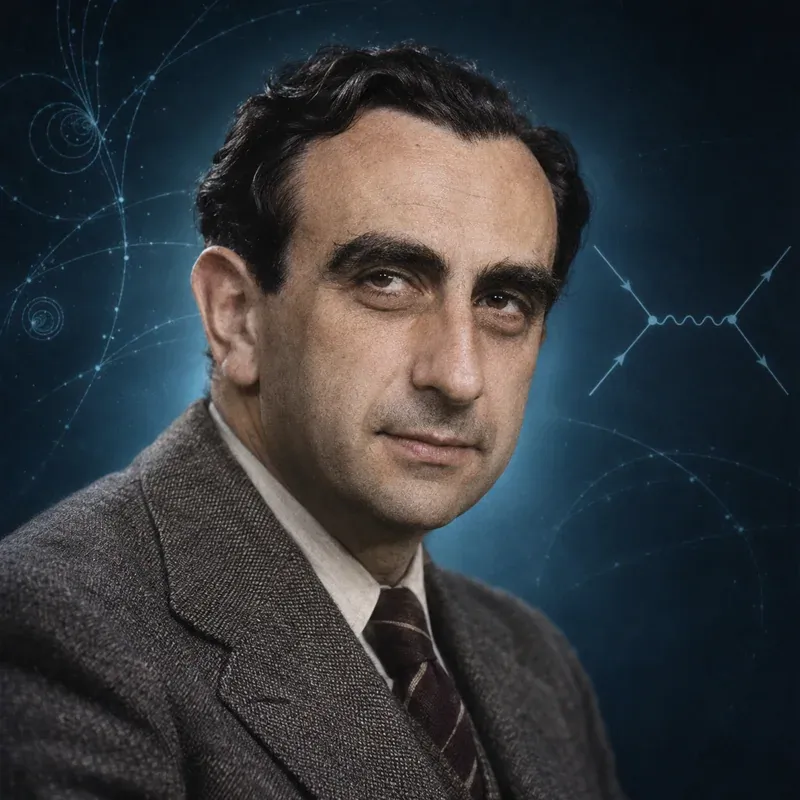
 Illustration
Edward Teller
With George Gamow in 1936, Teller introduced the Gamow-Teller selection rules for beta decay, allowing transitions with nuclear spin change of one unit (axial-vector-type couplings) in addition to Fermi's original vector transitions. This generalisation of Fermi theory was essential for interpreting beta-decay data and later for the V-A theory.
- Born
- 15 January 1908
Budapest, Hungary - Died
- 9 September 2003
Stanford, California, USA - Nationality
- Hungarian-American
- Field
- theoretical physics
- Institutions
- George Washington University, Los Alamos, University of Chicago, Lawrence Livermore National Laboratory
Education and early career
Edward Teller was born in Budapest on 15 January 1908. He studied chemical engineering at Karlsruhe, then physics in Munich under Arnold Sommerfeld, and received his PhD in Leipzig in 1930 under Werner Heisenberg with a thesis on the hydrogen molecular ion. He worked in Göttingen until 1933, then spent time in Copenhagen with Niels Bohr and in London. In 1935 he joined George Gamow as a professor at George Washington University in Washington, D.C.
Gamow–Teller transitions
Enrico Fermi's 1934 theory of beta decay used a vector-type coupling in which the electron and the antineutrino leave with their spins opposed. Such 'Fermi transitions' cannot change the nuclear spin. Yet many observed decays did change it by one unit. In 1936 Gamow and Teller showed that a different kind of coupling, now called axial-vector, lets the electron and antineutrino carry away one unit of angular momentum together. The resulting Gamow–Teller selection rules allow the nuclear spin to change by 0 or ±1, but forbid 0 → 0 transitions.
This generalisation made Fermi theory fit the data and prepared the ground for the V−A theory of 1957–58, in which vector and axial-vector couplings combine. Gamow–Teller strengths are still essential in neutrino physics: they govern neutron decay together with the Fermi part, the capture rates in radiochemical detectors such as chlorine and gallium, the cross-sections of supernova neutrinos on nuclei, and the nuclear matrix elements of double beta decay.
Later career
Teller also predicted the Jahn–Teller effect (1937) and co-developed the BET adsorption theory. From 1943 he worked at Los Alamos; with Emil Konopinski and C. Marvin he wrote the report LA-602 on whether a nuclear explosion could ignite the atmosphere. After the war he pushed for the hydrogen bomb, co-devised the Teller–Ulam design in 1951 and co-founded Lawrence Livermore National Laboratory, which he directed in 1958–60. His 1954 testimony against J. Robert Oppenheimer estranged many colleagues. He received the Enrico Fermi Award in 1962 and the Presidential Medal of Freedom in 2003, and died at Stanford on 9 September 2003.
Known for
- Gamow–Teller selection rules (1936)
- LA-602 report on atmospheric ignition (with Konopinski and Marvin)
Chronology
- 1936Gamow–Teller selection rules
Original papers
- G. Gamow, E. Teller, Selection rules for the β-disintegration, Phys. Rev. 49, 895 (1936)DOI 10.1103/PhysRev.49.895
Connected people
Frequently asked questions
What are Gamow–Teller transitions?
Beta decays in which the emitted electron and antineutrino carry one unit of spin together, so the nuclear spin can change by one. They come from the axial-vector part of the weak interaction, introduced by Gamow and Teller in 1936.
Why does Teller appear in neutrino history?
Because the Gamow–Teller rules completed Fermi's theory of beta decay, and Gamow–Teller strengths still determine many neutrino–nucleus cross-sections used in detectors.
Mentioned in 13 pages
Lessons 1
Milestones 1
People 9
Last updated: · Editorial standard
Cite this page
Text
Neutrino Atlas (2026). “Edward Teller”. Retrieved 22 November 2026, from https://neutrino-atlas.com/people/edward-teller/BibTeX
@misc{neutrinoatlas2026peopleedwardteller,
  title        = {Edward Teller},
  author       = {{Neutrino Atlas}},
  year         = {2026},
  url          = {https://neutrino-atlas.com/people/edward-teller/},
  note         = {Accessed 2026-11-22},
  language     = {english}
}