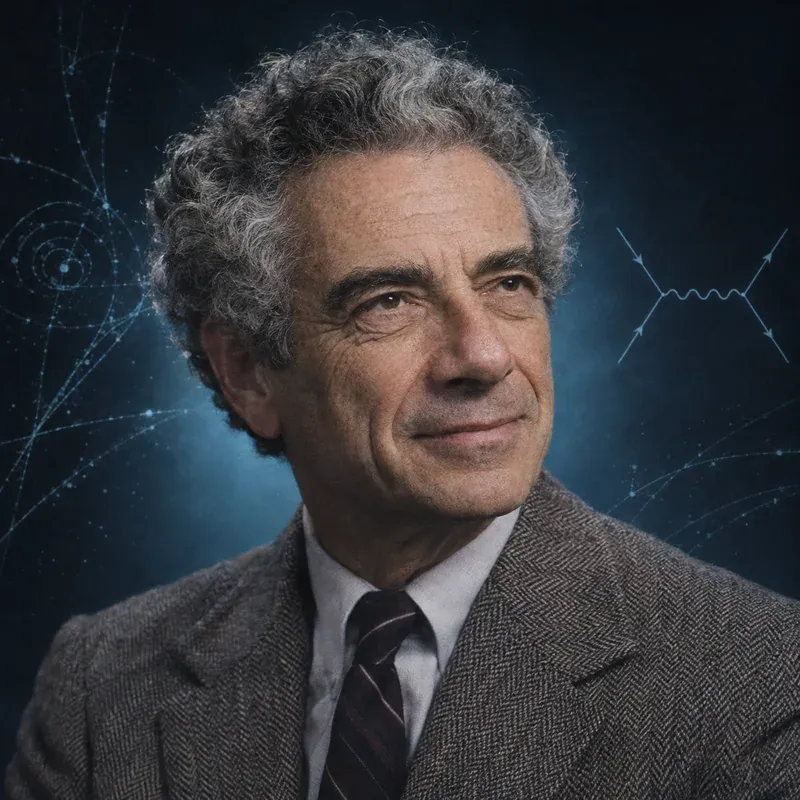
 Illustration
Jack Steinberger
His 1949 thesis on the muon decay electron spectrum showed it to be a three-body decay involving two neutral particles. In 1962 he co-led the Brookhaven experiment that discovered the muon neutrino. As spokesperson of ALEPH at CERN's LEP collider, he led an experiment whose early Z-boson measurements (1989) counted the number of light neutrino species, consistent with three.
- Born
- 25 May 1921
Bad Kissingen, Germany - Died
- 12 December 2020
Geneva, Switzerland - Nationality
- German-born American
- Field
- Experimental particle physics
- Nobel Prize
- Physics 1988 – for the neutrino beam method and the demonstration of the doublet structure of the leptons through the discovery of the muon neutrino (shared with Lederman and Schwartz)
- Institutions
- University of Chicago, University of California, Berkeley, Columbia University, CERN
Early life and education
Hans Jakob (Jack) Steinberger was born in 1921 in Bad Kissingen, Bavaria, into a Jewish family. As the Nazi persecution intensified, he and his brother Herbert were sent to the United States at the age of 13, under a programme that placed refugee children with American families; his parents and younger brother followed in 1938. He began studying chemical engineering at the Armour Institute in Chicago, had to stop when his scholarship ran out, and completed a bachelor’s degree in chemistry at the University of Chicago in 1942.
During the Second World War he served in the Army Signal Corps and was assigned to the MIT Radiation Laboratory, where he worked on radar and first became interested in physics. In 1946 he returned to Chicago on the G.I. Bill as a graduate student of Enrico Fermi, with Edward Teller among his teachers.
Path to neutrino physics
Fermi suggested a thesis on the decay of the muon, then called the mu meson. Steinberger measured the energy spectrum of the electrons from muon decay, using cosmic-ray muons, and found that it was continuous rather than a single line. A two-body decay would give every electron the same energy; a continuous spectrum meant the energy was being shared with at least two invisible partners. The muon therefore decays into an electron and two neutral particles, which we now know as a muon neutrino and an electron antineutrino. He received his PhD in 1949.
After a year at the Institute for Advanced Study in Princeton he moved to the Radiation Laboratory in Berkeley, where he showed that neutral pions are produced in collisions and decay into two photons. In 1950 he had to leave Berkeley after refusing to sign the University of California’s anti-communist loyalty oath, and he joined Columbia University, where he stayed until 1968. There he became one of the first users of bubble chambers for particle physics; among the results was the discovery of the neutral Sigma hyperon in 1956.
Key contributions
In 1961–62, with Leon Lederman and Melvin Schwartz, Steinberger carried out the Brookhaven two-neutrino experiment. It used the first accelerator neutrino beam, made from decaying pions, and a large spark chamber behind thick steel shielding. The neutrinos produced muons but no electrons, showing that the muon neutrino is distinct from the electron neutrino. The leptons thus come in pairs, or doublets: the electron with its neutrino and the muon with its own. This is the structure later extended to three lepton generations.
In 1968 Steinberger moved to CERN. In the 1970s and 1980s he was a leading member of the CDHS experiment, an electronic neutrino detector of magnetised iron in the neutrino beams of the SPS, which measured deep inelastic scattering of neutrinos on nucleons and so mapped the quark structure of the proton and neutron. Later, the NA31 experiment, in which he took part, found the first evidence for direct CP violation in the decay of neutral kaons.
His final major project was ALEPH, one of the four detectors at CERN’s Large Electron–Positron collider, of which he was the spokesperson. In autumn 1989, within weeks of the start of LEP, ALEPH and the other experiments measured the width of the Z boson resonance. Each light neutrino species into which the Z can decay adds to this width. The result fixed the number of light neutrinos at three, closing the door on a fourth light generation of the type known so far.
Nobel Prize and later life
The 1988 Nobel Prize in Physics was shared by Lederman, Schwartz and Steinberger for the neutrino beam method and for the demonstration of the doublet structure of the leptons through the discovery of the muon neutrino. In the same year he received the US National Medal of Science. After retiring from CERN in 1986 he taught at the Scuola Normale Superiore in Pisa and remained active in public debate on energy and climate. His former school in Bad Kissingen was named after him in 2001, and in 2006 he became an honorary citizen of the town. He died at his home in Geneva on 12 December 2020, aged 99.
Known for
- Discovery of the muon neutrino (1962)
- Spokesperson of ALEPH at LEP
- Number of light neutrino families from Z decays
- CP-violation experiments (NA31)
Chronology
- 1948PhD thesis on muon decay (three-body)
- 1962Two-neutrino experiment at Brookhaven
- 1968Moves to CERN
- 1988Nobel Prize in Physics
- 1989ALEPH measures number of light neutrino species
Original papers
- G. Danby et al., Observation of High-Energy Neutrino Reactions and the Existence of Two Kinds of Neutrinos, Phys. Rev. Lett. 9, 36 (1962)DOI 10.1103/PhysRevLett.9.36
- D. Decamp et al. (ALEPH), Determination of the number of light neutrino species, Phys. Lett. B 231, 519 (1989)DOI 10.1016/0370-2693(89)90704-1
Experiments
Connected people
Frequently asked questions
What did Jack Steinberger discover?
Together with Leon Lederman and Melvin Schwartz he showed in 1962 that there are two different kinds of neutrinos, discovering the muon neutrino. Earlier, his thesis showed that the muon decays into an electron and two neutral particles.
How did ALEPH count the neutrino species?
By measuring how wide the Z-boson resonance is. Every light neutrino species opens an additional, invisible decay channel for the Z and broadens the resonance. The measured width matches exactly three light neutrinos.
Why did Steinberger leave Berkeley?
In 1950 he refused to sign the loyalty oath that the University of California required of its staff, and had to leave. He then moved to Columbia University.
On the timeline
- 1962Brookhaven experiment discovers the muon neutrino
- 1988Nobel Prize for the muon neutrino
- 1989LEP shows there are three light neutrinos
Mentioned in 32 pages
Milestones 8
- 1957 · Nobel Prize for Lee and Yang
- 1957 · Wu experiment shows parity violation
- 1960 · Proposals for accelerator neutrino beams
- 1962 · Brookhaven experiment discovers the muon neutrino
- 1988 · Nobel Prize for the muon neutrino
- 1989 · LEP shows there are three light neutrinos
- 2015 · Nobel Prize for neutrino oscillations
- 2026 · Nobel Prize for Francis Halzen and IceCube
Last updated: · Editorial standard
Cite this page
Text
Neutrino Atlas (2026). “Jack Steinberger”. Retrieved 22 November 2026, from https://neutrino-atlas.com/people/jack-steinberger/BibTeX
@misc{neutrinoatlas2026peoplejacksteinberger,
  title        = {Jack Steinberger},
  author       = {{Neutrino Atlas}},
  year         = {2026},
  url          = {https://neutrino-atlas.com/people/jack-steinberger/},
  note         = {Accessed 2026-11-22},
  language     = {english}
}