1957Award
Nobel Prize for Lee and Yang
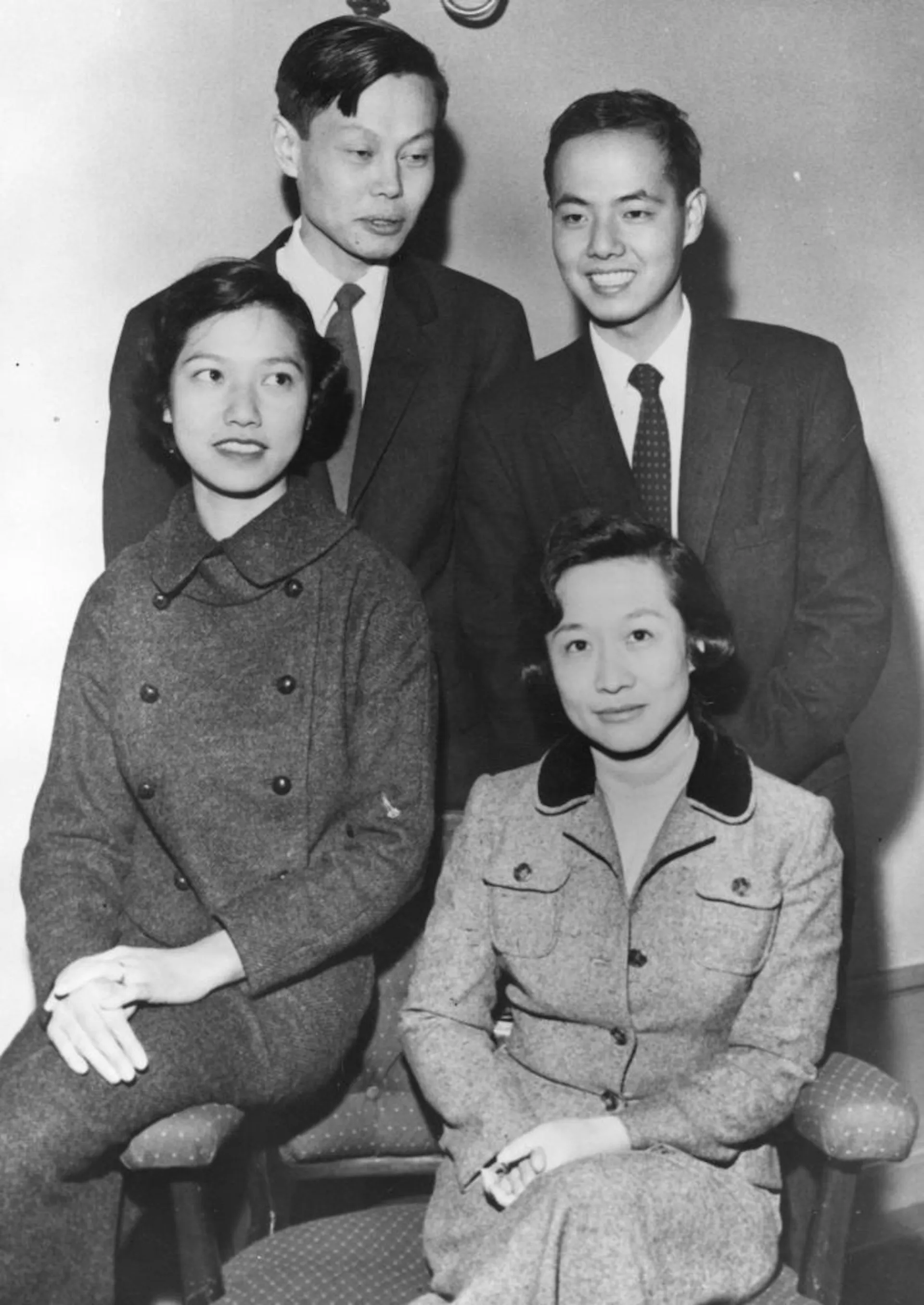
The 1957 Nobel Prize in Physics went to Chen-Ning Yang and Tsung-Dao Lee 'for their penetrating investigation of the so-called parity laws which has led to important discoveries regarding the elementary particles'. The prize came only about a year after their paper, after Wu's experiment had confirmed parity violation. Chien-Shiung Wu herself was not included, an omission widely discussed since.
- Date
- 1957
- Kind of event
- Award
- People involved
- Chen-Ning Yang, Tsung-Dao Lee, Chien-Shiung Wu
The situation before
At the start of 1957 the conservation of parity, the idea that the laws of physics do not change when viewed in a mirror, collapsed within a few weeks. Tsung-Dao Lee and Chen-Ning Yang had argued in a paper published on 1 October 1956 that parity had never been tested in weak interactions. In January 1957 the experiment of Chien-Shiung Wu and her colleagues at the National Bureau of Standards, and the pion-muon experiment of Richard Garwin, Leon Lederman and Marcel Weinrich, showed that parity is in fact strongly violated in beta decay and in meson decays.
What happened
Later in 1957 the Royal Swedish Academy of Sciences awarded the Nobel Prize in Physics jointly to Yang and Lee "for their penetrating investigation of the so-called parity laws which has led to important discoveries regarding the elementary particles". The prize was presented in Stockholm on 10 December 1957. In their Nobel lectures the next day, Yang spoke on the law of parity conservation and other symmetry laws of physics, and Lee on weak interactions and the non-conservation of parity.
- Laureates: Chen-Ning Yang (born 1922), Institute for Advanced Study, Princeton; Tsung-Dao Lee (born 1926), Columbia University, New York.
- Interval between proposal and prize: about one year after publication of the paper, and less than a year after its experimental confirmation.
- Both laureates were born in China; they were the first Chinese Nobel laureates.
The speed of the award was unusual. The Nobel Prize often recognises work decades after it was done; here the decisive experiments were barely ten months old. Lee was among the youngest physics laureates up to that time.
Reaction and the question of Wu
The award was widely seen as deserved, because Lee and Yang's analysis had overturned an assumption that almost all physicists had shared. Discussion has focused on who was left out. Wu's experiment provided the decisive evidence, and her role was mentioned in the presentation speech, but the prize went only to the theorists. Jack Steinberger later called the omission the biggest mistake in the Nobel committee's history. Wu received the first Wolf Prize in Physics in 1978, and her experiment is still widely known simply as the Wu experiment.
Why it matters
The prize marked the moment when parity violation became established physics. For neutrinos, the consequences followed directly. In 1957 Lee and Yang, as well as Lev Landau and Abdus Salam, proposed that the neutrino is a two-component particle with a definite handedness. In 1958 Maurice Goldhaber and colleagues showed that the neutrino is left-handed, and the V−A theory of weak interactions built this asymmetry into its foundations. Parity violation is therefore one of the central properties of the weak interaction in the Standard Model, and every neutrino that has ever been detected has been left-handed, every antineutrino right-handed.
The 1957 prize also opened a series of awards for discoveries about symmetries: the 1980 prize to James Cronin and Val Fitch for CP violation, and the 2008 prize to Yoichiro Nambu, Makoto Kobayashi and Toshihide Maskawa for symmetry breaking.
Frequently asked questions
Who won the 1957 Nobel Prize in Physics?
Chen-Ning Yang and Tsung-Dao Lee, for their investigation of the parity laws, which led to the discovery that weak interactions are not mirror-symmetric.
Why was Chien-Shiung Wu not included?
The prize honoured only the theoretical proposal. The committee's reasoning is not public, and Wu's omission has been criticised by many physicists.
How quickly was the prize awarded?
Within about a year of Lee and Yang's paper and less than a year after the experimental confirmation in January 1957, unusually fast for a Nobel Prize.
Original papers
- TheoryT. D. Lee and C. N. Yang, Question of Parity Conservation in Weak Interactions, Phys. Rev. 104, 254 (1956)DOI 10.1103/PhysRev.104.254
Concepts
Last updated: · Editorial standard
Cite this page
Text
Neutrino Atlas (2026). “1957: Nobel Prize for Lee and Yang”. Retrieved 22 November 2026, from https://neutrino-atlas.com/timeline/1957-nobel-lee-yang/BibTeX
@misc{neutrinoatlas2026timeline1957nobelleeyang,
  title        = {1957: Nobel Prize for Lee and Yang},
  author       = {{Neutrino Atlas}},
  year         = {2026},
  url          = {https://neutrino-atlas.com/timeline/1957-nobel-lee-yang/},
  note         = {Accessed 2026-11-22},
  language     = {english}
}