1956Theory
Lee and Yang question parity in weak decays
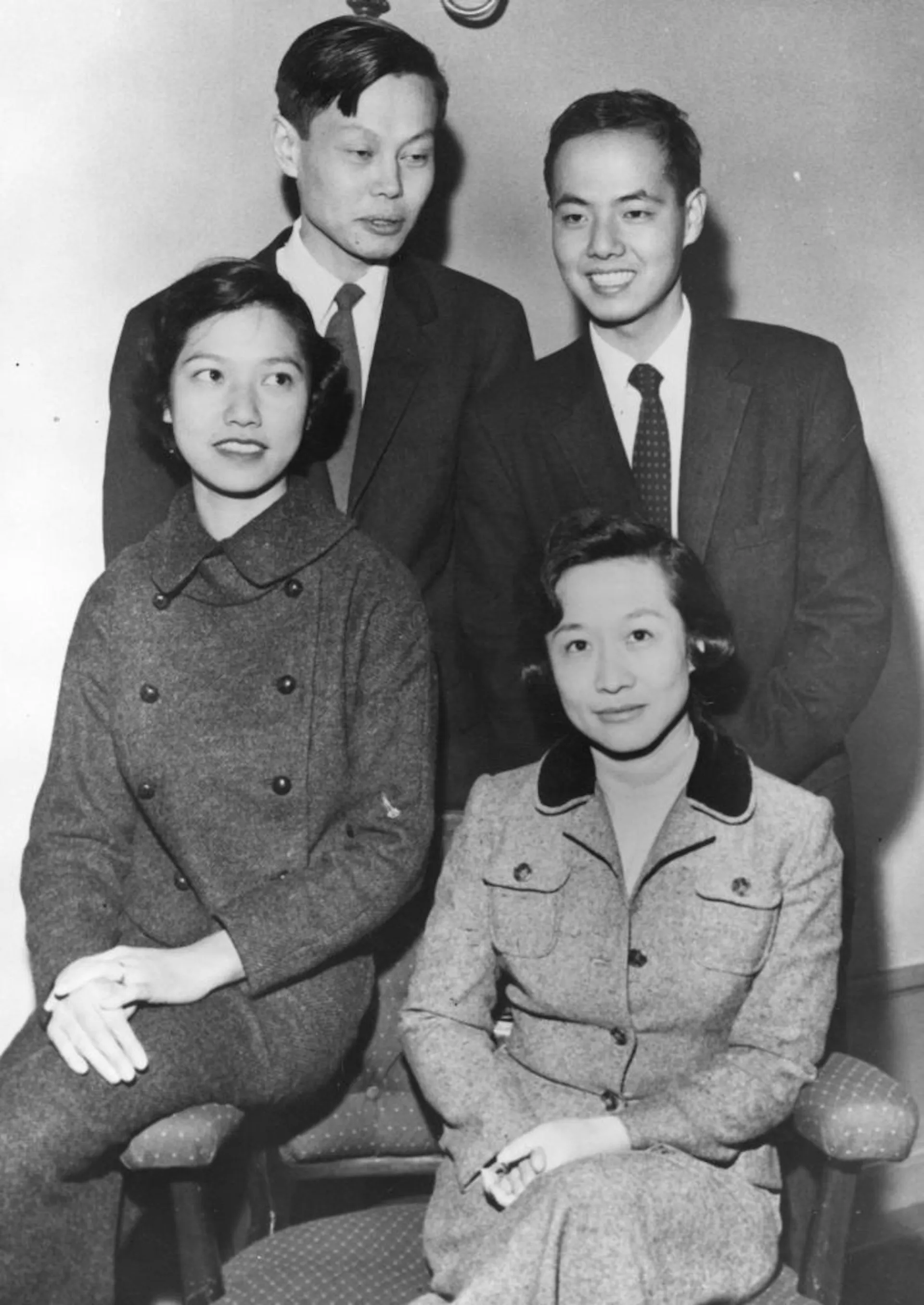
Tsung-Dao Lee and Chen-Ning Yang pointed out that, although parity conservation was well tested in strong and electromagnetic processes, there was no experimental evidence for it in weak interactions. Their paper, published on 1 October 1956, proposed concrete tests, including the angular distribution of electrons from polarised nuclei. It was motivated by the tau-theta puzzle in kaon decays. Experiments within months showed that parity is indeed violated.
- Date
- 1 October 1956
- Kind of event
- Theory
- People involved
- Tsung-Dao Lee, Chen-Ning Yang
The situation before
Parity, the symmetry between a physical process and its mirror image, was regarded as an exact law of nature. It held in atomic, nuclear and electromagnetic physics, and physicists assumed it held everywhere. By 1956, however, a puzzle had emerged in the decays of newly discovered strange particles. Two particles, called tau and theta, had the same mass and lifetime within errors, yet one decayed into two pions and the other into three, final states of opposite parity. Either two different particles happened to be identical in every other respect, or a single particle was decaying in ways that did not respect parity. The question was discussed openly at the Rochester conference in April 1956.
What happened
Tsung-Dao Lee of Columbia University and Chen-Ning Yang, then at Brookhaven for the summer and normally at the Institute for Advanced Study in Princeton, examined the evidence systematically. They found that the many experiments supporting parity conservation involved strong and electromagnetic interactions. For the weak interaction, responsible for beta decay and the decay of the strange particles, parity conservation had simply been assumed; no experiment had been designed in a way that could detect its violation.
Their paper, "Question of parity conservation in weak interactions", was received by the Physical Review on 22 June 1956 and published on 1 October 1956 in volume 104. It proposed concrete tests. The clearest was to align the spins of radioactive nuclei and measure whether beta electrons are emitted more often in one direction than the opposite. Others involved the chain of decays from pion to muon to electron and the decays of hyperons.
Reaction
Many physicists considered parity violation unlikely, and few were eager to invest months in an experiment expected to confirm the obvious. An exception was Chien-Shiung Wu, a Columbia colleague of Lee's and an expert on beta decay. She recognised the importance of the cobalt-60 test and began preparing it in the spring of 1956 with low-temperature specialists at the National Bureau of Standards in Washington.
Consequences
By January 1957 Wu's experiment, and immediately afterwards the pion-muon experiment of Richard Garwin, Leon Lederman and Marcel Weinrich, showed that parity violation in weak interactions is large. The tau-theta puzzle was solved: they were one particle, the kaon. Lee and Yang received the Nobel Prize in Physics in 1957. For neutrino physics the consequence was profound: parity violation led directly to the two-component theory of a neutrino with fixed handedness.
Frequently asked questions
What did Lee and Yang propose?
That parity, mirror symmetry, might not be conserved in weak interactions, since no experiment had tested it there. They suggested specific experiments to check.
What was the tau-theta puzzle?
Two particles with the same mass and lifetime that decayed into final states of opposite parity. Parity violation showed that they were one particle, the kaon.
Original papers
- TheoryT. D. Lee and C. N. Yang, Question of Parity Conservation in Weak Interactions, Phys. Rev. 104, 254 (1956)DOI 10.1103/PhysRev.104.254
Concepts
Mentioned in 1 page
Lessons 1
Last updated: · Editorial standard
Cite this page
Text
Neutrino Atlas (2026). “1956: Lee and Yang question parity in weak decays”. Retrieved 22 November 2026, from https://neutrino-atlas.com/timeline/1956-lee-yang-parity/BibTeX
@misc{neutrinoatlas2026imeline1956leeyangparity,
  title        = {1956: Lee and Yang question parity in weak decays},
  author       = {{Neutrino Atlas}},
  year         = {2026},
  url          = {https://neutrino-atlas.com/timeline/1956-lee-yang-parity/},
  note         = {Accessed 2026-11-22},
  language     = {english}
}