1953Experiment
Project Poltergeist at the Hanford reactor
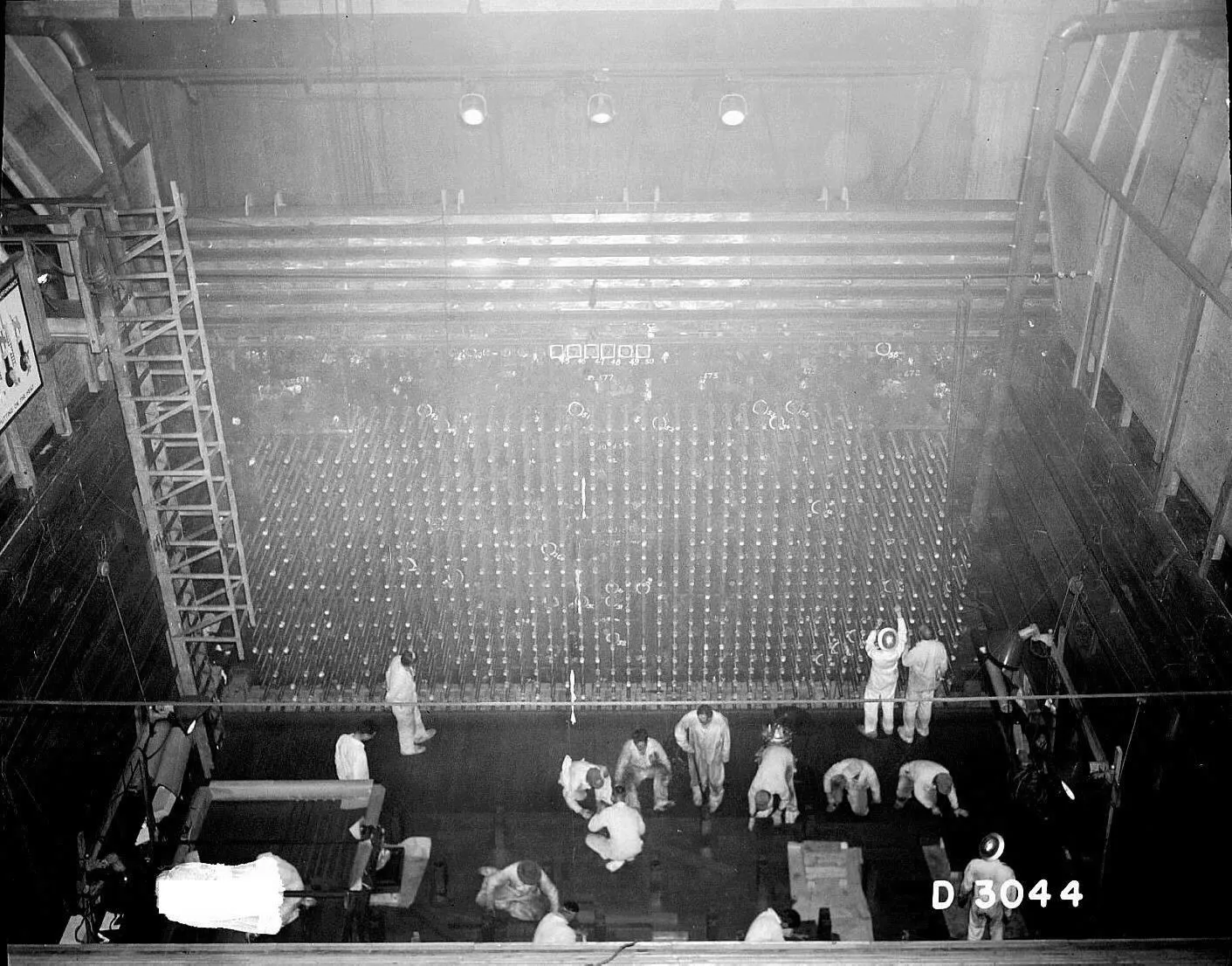
Frederick Reines and Clyde Cowan first tried to detect reactor antineutrinos at the Hanford reactor with a 300-litre liquid scintillator loaded with cadmium. They looked for inverse beta decay: a positron signal followed by a delayed neutron capture. Cosmic-ray backgrounds were too high and the result was only a weak hint. The experience led them to a better shielded, layered detector at Savannah River.
- Date
- 1953
- Kind of event
- Experiment
- People involved
- Frederick Reines, Clyde L. Cowan Jr.
- Experiments
- Cowan–Reines Neutrino Experiment
The situation before
In 1951 Frederick Reines, a theorist at Los Alamos who had worked on nuclear weapons tests, decided to try to detect the free neutrino. He and his colleague Clyde Cowan first considered the most intense source then available, a nuclear explosion. Their plan was to drop a detector of about a cubic metre down a vacuum shaft near a test bomb so that it would fall freely while the shock wave passed. Los Alamos approved the idea, even though the expected sensitivity was well short of the predicted cross-section.
A better signature
In 1952 the two realised that they could suppress backgrounds well enough to use a steady source, a nuclear reactor, instead. The key was the reaction itself. In inverse beta decay an antineutrino strikes a proton and produces a positron and a neutron. The positron annihilates at once and gives a prompt flash; the neutron wanders for a few microseconds until it is captured by a cadmium nucleus, which releases a second burst of gamma rays. A pair of signals with the right delayed coincidence is far less likely to be faked by random background than a single flash.
What happened
For the first attempt, nicknamed Project Poltergeist, Cowan and Reines built a cylinder holding about 300 litres of liquid scintillator with dissolved cadmium propionate, viewed by 90 two-inch photomultiplier tubes. It was one of the largest scintillation detectors of its time. In spring 1953 they took it to the plutonium production reactor at Hanford in Washington State and compared counts with the reactor on and off.
They found a small reactor-associated excess of about 0.4 ± 0.2 delayed-coincidence events per minute. The problem was background: cosmic rays and electronic noise produced coincidences at a far higher rate than the expected signal, even with shielding. They published "Detection of the free neutrino" in the Physical Review in 1953, presenting the result as suggestive rather than conclusive.
Reaction and consequences
The weak result convinced Cowan and Reines that the method worked in principle but that the detector design had to change. They separated the target, tanks of water with dissolved cadmium chloride, from the detecting scintillator, placing the water between scintillator layers so that a true event would light up two adjacent layers in a characteristic pattern. They also chose a site with better shielding against cosmic rays. In late 1955 they moved the new detector to the Savannah River reactor in South Carolina, where in 1956 they achieved the first clear detection of the neutrino.
Frequently asked questions
What was Project Poltergeist?
The name of Cowan and Reines's effort to detect reactor antineutrinos. Its first run, at the Hanford reactor in 1953, gave only a weak hint of a signal.
Why did the Hanford experiment fail to give a clear result?
Cosmic-ray and electronic backgrounds produced too many false coincidences. The improved layered detector at Savannah River solved this in 1956.
Original papers
- First resultF. Reines and C. L. Cowan, Detection of the Free Neutrino, Phys. Rev. 92, 830 (1953)DOI 10.1103/PhysRev.92.830
Concepts
Mentioned in 2 pages
Last updated: · Editorial standard
Cite this page
Text
Neutrino Atlas (2026). “1953: Project Poltergeist at the Hanford reactor”. Retrieved 22 November 2026, from https://neutrino-atlas.com/timeline/1953-hanford-poltergeist/BibTeX
@misc{neutrinoatlas2026ne1953hanfordpoltergeist,
  title        = {1953: Project Poltergeist at the Hanford reactor},
  author       = {{Neutrino Atlas}},
  year         = {2026},
  url          = {https://neutrino-atlas.com/timeline/1953-hanford-poltergeist/},
  note         = {Accessed 2026-11-22},
  language     = {english}
}