Cowan–Reines Neutrino Experiment
The 1956 experiment at the Savannah River reactor that first detected neutrinos.
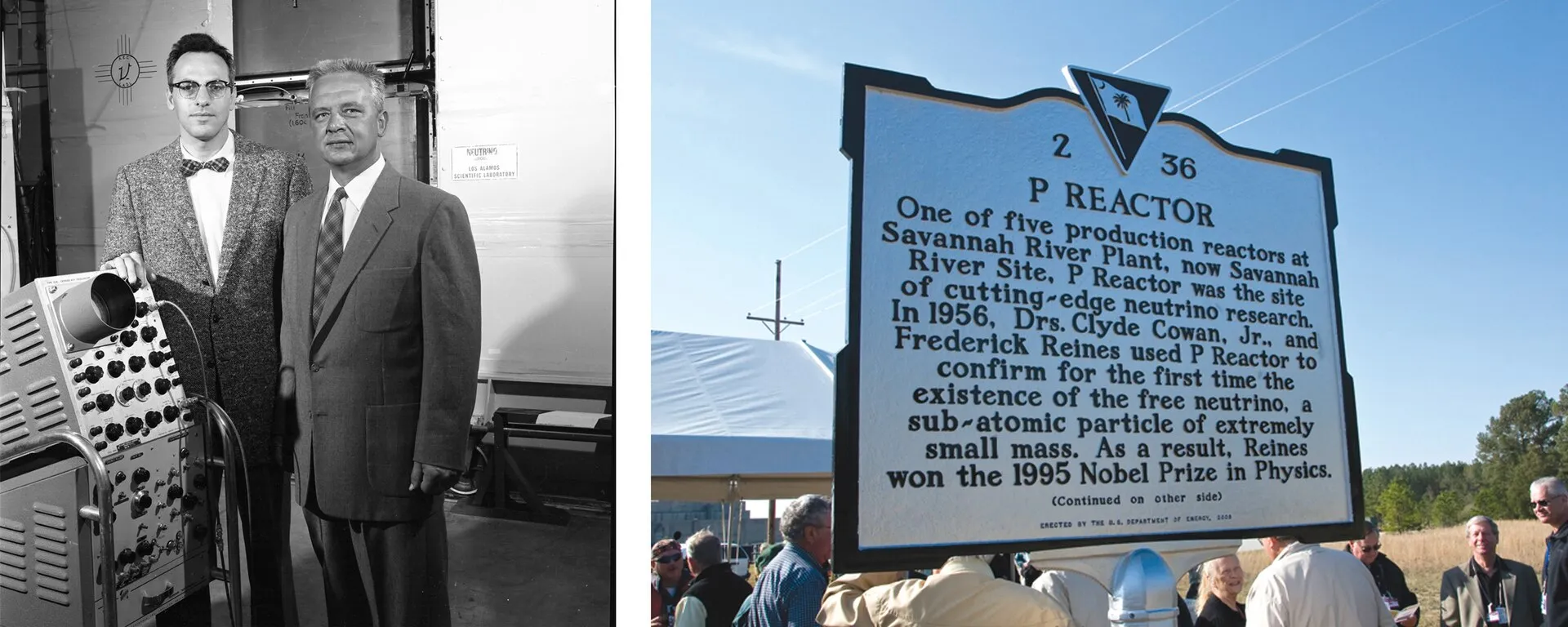
Clyde Cowan and Frederick Reines used water tanks with dissolved cadmium chloride sandwiched between liquid-scintillator detectors near a powerful reactor. They detected the inverse beta decay coincidence of the positron's annihilation gammas followed by delayed neutron-capture gammas on cadmium. A first attempt at Hanford in 1953 was inconclusive. Reines shared the 1995 Nobel Prize for the discovery.
Compare all experiments → · World map →
In plain words
In 1951 Los Alamos physicist Frederick Reines wanted to catch a particle that could pass through a light-year of lead. His first idea was to set up a detector next to a nuclear bomb test. With his colleague Clyde Cowan he soon found a better source: a nuclear reactor, which releases huge numbers of antineutrinos steadily rather than in one flash. The pair called their effort Project Poltergeist.
How the detector worked
A reactor antineutrino can hit a proton in water and turn it into a neutron and a positron, inverse beta decay. The positron annihilates at once, giving two gamma rays. The neutron wanders for a few microseconds until it is captured by cadmium, which emits a burst of gamma rays. A real event is therefore a pair of flashes a few microseconds apart, a delayed coincidence that random background rarely imitates.
At the Savannah River Plant in South Carolina, the team built a stack of three tanks of liquid scintillator, each about 1400 litres and viewed by 110 photomultipliers, interleaved with two 200-litre tanks of water containing about 40 kg of dissolved cadmium chloride. The stack sat about 11 m from the reactor core and some 12 m underground, which shielded it from cosmic rays.
In numbers
- Hanford, 1953: a 300-litre scintillator detector gave only a hint, swamped by cosmic-ray background.
- Savannah River, 1956: about three neutrino events per hour more with the reactor on than with it off.
Key result
On 14 June 1956 Cowan and Reines sent a telegram to Wolfgang Pauli telling him that they had detected neutrinos, a quarter of a century after he proposed them. The paper 'Detection of the Free Neutrino: a Confirmation' appeared in Science on 20 July 1956. The measured cross section, about 6 × 10⁻⁴⁴ cm², matched the theory of the time; later work showed the prediction should be roughly doubled because of parity violation, and Reines's refined measurements agreed.
Legacy
Frederick Reines shared the 1995 Nobel Prize in Physics for the discovery; Clyde Cowan had died in 1974. The method of inverse beta decay in scintillator, with a delayed neutron tag, remains the standard technique for reactor antineutrinos, from KamLAND and Daya Bay to JUNO.
Frequently asked questions
Why did Cowan and Reines use a reactor rather than a bomb?
A reactor gives a steady, intense flux, so the signal can be checked by switching the reactor on and off, and the detector survives. A bomb would give only one brief chance.
Did Clyde Cowan receive the Nobel Prize?
No. Cowan died in 1974, and the Nobel Prize is not awarded posthumously. Reines received it in 1995, shared with Martin Perl for the discovery of the tau lepton.
Original papers
- First resultF. Reines and C. L. Cowan, Detection of the Free Neutrino, Phys. Rev. 92, 830 (1953)DOI 10.1103/PhysRev.92.830
- DiscoveryC. L. Cowan, F. Reines, F. B. Harrison, H. W. Kruse and A. D. McGuire, Detection of the Free Neutrino: a Confirmation, Science 124, 103 (1956)DOI 10.1126/science.124.3212.103
Related terms
People
On the timeline
- 1953Project Poltergeist at the Hanford reactor
- 1956Cowan and Reines detect the neutrino
- 1995Nobel Prize for neutrino detection
Mentioned in 31 pages
Lessons 1
FAQ 3
Comparisons 1
Milestones 3
People 7
Terms 16
Last updated: · Editorial standard
Cite this page
Text
Neutrino Atlas (2026). “Cowan–Reines Neutrino Experiment”. Retrieved 22 November 2026, from https://neutrino-atlas.com/terms/cowan-reines/BibTeX
@misc{neutrinoatlas2026termscowanreines,
  title        = {Cowan–Reines Neutrino Experiment},
  author       = {{Neutrino Atlas}},
  year         = {2026},
  url          = {https://neutrino-atlas.com/terms/cowan-reines/},
  note         = {Accessed 2026-11-22},
  language     = {english}
}