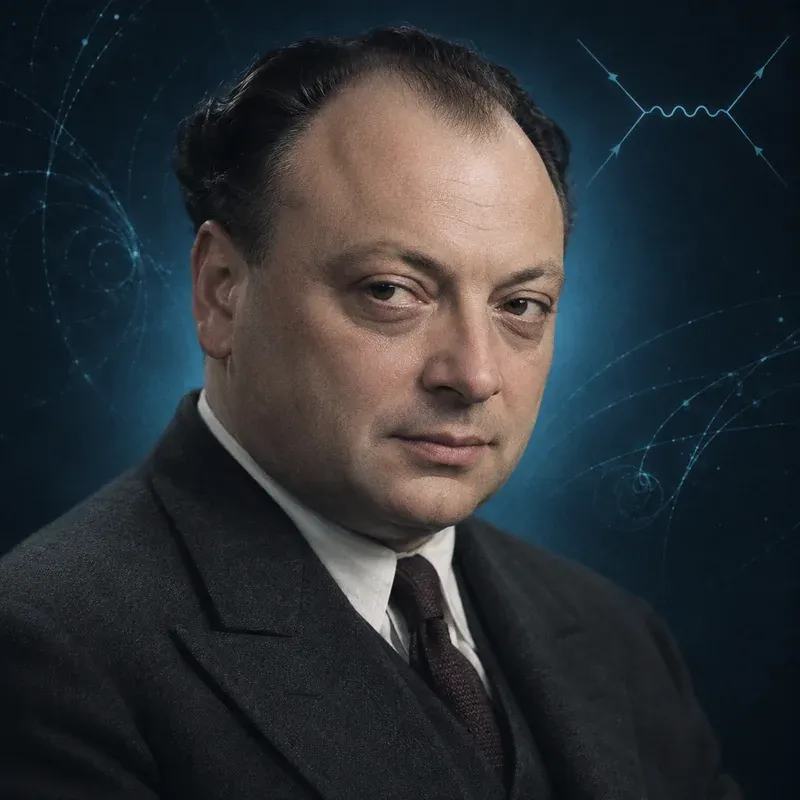
 Illustration
Wolfgang Pauli
In an open letter dated 4 December 1930, addressed to Lise Meitner, Hans Geiger and the 'radioactive ladies and gentlemen' gathered at a meeting in Tübingen, Pauli proposed a light, electrically neutral spin-1/2 particle (which he called a 'neutron') emitted together with the electron in beta decay, as a 'desperate remedy' to save energy conservation and explain the continuous beta spectrum. He discussed the hypothesis publicly at the 7th Solvay Conference in 1933. Fermi built his beta-decay theory on the idea and renamed the particle the neutrino. Pauli received the 1956 telegram from Cowan and Reines announcing its detection.
- Born
- 25 April 1900
Vienna, Austria-Hungary - Died
- 15 December 1958
Zurich, Switzerland - Nationality
- Austrian (later US 1946 and Swiss 1949 citizen)
- Field
- theoretical physics
- Nobel Prize
- Physics 1945 – for the discovery of the Exclusion Principle, also called the Pauli Principle
- Institutions
- University of Hamburg, ETH Zurich, Institute for Advanced Study, Princeton
Early life and education
Wolfgang Ernst Pauli was born in Vienna in 1900, the son of a chemist and physician. His godfather was Ernst Mach. As a student in Munich he wrote, at Arnold Sommerfeld’s invitation, an encyclopedia article on relativity that Einstein praised. He completed his doctorate under Sommerfeld in 1921 with a thesis on the quantum theory of the ionised hydrogen molecule.
After assistant posts with Max Born in Göttingen and a stay with Niels Bohr in Copenhagen, he went to the University of Hamburg. There, in 1925, he formulated the exclusion principle: no two electrons in an atom can occupy the same quantum state. This explained the structure of the periodic table and, together with the electron spin that it anticipated, became one of the foundations of quantum mechanics. In 1928 he became professor of theoretical physics at ETH Zurich, the post he held for the rest of his life, apart from the war years, which he spent at the Institute for Advanced Study in Princeton.
The problem of the continuous beta spectrum
In the late 1920s nuclear physics faced a crisis. In alpha decay and gamma decay a nucleus emits particles with sharp, well-defined energies. In beta decay, however, the electrons come out with a continuous spread of energies up to a maximum. Calorimetric measurements by Charles Drummond Ellis and William Wooster in 1927, later confirmed by Lise Meitner, showed that the missing energy was not simply hidden in unseen gamma rays. Bohr was prepared to consider that energy might be conserved only on average. A second puzzle concerned angular momentum and statistics: the nitrogen-14 nucleus, then thought to consist of protons and electrons, appeared to have the wrong spin and statistics.
Key contributions
Pauli's answer was given not in a paper but in a letter dated 4 December 1930, which begins ‘Liebe Radioaktive Damen und Herren’ (‘Dear radioactive ladies and gentlemen’). It was addressed to Meitner, Hans Geiger and the participants of a physics meeting in Tübingen, which he could not attend because, as he wrote, a ball in Zurich on the night of 6 to 7 December required his presence. He described his idea as a ‘desperate remedy’ to save both the conservation of energy and the spin-statistics rule. He proposed that the nucleus contains an electrically neutral particle of spin 1/2 that obeys the exclusion principle and has a mass of the same order as the electron’s, and that it is emitted together with the electron in beta decay. The energy released is then shared between the two, which naturally produces a continuous electron spectrum ending at a fixed endpoint.
Pauli called the particle a ‘neutron’. After James Chadwick discovered the heavy neutron in 1932, the two had to be distinguished, and Enrico Fermi introduced the Italian name neutrino, ‘little neutral one’. Pauli presented the hypothesis publicly at the Solvay Conference in Brussels in October 1933, where he remarked that the neutrino’s mass might well be zero. Francis Perrin showed the same year, from the shape of the spectrum near its endpoint, that the mass must be much smaller than the electron’s. Within weeks of the conference Fermi published his theory of beta decay, built on Pauli’s particle (see Fermi theory).
Pauli doubted that the particle could ever be detected, because its interaction with matter is so weak. It took more than two decades: in June 1956 Clyde Cowan and Frederick Reines sent him a telegram reporting that they had detected neutrinos from a nuclear reactor through inverse beta decay (see Cowan–Reines experiment).
Later work
Pauli received the Nobel Prize in Physics in 1945 for the exclusion principle. In 1940 he proved the spin-statistics theorem, which states that particles with half-integer spin are fermions and those with integer spin are bosons, and he contributed to the formulation of the CPT theorem in the 1950s (see CPT theorem). He also remained involved with neutrinos. When Tsung-Dao Lee and Chen-Ning Yang proposed in 1956 that parity might be violated in weak interactions, Pauli expected nature to be left-right symmetric; the experiment of Chien-Shiung Wu proved him wrong in early 1957 (see parity violation). In 1957 he gave a lecture in Zurich on the earlier and more recent history of the neutrino. He died in Zurich in December 1958, aged 58.
Legacy
Pauli’s letter is one of the best-known documents in physics: it introduced a particle on purely theoretical grounds, from a conservation law, long before any detector could see it. Today the neutrino is known to come in three flavours, to oscillate between them and to have a small but non-zero mass; its absolute mass is measured in beta-decay experiments such as KATRIN.
Known for
- Neutrino hypothesis (1930)
- Pauli exclusion principle
- Spin-statistics theorem
- Pauli matrices
Chronology
- 1930Letter of 4 December proposing a light neutral particle in beta decay
- 1933Discusses the hypothesis at the 7th Solvay Conference, Brussels
- 1945Nobel Prize in Physics (exclusion principle)
- 1956Receives Cowan-Reines telegram announcing neutrino detection (14 June)
- 1957Lecture 'On the earlier and more recent history of the neutrino'
Original papers
- W. Pauli, Letter 'Liebe radioaktive Damen und Herren' to L. Meitner et al., 4 December 1930
- W. Pauli, Discussion of Heisenberg's report, 7ème Conseil de Physique Solvay, Brussels 1933, Gauthier-Villars (1934), p. 324
- W. Pauli, On the earlier and more recent history of the neutrino (1957), in Physik und Erkenntnistheorie, Vieweg (1984), p. 156
Experiments
Connected people
- Charles Drummond Ellis
- Clyde L. Cowan Jr.
- Enrico Fermi
- Frederick Reines
- Hermann Weyl
- Lise Meitner
- Niels Bohr
- Abdus Salam
- James Chadwick
- Francis Perrin
- Rudolf Peierls
- Otto Hahn
- Alexander Ilyich Leipunsky
- Wang Ganchang
Frequently asked questions
Did Pauli discover the neutrino?
He predicted it. In his letter of 4 December 1930 he proposed a light, neutral particle emitted in beta decay. It was first detected in 1956 by Cowan and Reines at a nuclear reactor.
Why did Pauli call the neutrino a ‘neutron’?
In 1930 the heavy neutron had not yet been discovered, so the name was free. After Chadwick found the neutron in 1932, Fermi gave Pauli’s particle the name neutrino, the ‘little neutral one’.
Did Pauli win a Nobel Prize for the neutrino?
No. His 1945 Nobel Prize in Physics recognised the exclusion principle. No Nobel Prize was awarded for the neutrino hypothesis itself.
On the timeline
- 1930Pauli proposes a new neutral particle
- 1932Discovery of the neutron renames Pauli's particle
- 1933Pauli presents the neutrino at the Solvay Conference
- 1956Cowan and Reines detect the neutrino
Mentioned in 58 pages
Lessons 4
FAQ 5
Comparisons 1
Milestones 14
- 1896 · Becquerel discovers radioactivity
- 1899 · Rutherford distinguishes alpha and beta rays
- 1914 · Chadwick finds the beta spectrum is continuous
- 1927 · Calorimetry confirms missing energy in beta decay
- 1930 · Pauli proposes a new neutral particle
- 1932 · Discovery of the neutron renames Pauli's particle
- 1933 · Fermi's theory of beta decay
- 1933 · Pauli presents the neutrino at the Solvay Conference
People 23
Last updated: · Editorial standard
Cite this page
Text
Neutrino Atlas (2026). “Wolfgang Pauli”. Retrieved 22 November 2026, from https://neutrino-atlas.com/people/wolfgang-pauli/BibTeX
@misc{neutrinoatlas2026peoplewolfgangpauli,
  title        = {Wolfgang Pauli},
  author       = {{Neutrino Atlas}},
  year         = {2026},
  url          = {https://neutrino-atlas.com/people/wolfgang-pauli/},
  note         = {Accessed 2026-11-22},
  language     = {english}
}