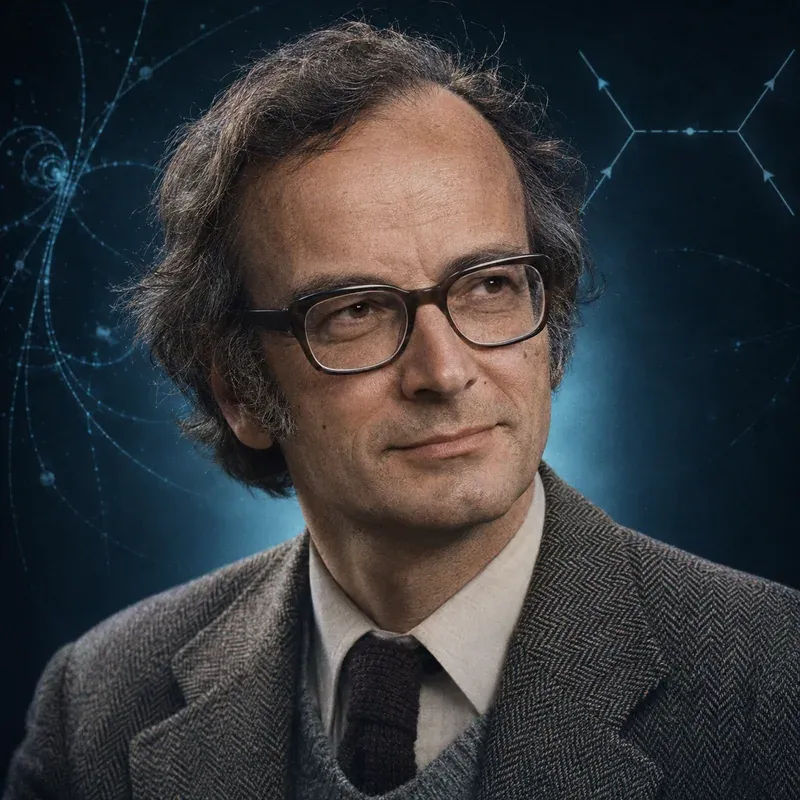
 Illustration
Peter Minkowski
In 1977, studying μ → eγ in left-right symmetric and unified models, Minkowski proposed that heavy right-handed neutrinos make the observed left-handed neutrinos very light, the first formulation of what became the type-I seesaw mechanism. The paper received few citations for about 27 years before being widely recognised as the seesaw's origin. He also took part in the DUMAND deep-underwater neutrino detector project.
- Born
- 10 May 1941
Zürich, Switzerland - Died
- 24 October 2025
Bern, Switzerland - Nationality
- Swiss
- Field
- Theoretical particle physics
- Institutions
- ETH Zurich, CERN, Caltech, University of Bern
Early life and education
Peter Minkowski was born in Zürich on 10 May 1941 into a family with roots in Poland, and grew up in the city. He studied physics at ETH Zurich and completed his doctorate in 1967 under Markus Fierz, a former assistant of Wolfgang Pauli and one of the founders of relativistic quantum field theory. He then held postdoctoral positions at the University of Louvain in Belgium and at the Swiss Institute for Nuclear Research (today the Paul Scherrer Institute), and was a fellow at CERN.
Path to neutrino physics
From 1973 to 1976 Minkowski worked at the California Institute of Technology, where he produced much of his best-known work. Together with Harald Fritzsch he proposed in 1974–75 a grand unified theory based on the symmetry group SO(10); Howard Georgi found the same group independently. Unlike the earlier SU(5) model, SO(10) places all the quarks and leptons of one generation, including a right-handed neutrino, into a single sixteen-component multiplet. In such a theory the right-handed neutrino is not an optional addition but a required member of each family, and the question of its mass arises naturally.
Key contributions
In 1976 Minkowski moved to the University of Bern. In a short paper in Physics Letters B in 1977, titled 'μ → eγ at a rate of one out of 10⁹ muon decays?', he examined how large the rate of this lepton-flavour-violating muon decay could be in left-right symmetric and unified models. Along the way he noted that if the right-handed neutrinos have very large masses, the left-handed neutrinos that take part in the weak interaction become extremely light.
This is the idea now known as the type-I seesaw mechanism. An ordinary Dirac-type mass term links the left- and right-handed neutrino, with a size similar to the masses of quarks and charged leptons. If the right-handed neutrino also has a large Majorana mass, the mass matrix has one heavy and one light eigenvalue, and the light one is suppressed by the ratio of the two scales.
With mD near the electroweak scale and MR around 10¹⁴–10¹⁵ GeV, the light neutrino mass falls in the range of fractions of an electronvolt, the range later indicated by oscillation experiments. Between 1979 and 1980 the same mechanism was published by Murray Gell-Mann, Pierre Ramond and Richard Slansky, by Tsutomu Yanagida, by Sheldon Glashow, and by Rabindra Mohapatra and Goran Senjanović. Minkowski's paper was scarcely cited for its first 27 years. When a conference in Paris in 2004 marked 25 years of the seesaw, he pointed out that his version was 27 years old; it is now regarded as the first statement of the mechanism and has been cited thousands of times.
Later work
In Bern Minkowski became associate professor in 1977 and full professor in 1989, and retired as professor emeritus in 2006. He worked on quantum chromodynamics, in particular on glueballs and the spectrum of scalar resonances, and with Peter Grieder he took part in the development of DUMAND, the Deep Underwater Muon and Neutrino Detector project off Hawaii that pioneered the idea of large neutrino telescopes in natural water. From 1985 to 1987 he was president of the Swiss Physical Society. He died in Bern on 24 October 2025.
Legacy
The seesaw mechanism links three of the central questions of neutrino physics. It predicts that neutrinos are Majorana particles, which experiments test through neutrinoless double beta decay. It introduces heavy right-handed neutrinos whose CP-violating decays in the early universe could create the matter–antimatter asymmetry through leptogenesis. And it connects the smallness of neutrino mass to physics at the scale of grand unification, far beyond the reach of direct experiments.
Known for
- First seesaw mechanism paper (1977)
- Grand unified theories
- Glueballs and QCD scalar resonances
- DUMAND project
Chronology
- 1967PhD at ETH Zurich under Markus Fierz
- 1977Seesaw paper in Physics Letters B
- 1985President of the Swiss Physical Society (1985–87)
- 2006Professor emeritus, Bern
Original papers
- P. Minkowski, μ → eγ at a rate of one out of 10⁹ muon decays?, Phys. Lett. B 67, 421 (1977)DOI 10.1016/0370-2693(77)90435-X
Experiments
Connected people
- Goran Senjanović
- Murray Gell-Mann
- Rabindra Nath Mohapatra
- Sheldon Lee Glashow
- Tsutomu Yanagida
- Pierre Ramond
- Jogesh C. Pati
Frequently asked questions
Who invented the seesaw mechanism?
Peter Minkowski first described it in 1977. Gell-Mann, Ramond and Slansky, Yanagida, Glashow, and Mohapatra and Senjanović developed it independently in 1979–80. The name 'seesaw' was introduced later.
Why was Minkowski's paper overlooked for so long?
The seesaw remark appeared in a paper about the rare muon decay μ → eγ rather than about neutrino mass, and the later papers framed the idea more directly. Citations rose only in the 2000s.
What is the link between SO(10) and neutrino mass?
SO(10) grand unified theories contain a right-handed neutrino in every generation. A large Majorana mass for that particle produces small neutrino masses through the seesaw.
On the timeline
Mentioned in 20 pages
Last updated: · Editorial standard
Cite this page
Text
Neutrino Atlas (2026). “Peter Minkowski”. Retrieved 22 November 2026, from https://neutrino-atlas.com/people/peter-minkowski/BibTeX
@misc{neutrinoatlas2026peoplepeterminkowski,
  title        = {Peter Minkowski},
  author       = {{Neutrino Atlas}},
  year         = {2026},
  url          = {https://neutrino-atlas.com/people/peter-minkowski/},
  note         = {Accessed 2026-11-22},
  language     = {english}
}