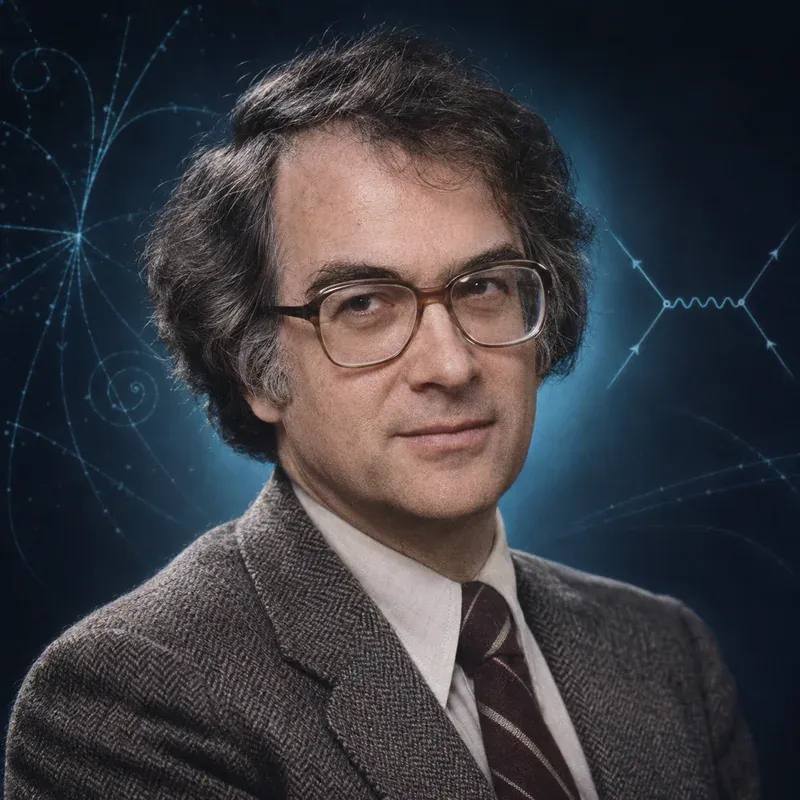
 Illustration
Sheldon Lee Glashow
Glashow's 1961 SU(2)×U(1) model introduced the neutral Z boson and so implied weak neutral currents, later seen in neutrino scattering at Gargamelle (1973). In 1960 he pointed out the resonant production of a W− boson in ν̄e–electron scattering near 6.3 PeV (the 'Glashow resonance'), for which IceCube reported a candidate event in 2021. He also independently proposed a seesaw explanation of small neutrino masses (Cargèse lectures 1979, published 1980).
- Born
- 5 December 1932
New York City, USA - Nationality
- American
- Field
- Theoretical particle physics
- Nobel Prize
- Physics 1979 – shared with Salam and Weinberg for contributions to the unified weak and electromagnetic interaction, including the prediction of the weak neutral current
- Institutions
- Harvard University, Boston University, University of California, Berkeley, Stanford University
Education and early career
Sheldon Lee Glashow was born in New York City in 1932 to Jewish immigrants from Russia. He attended the Bronx High School of Science, where Steven Weinberg was a classmate, and then Cornell University, graduating in 1954. He completed his PhD at Harvard University in 1959 under Julian Schwinger, who had suggested that the weak and electromagnetic forces might be described together, with charged intermediate bosons carrying the weak force. Glashow then spent postdoctoral years at the Niels Bohr Institute in Copenhagen and at CERN, followed by positions at Stanford and Berkeley. He returned to Harvard in 1966 and moved to Boston University in 2000.
Key contributions
In 1960 Glashow pointed out a striking process in neutrino physics. An electron antineutrino colliding with an electron at rest can produce a real W boson if its energy is just right. The cross section then rises sharply, as in any resonance. The required energy is very high because the target electron is so light.
No accelerator can reach this energy, so the Glashow resonance can be tested only with astrophysical neutrinos. In 2021 the IceCube collaboration reported an event from December 2016 that deposited about 6 PeV in the Antarctic ice and whose features fit this process, the first candidate in more than sixty years. Because only antineutrinos, not neutrinos, take part, such events help to tell how cosmic neutrinos are produced.
In 1961, in ‘Partial-symmetries of weak interactions’, Glashow proposed the gauge group SU(2)×U(1) to unify the weak and electromagnetic interactions. Its decisive new feature was a second neutral boson besides the photon, now called the Z boson. This implied weak neutral currents: processes in which a neutrino scatters without changing into a charged lepton. In 1961 the masses of the W and Z had to be put in by hand; the Higgs mechanism later supplied them in the models of Weinberg (1967) and Abdus Salam (1968). Neutral currents were discovered in neutrino interactions in the Gargamelle bubble chamber at CERN in 1973, and the W and Z bosons were found directly at CERN in 1983.
In 1970, with John Iliopoulos and Luciano Maiani, Glashow proposed the GIM mechanism. It explained why neutral currents that change the flavour of quarks are strongly suppressed, but only if a fourth quark, charm, exists. Charm was discovered in 1974. In 1974, with Howard Georgi, he proposed SU(5), the first grand unified theory, which places quarks and leptons in common multiplets. It predicted that the proton decays; the search for proton decay led to large underground water detectors such as IMB and Kamiokande, which in the end made their name with neutrinos, notably from SN 1987A.
At the Cargèse summer school in 1979 Glashow also proposed, independently of Peter Minkowski, Tsutomu Yanagida and Murray Gell-Mann with Pierre Ramond and Richard Slansky, that very heavy right-handed neutrinos could make the known neutrinos light. This is the seesaw mechanism, today the most widely discussed explanation of small neutrino masses.
Recognition and later work
Glashow shared the 1979 Nobel Prize in Physics with Salam and Weinberg for their contributions to the unified theory of the weak and electromagnetic interactions, including the prediction of the weak neutral current. He has written for general readers, notably the autobiography ‘Interactions’ (1988), and has been an outspoken critic of theories, such as string theory, that do not yet make testable predictions.
Known for
- SU(2)×U(1) electroweak structure with the Z0 (1961)
- GIM mechanism (1970)
- Georgi–Glashow SU(5) grand unification (1974)
- Glashow resonance (W− production by ν̄e on electrons)
- Early seesaw proposal (1979)
Chronology
- 1960Resonant W production by antineutrinos on electrons
- 1961SU(2)×U(1) model with neutral current
- 1970GIM mechanism with Iliopoulos and Maiani
- 1979Nobel Prize in Physics; seesaw lecture at Cargèse
Original papers
- S. L. Glashow, Resonant scattering of antineutrinos, Phys. Rev. 118, 316 (1960)DOI 10.1103/PhysRev.118.316
- S. L. Glashow, Partial-symmetries of weak interactions, Nucl. Phys. 22, 579 (1961)DOI 10.1016/0029-5582(61)90469-2
- S. L. Glashow, The future of elementary particle physics, NATO Sci. Ser. B 61, 687 (1980)
Experiments
Connected people
- Abdus Salam
- Murray Gell-Mann
- Peter Minkowski
- Steven Weinberg
- Daniel Z. Freedman
- Veniamin Sergeevich Berezinsky
- Álvaro De Rújula
- Gerardus 't Hooft
- John Clive Ward
- Julian Seymour Schwinger
- Luciano Maiani
- Martinus J. G. Veltman
Frequently asked questions
What is the Glashow resonance?
The resonant production of a W− boson when an electron antineutrino of about 6.3 PeV hits an electron. Glashow predicted it in 1960, and IceCube reported a candidate event in 2021; see Glashow resonance.
What did Glashow win the Nobel Prize for?
He shared the 1979 Nobel Prize in Physics with Abdus Salam and Steven Weinberg for the unified electroweak theory, including the prediction of weak neutral currents.
How is Glashow connected to neutrino masses?
In 1979 he was one of several physicists who independently proposed the seesaw mechanism, in which heavy right-handed neutrinos make the observed neutrinos very light.
On the timeline
- 1960Glashow predicts a resonance at 6.3 PeV
- 1967Weinberg's 'A Model of Leptons'
- 2021IceCube detects a Glashow resonance candidate
Mentioned in 42 pages
Comparisons 1
Milestones 7
- 1960 · Glashow predicts a resonance at 6.3 PeV
- 1966 · Antineutrinos from Earth's interior proposed
- 1967 · Weinberg's 'A Model of Leptons'
- 1973 · Gargamelle discovers weak neutral currents
- 1977 · Minkowski's seesaw explanation of light neutrinos
- 2011 · OPERA neutrino-speed anomaly and its resolution
- 2021 · IceCube detects a Glashow resonance candidate
People 17
Last updated: · Editorial standard
Cite this page
Text
Neutrino Atlas (2026). “Sheldon Lee Glashow”. Retrieved 22 November 2026, from https://neutrino-atlas.com/people/sheldon-glashow/BibTeX
@misc{neutrinoatlas2026peoplesheldonglashow,
  title        = {Sheldon Lee Glashow},
  author       = {{Neutrino Atlas}},
  year         = {2026},
  url          = {https://neutrino-atlas.com/people/sheldon-glashow/},
  note         = {Accessed 2026-11-22},
  language     = {english}
}