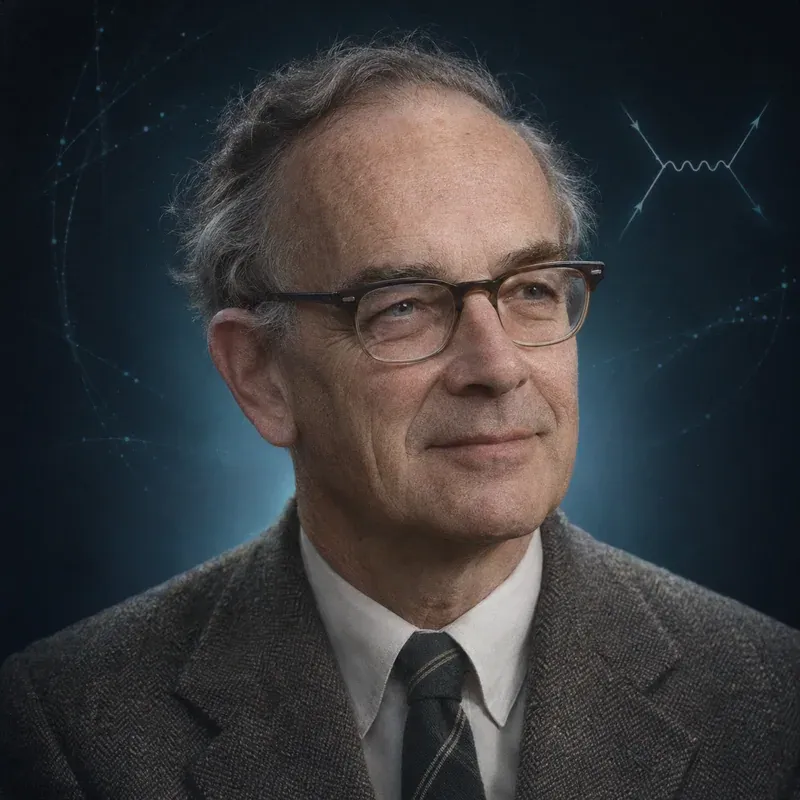
 Illustration
John Clive Ward
With Abdus Salam, Ward wrote a series of papers from 1959 to 1964 that unified the weak and electromagnetic interactions in a gauge theory. Their 1964 model, based on SU(2) × U(1), contained charged W bosons and a neutral heavy boson, the precursor of the Z, and thus implied neutral-current interactions of neutrinos. Combined with the Higgs mechanism, this structure became the electroweak theory confirmed by the 1973 discovery of neutral currents. Ward did not share the 1979 Nobel Prize awarded to Glashow, Salam and Weinberg.
- Born
- 1 August 1924
East Ham, London, England - Died
- 6 May 2000
British Columbia, Canada - Nationality
- British-Australian
- Field
- Theoretical physics; quantum field theory
- Institutions
- Merton College, Oxford (DPhil 1949), Institute for Advanced Study, Princeton, Atomic Weapons Research Establishment, Aldermaston, Johns Hopkins University (1961–1966)
Education and the Ward identity
John Clive Ward was born on 1 August 1924 in East Ham, London. He read engineering science at Merton College, Oxford, and then switched to theoretical physics, completing his doctorate under Maurice Pryce in 1949. In 1950 he published the Ward identity, a relation between the electron–photon vertex and the electron propagator in quantum electrodynamics. It guarantees that electric charge is renormalized consistently and became a basic tool of gauge field theories.
Unifying weak and electromagnetic forces
Ward's career took him to Princeton, Bell Laboratories, Adelaide, Maryland, Miami, Carnegie Tech and Johns Hopkins. In 1955 he also worked briefly at the Atomic Weapons Research Establishment at Aldermaston, where he independently arrived at a workable design for a hydrogen bomb.
From 1959 he collaborated with Abdus Salam on a gauge theory joining the weak and electromagnetic interactions. Their 1964 paper in Physics Letters proposed an SU(2) × U(1) symmetry with charged vector bosons, the later W bosons, and a heavy neutral partner of the photon, the later Z boson. Sheldon Glashow had reached a similar structure in 1961. What was missing was a way to give the bosons mass without spoiling the theory; Steven Weinberg and Salam supplied it in 1967–68 with the Higgs mechanism.
Why it matters for neutrino physics
A neutral heavy boson means that neutrinos can scatter without changing into charged leptons. This neutral current was found in 1973 with the Gargamelle bubble chamber at CERN, the first major confirmation of the electroweak theory. Ward was not among the 1979 Nobel laureates, an omission that has often been discussed since. He was elected a Fellow of the Royal Society in 1965 and received the Hughes Medal in 1983. He settled at Macquarie University in Sydney from 1968, later became an Australian citizen and died on 6 May 2000 in British Columbia, Canada.
Known for
- Ward identity in quantum electrodynamics (1950)
- Salam–Ward gauge theory of weak and electromagnetic interactions (1959–64)
- SU(2) × U(1) model with W and Z bosons (1964)
- Independent design of the British hydrogen bomb (1955)
Chronology
- 1949DPhil, Oxford, under Maurice Pryce
- 1950Publishes the Ward identity
- 1955Joins Aldermaston; hydrogen-bomb design
- 1959First Salam–Ward paper on weak and electromagnetic interactions
- 1964SU(2) × U(1) electroweak model with Salam
- 1965Fellow of the Royal Society
- 1983Hughes Medal
Original papers
- J. C. Ward, An Identity in Quantum Electrodynamics, Phys. Rev. 78, 182 (1950)DOI 10.1103/PhysRev.78.182
- A. Salam, J. C. Ward, Weak and electromagnetic interactions, Nuovo Cimento 11, 568 (1959)
- A. Salam, J. C. Ward, Electromagnetic and weak interactions, Phys. Lett. 13, 168 (1964)DOI 10.1016/0031-9163(64)90711-5
Experiments
Connected people
Frequently asked questions
What is the Ward identity?
A 1950 relation in quantum electrodynamics that links the electron–photon vertex to the electron propagator, ensuring consistent charge renormalization; it generalizes to all gauge theories.
Why did Ward not receive the Nobel Prize?
The 1979 prize went to Glashow, Salam and Weinberg, and the Nobel committee gives no reasons for its choices; the prize can be shared by at most three people.
Last updated: · Editorial standard
Cite this page
Text
Neutrino Atlas (2026). “John Clive Ward”. Retrieved 22 November 2026, from https://neutrino-atlas.com/people/john-clive-ward/BibTeX
@misc{neutrinoatlas2026peoplejohncliveward,
  title        = {John Clive Ward},
  author       = {{Neutrino Atlas}},
  year         = {2026},
  url          = {https://neutrino-atlas.com/people/john-clive-ward/},
  note         = {Accessed 2026-11-22},
  language     = {english}
}