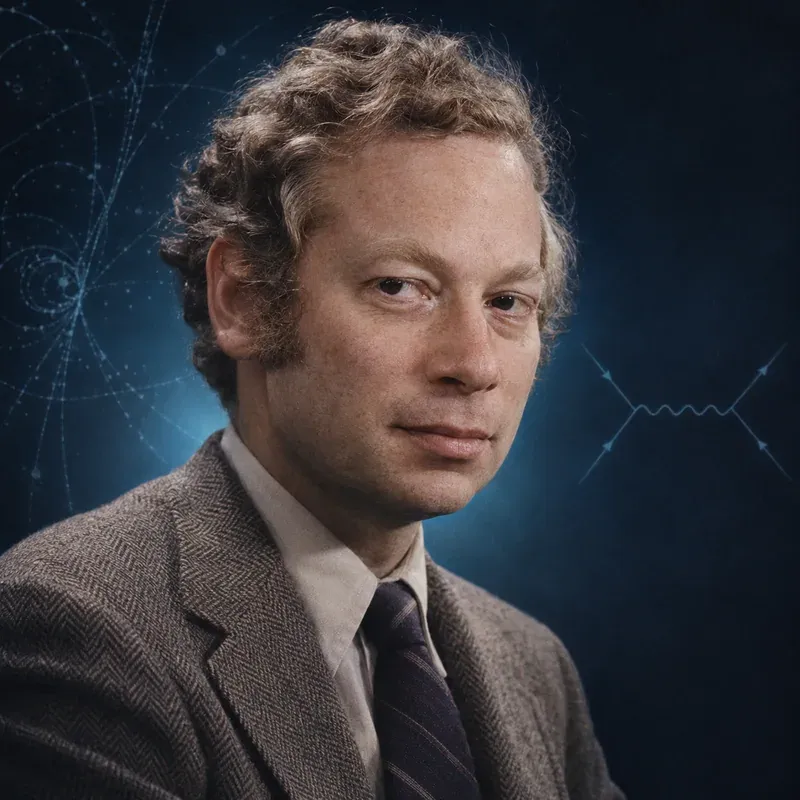
 Illustration
Steven Weinberg
Weinberg's 1967 'A Model of Leptons' gave the electroweak theory of leptons, including neutrino neutral-current interactions. In 1979 he classified the lowest-dimension (dimension-five) operator that gives Majorana neutrino masses after electroweak symmetry breaking, now called the Weinberg operator. In 1962 he proposed detecting the cosmic neutrino background by neutrino capture on beta-decaying nuclei, the idea behind PTOLEMY-type proposals, and with Ben Lee (1977) derived cosmological bounds on heavy stable neutral leptons.
- Born
- 3 May 1933
New York City, USA - Died
- 23 July 2021
Austin, Texas, USA - Nationality
- American
- Field
- Theoretical particle physics; cosmology
- Nobel Prize
- Physics 1979 – shared with Glashow and Salam for contributions to the unified weak and electromagnetic interaction, including the prediction of the weak neutral current
- Institutions
- Columbia University, University of California, Berkeley, MIT, Harvard University
Education and career
Steven Weinberg was born in New York City in 1933. Like Sheldon Glashow, he attended the Bronx High School of Science and then Cornell University, graduating in 1954. After a year at the Niels Bohr Institute in Copenhagen, he completed his PhD at Princeton in 1957 under Sam Treiman, with a thesis on the effect of strong interactions on weak processes. He held positions at Columbia, at the University of California, Berkeley, at MIT and at Harvard, and in 1982 moved to the University of Texas at Austin, where he worked until his death in July 2021.
Key contributions
Weinberg’s best-known paper, ‘A Model of Leptons’, appeared in Physical Review Letters in 1967 and is three pages long. It combined Glashow’s SU(2)×U(1) gauge structure with spontaneous symmetry breaking through a scalar field, the Higgs mechanism. In this way the W and Z bosons acquire mass while the photon stays massless, and the electron acquires mass through its coupling to the same field. The model fixed the strength of the weak neutral current in terms of a single parameter, the weak mixing angle, and so predicted how neutrinos scatter on electrons and nucleons through Z exchange. Abdus Salam proposed the same theory independently in 1968. After ’t Hooft proved in 1971 that such theories are renormalisable, and the Gargamelle experiment found neutral currents in 1973, the model became the core of the Standard Model of particle physics.
In the 1967 model neutrinos are massless and purely left-handed. In 1979 Weinberg asked what the Standard Model looks like as an effective field theory, with all interactions allowed by its symmetries, organised by their dimension. He found that there is exactly one possible term of dimension five, built from two lepton doublets and two Higgs fields. It violates lepton number by two units and, after electroweak symmetry breaking, gives the neutrinos a small Majorana mass. This Weinberg operator is the common low-energy form of all seesaw models.
The formula explains why neutrino masses are so small: they are suppressed by the ratio of the electroweak scale to a much higher scale. It also links neutrino mass to neutrinoless double beta decay, the process that would reveal its Majorana nature.
Two earlier papers concern neutrino cosmology. In ‘Universal neutrino degeneracy’ (1962) Weinberg considered a universe filled with a sea of neutrinos and pointed out that such relic neutrinos could be captured on beta-unstable nuclei, producing electrons with energies beyond the normal endpoint of the beta spectrum. Capture on tritium is the principle behind the proposed PTOLEMY experiment to detect the cosmic neutrino background. In 1977, with Benjamin Lee, he showed that a heavy stable neutrino would be overproduced in the early universe unless its mass exceeds about 2 GeV, the Lee–Weinberg bound, an early example of cosmology constraining heavy neutral leptons.
Recognition and legacy
Weinberg shared the 1979 Nobel Prize in Physics with Glashow and Salam. He also received the US National Medal of Science in 1991 and a Special Breakthrough Prize in Fundamental Physics in 2020. His textbooks, ‘Gravitation and Cosmology’ (1972) and the three volumes of ‘The Quantum Theory of Fields’, trained generations of physicists, and his popular book ‘The First Three Minutes’ (1977) described the early universe, including the decoupling of neutrinos, for a general audience. He later wrote ‘Dreams of a Final Theory’ (1992) and a history of science, ‘To Explain the World’ (2015). His 1987 argument that the cosmological constant must be small for galaxies to form was consistent with the small positive value found a decade later.
Known for
- 'A Model of Leptons' (1967) electroweak theory
- Weinberg operator for Majorana neutrino mass (1979)
- Relic neutrino capture on beta-unstable nuclei (1962)
- Lee–Weinberg bound on heavy neutral leptons (1977)
- The First Three Minutes
Chronology
- 1962Universal neutrino degeneracy and relic neutrino capture
- 1967'A Model of Leptons'
- 1977Lee–Weinberg cosmological bound on heavy neutrinos
- 1979Nobel Prize; dimension-five neutrino mass operator
Original papers
- S. Weinberg, Universal neutrino degeneracy, Phys. Rev. 128, 1457 (1962)DOI 10.1103/PhysRev.128.1457
- S. Weinberg, A model of leptons, Phys. Rev. Lett. 19, 1264 (1967)DOI 10.1103/PhysRevLett.19.1264
- B. W. Lee, S. Weinberg, Cosmological lower bound on heavy-neutrino masses, Phys. Rev. Lett. 39, 165 (1977)DOI 10.1103/PhysRevLett.39.165
- S. Weinberg, Baryon- and lepton-nonconserving processes, Phys. Rev. Lett. 43, 1566 (1979)DOI 10.1103/PhysRevLett.43.1566
Experiments
Connected people
- Abdus Salam
- Sheldon Lee Glashow
- Daniel Z. Freedman
- Gerald Feinberg
- Gerardus 't Hooft
- John Clive Ward
- Julian Seymour Schwinger
- Martinus J. G. Veltman
Frequently asked questions
What is the Weinberg operator?
The only dimension-five term that can be added to the Standard Model. It gives neutrinos a small Majorana mass suppressed by a high energy scale; see Weinberg operator.
Did Steven Weinberg win the Nobel Prize?
Yes. He shared the 1979 Nobel Prize in Physics with Sheldon Glashow and Abdus Salam for the unified theory of the weak and electromagnetic interactions.
How did Weinberg contribute to the search for relic neutrinos?
In 1962 he proposed detecting relic neutrinos through their capture on beta-unstable nuclei, which produces electrons above the normal beta-decay endpoint. This idea underlies today’s proposals with tritium targets.
On the timeline
Mentioned in 29 pages
Comparisons 1
Milestones 3
People 10
Last updated: · Editorial standard
Cite this page
Text
Neutrino Atlas (2026). “Steven Weinberg”. Retrieved 22 November 2026, from https://neutrino-atlas.com/people/steven-weinberg/BibTeX
@misc{neutrinoatlas2026peoplestevenweinberg,
  title        = {Steven Weinberg},
  author       = {{Neutrino Atlas}},
  year         = {2026},
  url          = {https://neutrino-atlas.com/people/steven-weinberg/},
  note         = {Accessed 2026-11-22},
  language     = {english}
}