1958Theory
V−A theory of the weak interaction
George Sudarshan and Robert Marshak, and independently Richard Feynman and Murray Gell-Mann, proposed that the weak interaction has a universal 'vector minus axial-vector' (V−A) form. Sudarshan and Marshak presented the idea in 1957, and both papers were published in 1958. V−A couples only to left-handed particles and right-handed antiparticles, matching parity violation and the measured neutrino helicity. It became a cornerstone of the later electroweak theory.
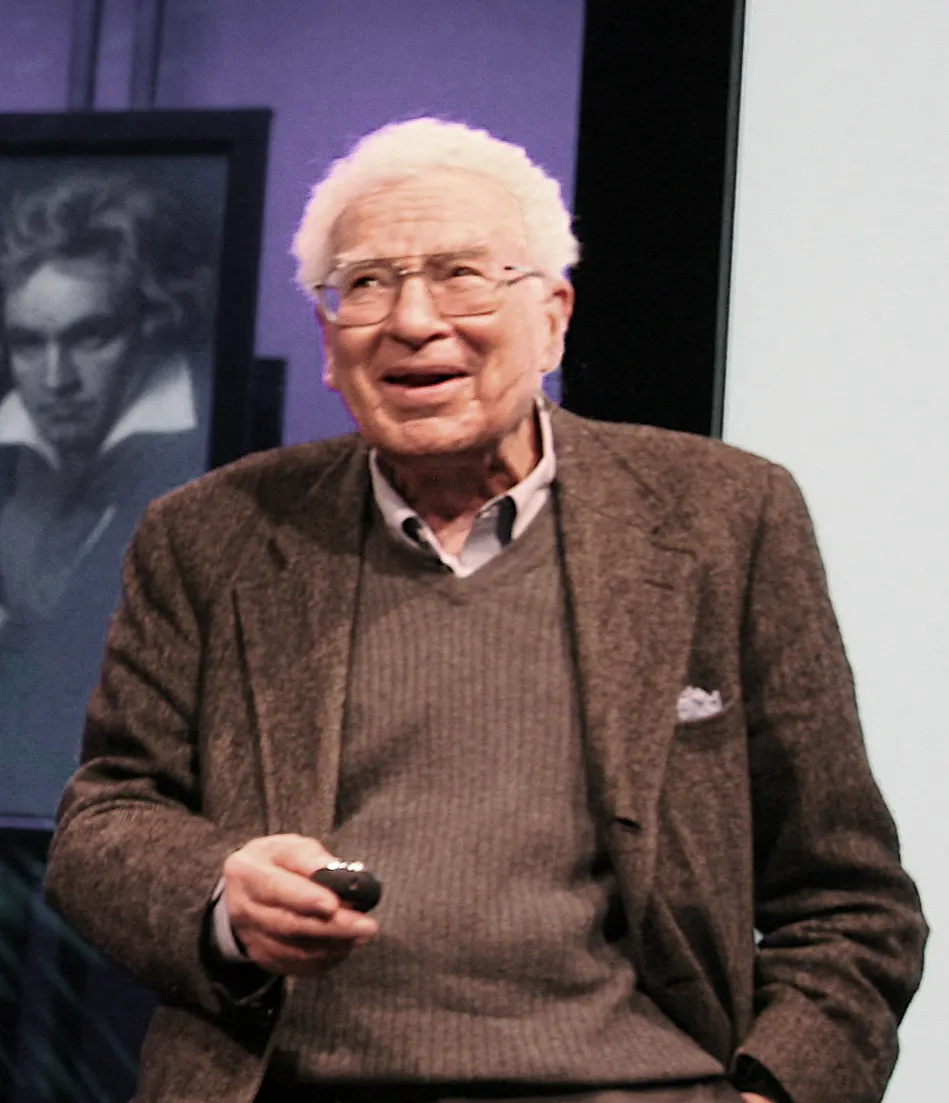
- Date
- 1958
- Kind of event
- Theory
- People involved
- E. C. George Sudarshan, Robert Marshak, Richard P. Feynman, Murray Gell-Mann
The situation before
Since Enrico Fermi's 1934 theory, beta decay had been described as a contact interaction of four fermions, but the mathematical form of that coupling was not fixed. Five possibilities were allowed: scalar, vector, tensor, axial vector and pseudoscalar. The discovery of parity violation in 1957 showed that the interaction mixes these forms in a way that distinguishes left from right. Experiments disagreed about which combination nature chose. Electron–neutrino angular correlations in helium-6 decay seemed to point to scalar and tensor couplings, while other data pointed elsewhere.
What happened
In the summer of 1957 George Sudarshan, then a graduate student, and his adviser Robert Marshak at the University of Rochester concluded that only one form was consistent with a universal interaction and with the reliable experiments: an equal mixture of vector and axial-vector currents with opposite sign, "V minus A". They argued that the conflicting correlation experiments must be wrong. Their paper was presented at a conference in Padua and Venice in September 1957 and published in Physical Review in 1958.
At Caltech, Richard Feynman and Murray Gell-Mann reached the same form by a different route, starting from a two-component description of fermions. Their paper "Theory of the Fermi Interaction" was received in September 1957 and appeared in Physical Review in January 1958. Feynman and Gell-Mann also proposed that the vector part of the weak current is conserved, in analogy with the electromagnetic current, which explained why the vector coupling of the neutron is almost unchanged by the strong interaction.
The (1 − γ⁵) structure means that the weak interaction acts only on the left-handed component of each particle and the right-handed component of each antiparticle. For a massless neutrino this is exactly the negative helicity that Maurice Goldhaber and colleagues had just measured.
Reaction
Within a short time, new measurements, including a corrected helium-6 correlation, came out in favour of V−A. The theory also explained why the pion decays to an electron far less often than to a muon, a ratio that was confirmed at CERN in 1958. Feynman later acknowledged the priority of Sudarshan and Marshak, and the question of credit has been discussed by historians ever since; today both pairs are usually named together.
Consequences
V−A made the weak interaction universal: the same current describes muon decay, nuclear beta decay and neutrino scattering, all with one coupling, the Fermi constant. It is still the low-energy form of the weak interaction. Its current-times-current structure suggested that the interaction is carried by a heavy charged boson, the later W boson, and V−A became the charged-current part of electroweak theory when Steven Weinberg and Abdus Salam built their model in 1967–68. The left-handedness it encodes is why the Standard Model has no right-handed neutrino in its original form.
Frequently asked questions
Who proposed the V−A theory?
George Sudarshan and Robert Marshak, and independently Richard Feynman and Murray Gell-Mann, in 1957. Both papers were published in 1958.
What does "V minus A" mean?
The weak current is a vector current minus an axial-vector current. This combination couples only left-handed particles and right-handed antiparticles.
Is V−A still valid?
Yes, as the low-energy description of charged-current weak interactions. At higher energies it is part of the electroweak theory, in which W and Z bosons carry the force.
Original papers
- TheoryR. P. Feynman and M. Gell-Mann, Theory of the Fermi Interaction, Phys. Rev. 109, 193 (1958)DOI 10.1103/PhysRev.109.193
- TheoryE. C. G. Sudarshan and R. E. Marshak, Chirality Invariance and the Universal Fermi Interaction, Phys. Rev. 109, 1860 (1958)DOI 10.1103/PhysRev.109.1860.2
Concepts
Mentioned in 1 page
Lessons 1
Last updated: · Editorial standard
Cite this page
Text
Neutrino Atlas (2026). “1958: V−A theory of the weak interaction”. Retrieved 22 November 2026, from https://neutrino-atlas.com/timeline/1958-v-minus-a/BibTeX
@misc{neutrinoatlas2026timeline1958vminusa,
  title        = {1958: V−A theory of the weak interaction},
  author       = {{Neutrino Atlas}},
  year         = {2026},
  url          = {https://neutrino-atlas.com/timeline/1958-v-minus-a/},
  note         = {Accessed 2026-11-22},
  language     = {english}
}