 Illustration
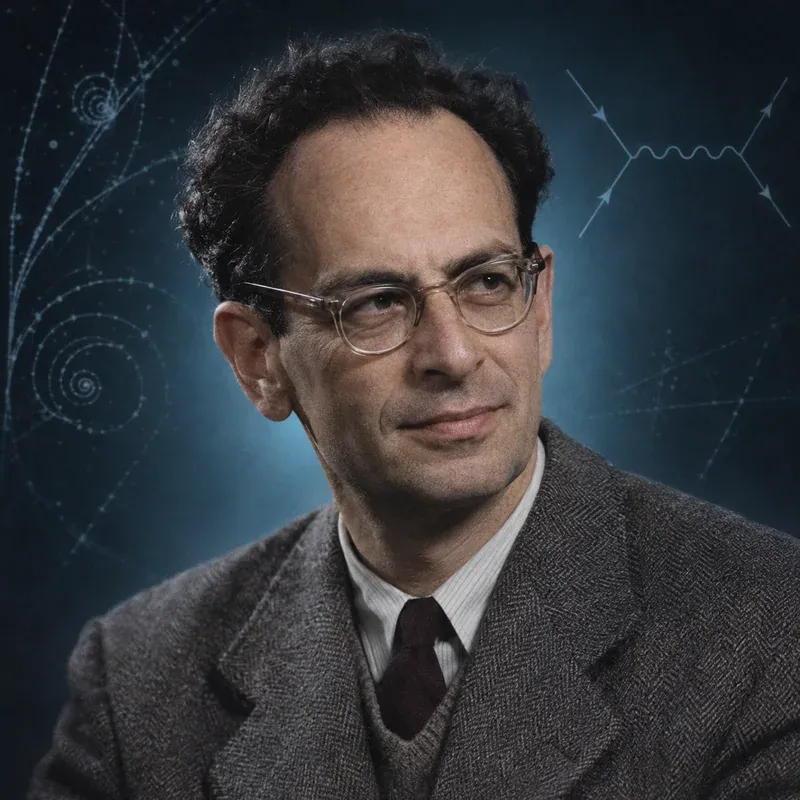
Maurice Goldhaber
In late 1957 Goldhaber, with Lee Grodzins and Andrew Sunyar at Brookhaven, measured the helicity of the neutrino in an elegant table-top experiment: electron capture in Eu-152m produces Sm-152* and a neutrino, and the circular polarization of the resonantly scattered gamma ray reveals the neutrino's spin direction. They found the neutrino is left-handed (negative helicity), confirming the two-component theory and selecting the V-A form of the weak interaction.
- Born
- 18 April 1911
Lemberg, Austria-Hungary (now Lviv, Ukraine) - Died
- 11 May 2011
East Setauket, New York, USA - Nationality
- Austrian-born American
- Field
- experimental nuclear and particle physics
- Institutions
- Cavendish Laboratory, Cambridge, University of Illinois, Brookhaven National Laboratory (director 1961–1973)
Early life and education
Maurice Goldhaber was born in 1911 in Lemberg, then part of Austria-Hungary and today Lviv in Ukraine. He began studying physics at the University of Berlin, but the political situation of 1933 led him to move to England. At the Cavendish Laboratory in Cambridge he joined the group of James Chadwick, who had discovered the neutron only two years earlier, and he completed his doctorate at Magdalene College in 1936.
Cambridge gave him his first major result. In 1934 Goldhaber and Chadwick used gamma rays to split the deuteron into a proton and a neutron. This nuclear photodisintegration showed that the deuteron is a bound state of the two nucleons, and because the energy of the gamma ray was known precisely, it also gave the first accurate value of the neutron mass. It showed that the neutron is slightly heavier than the proton.
Path to neutrino physics
In 1938 Goldhaber moved to the University of Illinois, where he worked on nuclear isomers and neutron physics. He joined Brookhaven National Laboratory on Long Island in 1950. There, with Edward Teller, he proposed the Goldhaber–Teller model of the giant dipole resonance, in which the protons of a nucleus oscillate collectively against the neutrons when the nucleus absorbs a photon.
His turn towards the neutrino came from the upheaval of 1956–57. Tsung-Dao Lee and Chen-Ning Yang had suggested that the weak interaction might not respect mirror symmetry, and the experiment of Chien-Shiung Wu confirmed parity violation in the beta decay of cobalt-60. Theorists, among them Lee and Yang, Lev Landau and Abdus Salam, then proposed a two-component theory in which the neutrino has only one handedness. Whether that handedness is left or right decided between competing forms of the weak interaction. At Brookhaven, Goldhaber, Lee Grodzins and Andrew Sunyar had already been measuring the polarisation of photons and electrons emitted in beta decay, so they were well placed to attack the question.
Key contributions
The difficulty is that a neutrino leaves no trace in a laboratory apparatus. Goldhaber's insight was to find a decay in which the neutrino's spin direction is copied onto a particle that can be measured. He chose an isomer of europium-152 that decays by electron capture: the nucleus absorbs an atomic electron and emits a single neutrino, leaving an excited samarium-152 nucleus that recoils in the opposite direction. That nucleus then emits a gamma ray of about 961 keV. Conservation of angular momentum links the helicity of the neutrino to the circular polarisation of gamma rays emitted in the direction of the recoil.
To select exactly those gamma rays, the team used resonant scattering. A gamma ray can be absorbed and re-emitted by a ring of samarium oxide only if it carries a little extra energy, which it gains when emitted by a nucleus moving towards the scatterer. Only gamma rays travelling opposite to the neutrino pass this filter. Before reaching the scatterer they crossed magnetised iron, whose absorption depends on whether the photon spin is parallel or antiparallel to the magnetisation. By reversing the magnetic field and comparing counting rates, the experimenters read off the photon polarisation and from it the neutrino's spin direction.
The result, received by Physical Review on 11 December 1957 and published in 1958 as ‘Helicity of neutrinos’, was clear: the neutrino is left-handed, with its spin opposite to its direction of motion. Combined with other beta-decay measurements, this selected the V−A structure of the weak interaction proposed in 1957–58 by E. C. G. Sudarshan and Robert Marshak and by Richard Feynman and Murray Gell-Mann. In the Standard Model only left-handed neutrinos and right-handed antineutrinos take part in the weak interaction, a fact that rests directly on this small table-top experiment.
Later work and legacy
From 1961 to 1973 Goldhaber directed Brookhaven National Laboratory during a period in which its Alternating Gradient Synchrotron produced several landmark results, among them the discovery of the muon neutrino in the two-neutrino experiment of 1962 and the discovery of CP violation in kaon decays in 1964. He remained active at the laboratory for decades after stepping down, with a lasting interest in conservation laws and the stability of matter, including the search for proton decay.
He received the National Medal of Science in 1983, the Wolf Prize in Physics in 1991, shared with Valentine Telegdi, and the Enrico Fermi Award in 1998. His wife, Gertrude Scharff Goldhaber, was also a nuclear physicist at Brookhaven. Goldhaber died at his home in East Setauket, New York, in May 2011, at the age of 100. The helicity experiment is still taught as a model of how a well-chosen nuclear process can answer a fundamental question with modest equipment.
Known for
- Measurement of neutrino helicity (Goldhaber experiment, 1957–58)
- Nuclear photodisintegration of the deuteron (with Chadwick)
- Director of Brookhaven
Chronology
- 1934Works with Chadwick at the Cavendish
- 1950Joins Brookhaven
- 1957Neutrino-helicity experiment (paper received 11 December)
- 1958'Helicity of neutrinos' published
- 1991Wolf Prize in Physics
Original papers
- M. Goldhaber, L. Grodzins, A.W. Sunyar, Evidence for circular polarization of bremsstrahlung produced by beta rays, Phys. Rev. 106, 826 (1957)DOI 10.1103/PhysRev.106.826
- M. Goldhaber, L. Grodzins, A.W. Sunyar, Helicity of neutrinos, Phys. Rev. 109, 1015 (1958)DOI 10.1103/PhysRev.109.1015
Experiments
- Goldhaber experiment
Connected people
- Andrew W. Sunyar
- Chen-Ning Yang
- James Chadwick
- Lee Grodzins
- Tsung-Dao Lee
- Robert Marshak
- Nicholas P. Samios
Frequently asked questions
What did Maurice Goldhaber discover about the neutrino?
In 1957–58, with Lee Grodzins and Andrew Sunyar, he showed that the neutrino is left-handed: its spin points opposite to its direction of motion. This established the V−A form of the weak interaction.
Why was europium-152 used in the Goldhaber experiment?
Its isomer decays by electron capture into a single neutrino and an excited samarium nucleus that then emits a gamma ray. The gamma ray's circular polarisation carries the information about the neutrino's helicity.
Did Maurice Goldhaber win a Nobel Prize?
No. His honours include the Wolf Prize in Physics (1991), the National Medal of Science (1983) and the Enrico Fermi Award (1998).
On the timeline
Mentioned in 24 pages
Comparisons 1
Milestones 5
People 10
Last updated: · Editorial standard
Cite this page
Text
Neutrino Atlas (2026). “Maurice Goldhaber”. Retrieved 22 November 2026, from https://neutrino-atlas.com/people/maurice-goldhaber/BibTeX
@misc{neutrinoatlas2026peoplemauricegoldhaber,
  title        = {Maurice Goldhaber},
  author       = {{Neutrino Atlas}},
  year         = {2026},
  url          = {https://neutrino-atlas.com/people/maurice-goldhaber/},
  note         = {Accessed 2026-11-22},
  language     = {english}
}