 Illustration
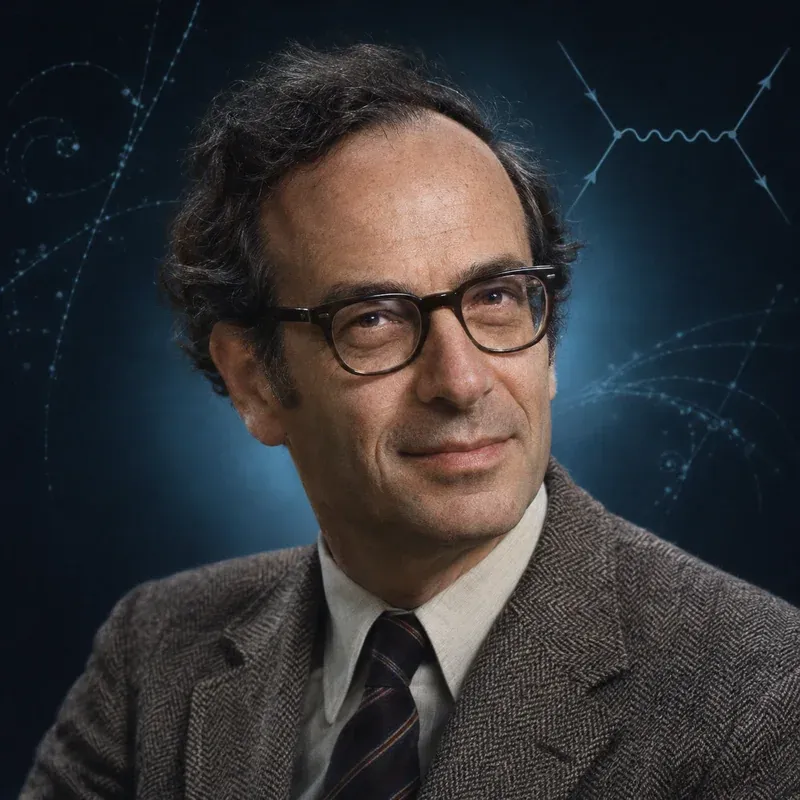
Lee Grodzins
As a young researcher at Brookhaven (1955-58), Grodzins worked with Maurice Goldhaber and Andrew Sunyar on helicity measurements of electrons and photons in beta decay, culminating in the 1957-58 experiment that showed the neutrino has negative helicity. His accompanying measurement of the lifetime of the 1- level in Sm-152 was a key ingredient of the resonance-scattering method.
- Born
- 10 July 1926
Lowell, Massachusetts, USA - Died
- 6 March 2025
Weston, Massachusetts, USA - Nationality
- American
- Field
- experimental nuclear physics
- Institutions
- Purdue University, Brookhaven National Laboratory, MIT, Niton Corporation
Early life and education
Lee Grodzins was born on 10 July 1926 in Lowell, Massachusetts, and grew up in Manchester, New Hampshire, where his father ran a gas station. He took a degree in engineering at the University of New Hampshire in 1946 but, as he later put it, “I have a degree in mechanical engineering, but I don't want to be one.” After a master's degree at Union College and work in the nuclear physics group of General Electric's research laboratory in Schenectady, he earned a PhD in physics at Purdue University in 1954 with a cloud-chamber study of positron scattering on gold nuclei.
The neutrino-helicity experiment
From 1955 to 1958 Grodzins worked in the nuclear physics group at Brookhaven National Laboratory. The discovery of parity violation in 1956–57 had raised an urgent question: if the weak interaction distinguishes left from right, which way does the neutrino spin relative to its motion? The answer, its helicity, would decide between competing forms of the weak interaction.
With Maurice Goldhaber and Andrew Sunyar, Grodzins devised a tabletop experiment that inferred the helicity of a particle nobody could detect directly. A metastable state of europium-152 decays by electron capture, emitting a neutrino and leaving samarium-152 in an excited state that immediately emits a gamma ray. Only gamma rays emitted opposite to the neutrino carry enough energy to be resonantly scattered by a samarium target, so the scattered photons select a known direction. Their circular polarization, measured by transmission through magnetised iron, then reveals the spin of the unseen neutrino.
Grodzins' companion measurement of the lifetime of the excited samarium level showed that the nucleus emits its gamma ray quickly enough, before the recoil imparted by the neutrino is lost, for this resonance scattering to work. The run took about ten days, followed by a month of checks. The letter “Helicity of neutrinos” was submitted to Physical Review on 11 December 1957 and showed that the neutrino is left-handed. The result supported the V−A theory and became a cornerstone of the Standard Model neutrino, which exists only in a left-handed chirality state. In 2008 Brookhaven marked the anniversary with the conference “Neutrino Helicity at 50”.
Later work
Grodzins joined the MIT physics faculty in 1959 and served as professor from 1966 until his retirement at the end of the 1990s. He led MIT's Relativistic Heavy Ion Group, studied heavy-ion reactions at Brookhaven's tandem accelerator, searched for superheavy elements and in 1985 carried out the first computed axial tomography experiment with synchrotron radiation.
Outside the laboratory he co-founded the Union of Concerned Scientists in 1969 and chaired it in 1970 and 1972. In 1987 he founded Niton Corporation, which developed instruments for radon and lead-paint testing and handheld X-ray fluorescence analysers for metal alloys and contraband. He held more than 60 US patents, founded the public-library initiative Cornerstones of Science in 1999, and died on 6 March 2025 in Weston, Massachusetts, aged 98.
Known for
- Goldhaber–Grodzins–Sunyar neutrino-helicity experiment
- X-ray fluorescence instruments
- Co-founder of the Union of Concerned Scientists
Chronology
- 1954PhD, Purdue University
- 1957Neutrino-helicity experiment at Brookhaven
- 1959Joins MIT physics faculty
Original papers
- M. Goldhaber, L. Grodzins, A.W. Sunyar, Helicity of neutrinos, Phys. Rev. 109, 1015 (1958)DOI 10.1103/PhysRev.109.1015
- L. Grodzins, Lifetime of a 1- level in Sm152, Phys. Rev. 109, 1014 (1958)DOI 10.1103/PhysRev.109.1014
Experiments
- Goldhaber experiment
Connected people
Frequently asked questions
What did the Goldhaber–Grodzins–Sunyar experiment show?
It showed in 1957 that the neutrino has negative helicity: it spins opposite to its direction of motion. This confirmed the left-handed structure of the weak interaction.
How can the spin of a neutrino be measured if the neutrino is not detected?
By momentum and angular-momentum conservation. The experiment selected gamma rays emitted opposite to the neutrino via resonance scattering and measured their circular polarization, which is tied to the neutrino's spin.
Did Lee Grodzins win a Nobel Prize?
No. He was a Fellow of the American Physical Society and the American Academy of Arts and Sciences and a two-time Guggenheim Fellow.
On the timeline
Mentioned in 11 pages
Milestones 3
Terms 2
Last updated: · Editorial standard
Cite this page
Text
Neutrino Atlas (2026). “Lee Grodzins”. Retrieved 22 November 2026, from https://neutrino-atlas.com/people/lee-grodzins/BibTeX
@misc{neutrinoatlas2026peopleleegrodzins,
  title        = {Lee Grodzins},
  author       = {{Neutrino Atlas}},
  year         = {2026},
  url          = {https://neutrino-atlas.com/people/lee-grodzins/},
  note         = {Accessed 2026-11-22},
  language     = {english}
}