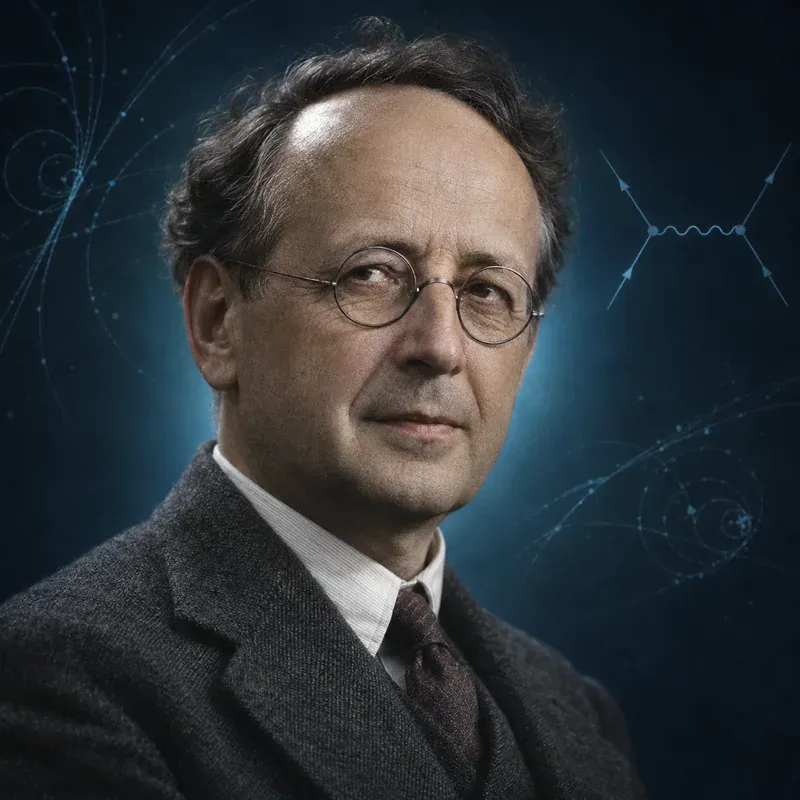
 Illustration
Hermann Weyl
In 1929 Weyl wrote down the wave equation for a massless spin-1/2 particle described by a two-component spinor. Pauli rejected it in 1933 because it is not invariant under reflection, but after the discovery of parity violation in 1957 the Weyl equation became the basis of the two-component neutrino theory of Landau, Lee and Yang, and Salam.
- Born
- 9 November 1885
Elmshorn, German Empire - Died
- 8 December 1955
Zurich, Switzerland - Nationality
- German
- Field
- mathematics, mathematical physics
- Institutions
- ETH Zurich, University of Göttingen, Institute for Advanced Study, Princeton
Early life and education
Hermann Klaus Hugo Weyl was born on 9 November 1885 in Elmshorn near Hamburg. He studied mathematics and physics at Göttingen, where he completed his doctorate under David Hilbert in 1908. In 1913 he became professor of mathematics at the ETH in Zurich, where Albert Einstein was briefly a colleague. In 1930 he returned to Göttingen as Hilbert's successor, but left Germany in 1933 after the Nazi seizure of power, partly because his wife was of Jewish descent. He joined the newly founded Institute for Advanced Study in Princeton, where he worked until his retirement. He died in Zurich on 8 December 1955.
Weyl was one of the most versatile mathematicians of the century, working on analysis, geometry, number theory and the representation theory of continuous groups. His books “Raum, Zeit, Materie” (1918) on general relativity and “Gruppentheorie und Quantenmechanik” (1928) brought group theory into quantum physics.
Key contributions
In 1918 Weyl tried to unify gravity and electromagnetism through invariance under local changes of length scale, which he called Eichinvarianz, the origin of the word “gauge”. The idea failed as a theory of length, but in 1929 he reformulated it for quantum mechanics: the phase of the electron's wave function may be changed independently at every point in space and time, provided the electromagnetic potential changes at the same time. This gauge principle became the organising idea of the whole Standard Model, including the electroweak theory that describes neutrino interactions.
In the same papers of 1929, “Elektron und Gravitation” in the Zeitschrift für Physik and a shorter version in the Proceedings of the National Academy of Sciences, Weyl wrote down a wave equation for a massless spin-½ particle that needs only two components instead of the four of Paul Dirac's electron equation. A solution of the Weyl equation has a fixed helicity: its spin points either always along or always against its direction of motion. Such a particle distinguishes left from right, so the equation is not invariant under mirror reflection, or parity.
Rejection and revival
In 1933 Wolfgang Pauli rejected the Weyl equation in his Handbuch article on wave mechanics because it violates parity, a symmetry everyone then assumed to be exact. For almost three decades the equation was a mathematical curiosity. That changed in 1956–57, when Tsung-Dao Lee and Chen-Ning Yang questioned parity conservation in weak interactions and Chien-Shiung Wu observed parity violation in the beta decay of cobalt-60. Within weeks, Lev Landau, Lee and Yang, and Abdus Salam independently proposed that the neutrino is described by Weyl's two-component equation.
The idea was confirmed in 1958 by Maurice Goldhaber, Lee Grodzins and Andrew Sunyar, who found that the neutrino is left-handed. The two-component neutrino also fits naturally into the V−A theory of weak interactions.
Legacy
Since neutrinos are now known to have small masses, they cannot be exactly Weyl particles. Yet the Standard Model is still built from two-component Weyl fields: the weak interaction acts only on left-handed chirality states, and whether a neutrino mass is of Dirac or Majorana type is a question about how such Weyl components are combined. In 2015 quasiparticles obeying the Weyl equation were observed in so-called Weyl semimetals, a late confirmation in condensed matter of a structure first written down for its mathematical elegance.
Known for
- Weyl equation for massless two-component spinors (1929)
- Gauge principle
Chronology
- 1929Weyl equation published
Original papers
- H. Weyl, Z. Phys. 56, 330 (1929)
- H. Weyl, Proc. Natl. Acad. Sci. USA 15, 323 (1929)
Connected people
Frequently asked questions
What is the Weyl equation?
A relativistic wave equation for a massless spin-½ particle with two components. Its solutions have fixed helicity, so they distinguish left from right and violate parity.
Did Weyl know his equation described the neutrino?
No. He published it in 1929, before Pauli proposed the neutrino in 1930. Its connection to the neutrino was made only after parity violation was discovered in 1957, two years after Weyl's death.
Did Hermann Weyl win a Nobel Prize?
No. Weyl was primarily a mathematician, and there is no Nobel Prize in mathematics.
On the timeline
Mentioned in 7 pages
Last updated: · Editorial standard
Cite this page
Text
Neutrino Atlas (2026). “Hermann Weyl”. Retrieved 22 November 2026, from https://neutrino-atlas.com/people/hermann-weyl/BibTeX
@misc{neutrinoatlas2026peoplehermannweyl,
  title        = {Hermann Weyl},
  author       = {{Neutrino Atlas}},
  year         = {2026},
  url          = {https://neutrino-atlas.com/people/hermann-weyl/},
  note         = {Accessed 2026-11-22},
  language     = {english}
}