 Illustration
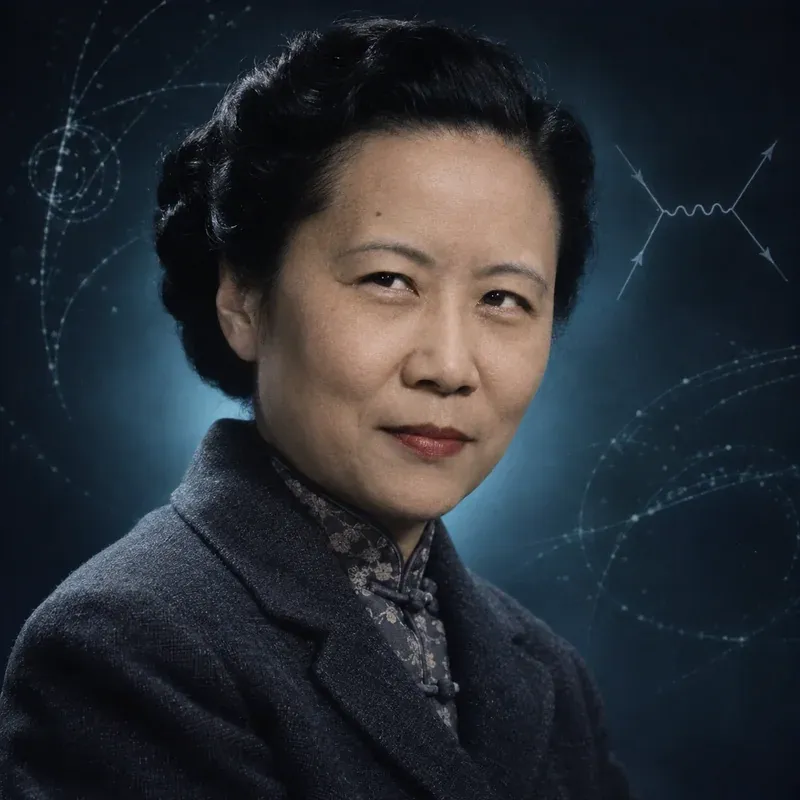
Chien-Shiung Wu
Wu's precise beta-spectrum measurements with thin, uniform sources resolved discrepancies with Fermi's theory (1949). With Ambler, Hayward, Hoppes and Hudson at the National Bureau of Standards she cooled and polarized Co-60 nuclei and found in late December 1956 that beta electrons are emitted preferentially opposite the nuclear spin - the first proof of parity violation in weak interactions, published February 1957. Her 1963 test of the conserved vector current hypothesis confirmed a key prediction of the Feynman-Gell-Mann V-A theory.
- Born
- 31 May 1912
Liuhe, Taicang, Jiangsu, China - Died
- 16 February 1997
New York City, USA - Nationality
- Chinese-American
- Field
- experimental nuclear physics
- Institutions
- University of California, Berkeley, Smith College, Princeton University, Columbia University
Early life and education
Chien-Shiung Wu was born in 1912 in Liuhe, a small town in Taicang, Jiangsu province. In 1923 she entered the Suzhou Women’s Normal School No. 2, a boarding school that also taught science, and graduated at the top of her class in 1929. She studied at National Central University in Nanjing, switching from mathematics to physics, and then worked as a research assistant at Zhejiang University and at the Institute of Physics of Academia Sinica.
In August 1936 she sailed to the United States, intending to study at the University of Michigan, but stayed at the University of California, Berkeley, after visiting the Radiation Laboratory. She completed her PhD there in 1940 under Ernest Lawrence, with work on beta decay and on radioactive isotopes of xenon produced in uranium fission.
Path to neutrino physics
After teaching at Smith College and at Princeton, where she was the first woman on the physics faculty, Wu joined the Manhattan Project’s laboratories at Columbia University in 1944. She worked on gaseous-diffusion enrichment of uranium and, drawing on her thesis work, helped explain why the Hanford B reactor kept shutting itself down: the fission product xenon-135 was absorbing neutrons. From 1945 she remained at Columbia for the rest of her career. In 1952 she became one of the first women with tenure in a university physics department, and in 1973 the first Michael I. Pupin Professor of Physics.
Key contributions
Beta decay was the original reason for the neutrino, and in the 1940s its energy spectrum was still puzzling: measured spectra did not match Fermi’s theory. Wu showed that the discrepancy came from the radioactive sources themselves. Thick or uneven sources slowed the electrons before they left. With thin, uniform sources her spectra agreed with Fermi’s predictions (1949), and she became the world’s leading authority on beta spectroscopy.
In 1956 Tsung-Dao Lee and Chen-Ning Yang pointed out that nobody had tested whether the weak interaction respects parity, the symmetry between a process and its mirror image. Wu designed the decisive test. Together with Ernest Ambler, Raymond Hayward, Dale Hoppes and Ralph Hudson at the National Bureau of Standards, she cooled cobalt-60 nuclei to a few thousandths of a kelvin and aligned their spins in a magnetic field. If parity held, the decay electrons would leave equally along and against the spin. On 27 December 1956 the team saw a clear asymmetry: electrons were emitted preferentially opposite to the nuclear spin. The paper was received on 15 January 1957 and published on 15 February 1957. Parity violation was established.
For neutrino physics this was a turning point. It led directly to the V−A structure of the weak interaction proposed in 1957–58 by Robert Marshak and E. C. G. Sudarshan and by Richard Feynman and Murray Gell-Mann, and to the picture of the neutrino as a particle of fixed helicity: in the weak interaction only left-handed neutrinos and right-handed antineutrinos take part.
In 1963 Wu, with Y. K. Lee and L. W. Mo, confirmed another prediction of the Feynman–Gell-Mann theory, the conserved vector current hypothesis, by comparing the beta spectra of boron-12 and nitrogen-12. In the 1960s she also searched for double beta decay in a salt mine below Lake Erie, an early example of a low-background underground experiment. Her monograph Beta Decay, written with Steven Moszkowski, appeared in 1966.
Recognition
The 1957 Nobel Prize in Physics went to Lee and Yang alone. Wu was nominated many times between 1958 and 1974 but never received it, an omission widely discussed ever since. She did receive many other honours: the Comstock Prize (1964, the first woman to do so), the National Medal of Science (1975), the first Wolf Prize in Physics (1978), and in 1975 she became the first woman to serve as president of the American Physical Society. Asteroid 2752 Wu Chien-Shiung is named after her. She retired in 1981 and died in New York in 1997.
Known for
- Wu experiment: parity violation in Co-60 beta decay (1956–57)
- Precision beta spectroscopy confirming Fermi theory (1949)
- Test of conserved vector current (1963)
Chronology
- 1949Beta-spectrum measurements confirm Fermi theory
- 1956First asymmetry seen at NBS (27 December)
- 1957Wu et al. Phys. Rev. paper (15 February)
- 1963Confirms conserved vector current hypothesis
- 1978First Wolf Prize in Physics
Original papers
- C.S. Wu, E. Ambler, R.W. Hayward, D.D. Hoppes, R.P. Hudson, Experimental test of parity conservation in beta decay, Phys. Rev. 105, 1413 (1957)DOI 10.1103/PhysRev.105.1413
- C.S. Wu, Parity experiments in beta decays, Rev. Mod. Phys. 31, 783 (1959)DOI 10.1103/RevModPhys.31.783
Experiments
- Wu experiment
Connected people
Frequently asked questions
What did the Wu experiment show?
It showed that electrons from the beta decay of polarized cobalt-60 nuclei are emitted preferentially opposite to the nuclear spin. Nature therefore distinguishes left from right in the weak interaction: parity is violated.
Did Chien-Shiung Wu win a Nobel Prize?
No. The 1957 Nobel Prize for parity violation was awarded to the theorists Tsung-Dao Lee and Chen-Ning Yang. Wu received the first Wolf Prize in Physics in 1978 and the US National Medal of Science in 1975.
Why is her work important for neutrinos?
Parity violation revealed that neutrinos in the weak interaction are always left-handed. This led to the V−A theory, the basis of the modern description of weak interactions of neutrinos.
On the timeline
Mentioned in 28 pages
Lessons 1
Milestones 5
People 15
Last updated: · Editorial standard
Cite this page
Text
Neutrino Atlas (2026). “Chien-Shiung Wu”. Retrieved 22 November 2026, from https://neutrino-atlas.com/people/chien-shiung-wu/BibTeX
@misc{neutrinoatlas2026peoplechienshiungwu,
  title        = {Chien-Shiung Wu},
  author       = {{Neutrino Atlas}},
  year         = {2026},
  url          = {https://neutrino-atlas.com/people/chien-shiung-wu/},
  note         = {Accessed 2026-11-22},
  language     = {english}
}