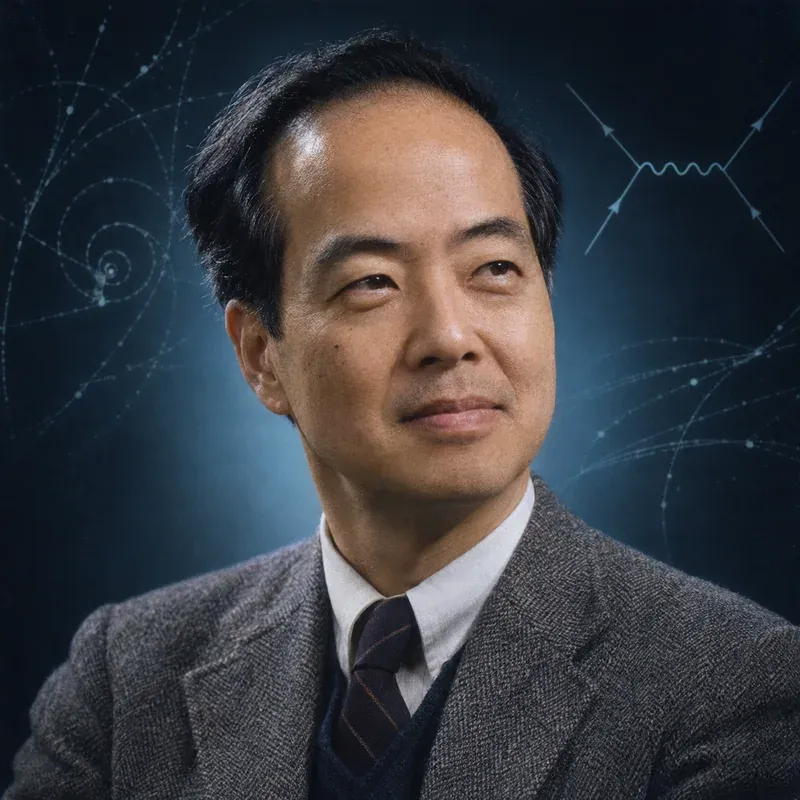
 Illustration
Tsung-Dao Lee
With C.N. Yang, Lee pointed out in 1956 that parity conservation had never been tested in weak interactions and proposed experiments, including the beta decay of polarized Co-60. In January 1957, independently of Landau and Salam, they formulated the two-component theory of a massless neutrino of definite helicity. In 1960 they analysed possible high-energy accelerator neutrino experiments, helping launch the programme that discovered the muon neutrino.
- Born
- 24 November 1926
Shanghai, China - Died
- 4 August 2024
San Francisco, California, USA - Nationality
- Chinese-American
- Field
- theoretical physics
- Nobel Prize
- Physics 1957 (shared with C.N. Yang) – for their penetrating investigation of the so-called parity laws which has led to important discoveries regarding the elementary particles
- Institutions
- Columbia University, Institute for Advanced Study, Princeton, University of California, Berkeley
Early life and education
Tsung-Dao Lee was born in Shanghai in 1926. His studies took place during the war with Japan: in 1943 he entered National Chekiang (Zhejiang) University, first in chemical engineering and then in physics, and in 1945 he continued at National Southwestern Associated University in Kunming, where he studied under Wu Ta-You. In 1946 he received a fellowship to study in the United States and was admitted to the graduate programme of the University of Chicago without a bachelor’s degree. He completed his PhD there in 1950 under Enrico Fermi, with a thesis on the hydrogen content of white dwarf stars.
After a year at Berkeley and two years at the Institute for Advanced Study in Princeton, where he began his long collaboration with Chen-Ning Yang, he joined Columbia University in 1953. He remained there for the rest of his career, retiring in 2012.
Key contributions
In the mid-1950s particle physics faced the ‘τ–θ puzzle’: two strange mesons appeared identical in mass and lifetime, yet decayed into final states of opposite parity. In a paper received by Physical Review in June 1956 and published in October, Lee and Yang pointed out that, while parity conservation was well tested in strong and electromagnetic processes, there was no experimental evidence for it in weak interactions. They proposed specific tests, among them measuring whether electrons from the beta decay of polarised cobalt-60 nuclei are emitted preferentially in one direction relative to the nuclear spin. Chien-Shiung Wu and her colleagues carried out this experiment and reported a large asymmetry in January 1957: parity violation was established. Lee and Yang received the 1957 Nobel Prize in Physics less than a year after the experiment, at the time among the youngest laureates.
Parity violation immediately changed the picture of the neutrino. In early 1957 Lee and Yang, and independently Lev Landau and Abdus Salam, proposed the two-component theory: a massless neutrino described by a single two-component Weyl spinor, existing in only one helicity state, with the antineutrino in the opposite state. The idea had been considered by Hermann Weyl in 1929 but rejected because it violated parity. It predicted maximal parity violation in processes involving neutrinos and was confirmed when Maurice Goldhaber and colleagues found that the neutrino is left-handed, at the end of 1957. It became part of the V−A theory and of the Standard Model.
Lee also helped to start accelerator neutrino physics. In 1959, at a Columbia coffee discussion, he raised the question of how weak interactions could be studied at high energies; Melvin Schwartz responded with the idea of a neutrino beam made from pion decays. In 1960 Lee and Yang published a theoretical analysis of possible high-energy neutrino experiments, discussing among other things whether the neutrinos produced with muons and with electrons are the same. The Brookhaven two-neutrino experiment of Schwartz, Leon Lederman and Jack Steinberger showed in 1962 that they are not, discovering the muon neutrino.
Later work and legacy
Lee’s work covered a wide range of physics: the Lee model, an exactly solvable model in quantum field theory; the Lee–Yang theorem in statistical mechanics; the Kinoshita–Lee–Nauenberg theorem on infrared divergences (1964); and the study of CP violation and of new states of nuclear matter in heavy-ion collisions. From 1997 to 2003 he directed the RIKEN BNL Research Center at Brookhaven, which built dedicated supercomputers for lattice QCD.
From 1979 he organised the China–US Physics Examination and Application programme (CUSPEA), which over the following decade enabled several hundred Chinese students to do doctoral studies in physics in the United States. The T. D. Lee Institute at Shanghai Jiao Tong University, where Tsutomu Yanagida now works, is named after him. Lee died in San Francisco in August 2024, aged 97.
Known for
- Parity violation in weak interactions (1956, with Yang)
- Two-component neutrino theory (1957)
- High-energy neutrino physics programme (1960)
Chronology
- 1956'Question of parity conservation in weak interactions' (Phys. Rev., 1 October)
- 1957Two-component neutrino theory; Nobel Prize in Physics
- 1960Theoretical discussion of high-energy neutrino experiments
Original papers
- T.D. Lee, C.N. Yang, Question of parity conservation in weak interactions, Phys. Rev. 104, 254 (1956)DOI 10.1103/PhysRev.104.254
- T.D. Lee, C.N. Yang, Parity nonconservation and a two-component theory of the neutrino, Phys. Rev. 105, 1671 (1957)DOI 10.1103/PhysRev.105.1671
- T.D. Lee, C.N. Yang, Theoretical discussions on possible high-energy neutrino experiments, Phys. Rev. Lett. 4, 307 (1960)DOI 10.1103/PhysRevLett.4.307
Experiments
- Wu experiment
- Goldhaber experiment
Connected people
Frequently asked questions
What did T. D. Lee win the Nobel Prize for?
He shared the 1957 Nobel Prize in Physics with Chen-Ning Yang for their analysis of parity conservation, which led to the discovery of parity violation in weak interactions.
What is the two-component neutrino theory?
The proposal of 1957 that the neutrino is massless and exists in only one helicity state, left-handed for the neutrino and right-handed for the antineutrino. Lee and Yang, Landau and Salam proposed it independently.
How was Lee involved in the discovery of the muon neutrino?
He prompted Melvin Schwartz’s idea of a high-energy neutrino beam and, with Yang, analysed the physics such experiments could test in 1960. The Brookhaven experiment of 1962 then found the muon neutrino.
On the timeline
- 1956Lee and Yang question parity in weak decays
- 1957Nobel Prize for Lee and Yang
- 1957Two-component theory of a massless neutrino
- 1960Proposals for accelerator neutrino beams
Mentioned in 27 pages
Lessons 1
Milestones 6
People 11
Last updated: · Editorial standard
Cite this page
Text
Neutrino Atlas (2026). “Tsung-Dao Lee”. Retrieved 22 November 2026, from https://neutrino-atlas.com/people/tsung-dao-lee/BibTeX
@misc{neutrinoatlas2026peopletsungdaolee,
  title        = {Tsung-Dao Lee},
  author       = {{Neutrino Atlas}},
  year         = {2026},
  url          = {https://neutrino-atlas.com/people/tsung-dao-lee/},
  note         = {Accessed 2026-11-22},
  language     = {english}
}