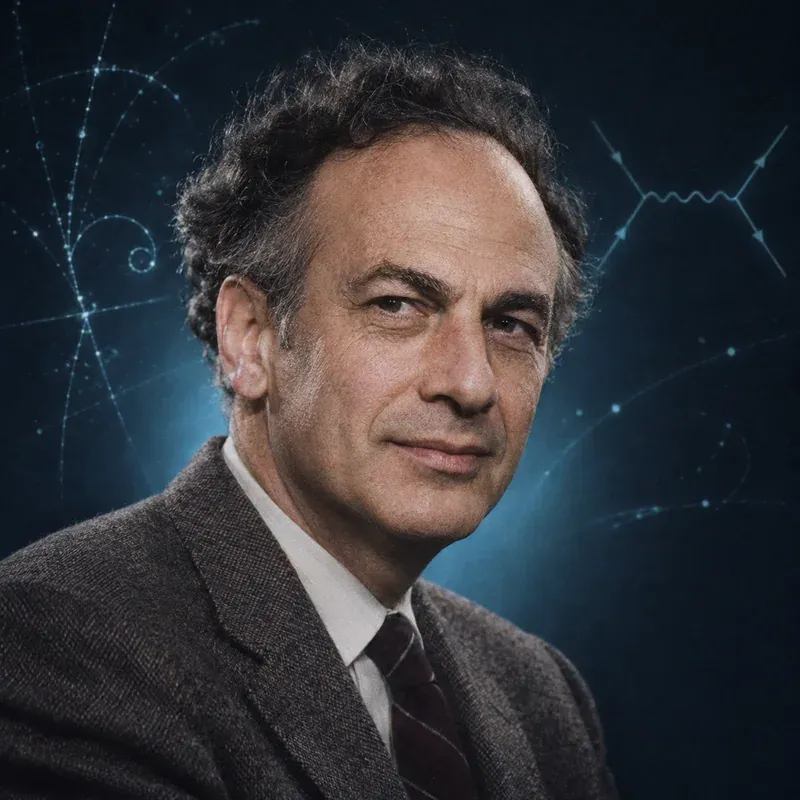
 Illustration
Robert Marshak
With his student George Sudarshan, Marshak proposed in 1957 the universal V-A (vector minus axial-vector) form of the weak interaction, based on chirality invariance, which implies left-handed neutrinos. He also founded in 1950 the Rochester conferences, where much of the 1956-57 debate on parity violation and the structure of weak interactions took place.
- Born
- 11 October 1916
The Bronx, New York City, USA - Died
- 23 December 1992
Cancún, Mexico - Nationality
- American
- Field
- theoretical physics
- Institutions
- University of Rochester, City College of New York (president 1970–79), Virginia Tech, Los Alamos (Manhattan Project)
Early life and education
Robert Eugene Marshak was born in the Bronx, New York City, in 1916, the son of immigrants from Minsk. After one semester at City College of New York he won a Pulitzer Scholarship to Columbia University, where he took his bachelor’s degree. He did his doctorate at Cornell University under Hans Bethe, finishing in 1939. With Bethe he worked on the nuclear reactions that power stars, the same field in which Bethe identified the CNO cycle and the pp chain, whose neutrinos are now measured by solar neutrino detectors.
Path to particle physics
During the Second World War Marshak worked at Los Alamos on the Manhattan Project. He analysed how shock waves travel through matter at the extreme temperatures of a nuclear explosion, where radiation dominates the transport of energy; such radiation-driven fronts are still called Marshak waves. After the war he joined the University of Rochester and became head of its physics department in 1950.
At the Shelter Island Conference in 1947 Marshak proposed, with Bethe, that the particle seen in cosmic rays was not the meson predicted by Yukawa but the decay product of a heavier, strongly interacting meson. The pion was found shortly afterwards, confirming the picture, which Shoichi Sakata and Takesi Inoue had proposed independently in Japan in 1942. In 1950 Marshak founded the Rochester conferences, small meetings that grew into the International Conference on High Energy Physics, still the main biennial meeting of the field. The discussions there in 1956 and 1957 played a large part in the debate about parity violation.
Key contributions: the V−A theory
After Tsung-Dao Lee and Chen-Ning Yang questioned parity conservation and the experiment of Chien-Shiung Wu confirmed its violation in early 1957, the precise form of the weak interaction was open. Fermi’s theory allowed five possible types of coupling (scalar, pseudoscalar, vector, axial vector and tensor), and the experimental data of the time, some of them later shown to be wrong, seemed to favour a scalar–tensor mixture.
Marshak and his student E. C. G. Sudarshan analysed all the data critically and argued that a single principle, invariance under chirality transformations, fixes the interaction to be a combination of vector and axial-vector currents with equal strength and opposite sign: V−A. In this form only the left-handed chirality component of each fermion takes part in charged weak interactions. For a massless neutrino this means the neutrino is always left-handed and the antineutrino right-handed, which an experiment led by Maurice Goldhaber confirmed by measuring neutrino helicity at the end of 1957.
Sudarshan and Marshak presented the proposal at the Padua–Venice conference in September 1957, and the full paper, ‘Chirality invariance and the universal Fermi interaction’, appeared in Physical Review in 1958. Richard Feynman and Murray Gell-Mann reached the same form independently and published it in January 1958. Their paper became better known, and the question of credit remained a sore point for Marshak and Sudarshan. V−A became the basis of the charged-current part of the electroweak theory.
Later work
In 1970 Marshak became president of City College of New York, where he served until 1979 during the period of open admissions. He then moved to Virginia Tech as a university distinguished professor and retired in 1991. He remained active in research: with his former student Rabindra Mohapatra he showed in 1980 that the difference between baryon and lepton number, B−L, can be a local gauge symmetry, a framework in which neutrinos are naturally Majorana particles with small masses and lepton number is violated. He was president of the American Physical Society in 1983, shared the 1982 J. Robert Oppenheimer Memorial Prize with Maurice Goldhaber, and wrote several books on weak interactions, including ‘Conceptual Foundations of Modern Particle Physics’ (1993). His doctoral students included Sudarshan, Susumu Okubo, Tullio Regge and Mohapatra. He drowned in an accident near Cancún, Mexico, in December 1992.
Known for
- Two-meson hypothesis (1947)
- Founding the Rochester conferences (1950)
- V−A theory of the weak interaction (with Sudarshan)
- President of CCNY and of the APS
Chronology
- 1947Two-meson hypothesis at Shelter Island
- 1950Founds the Rochester Conference
- 1957V−A theory with Sudarshan
- 1957V−A proposal at the Padua–Venice conference
- 1958V−A paper in Physical Review
- 1982J. Robert Oppenheimer Memorial Prize (shared with Goldhaber)
Original papers
- E.C.G. Sudarshan, R.E. Marshak, Chirality invariance and the universal Fermi interaction, Phys. Rev. 109, 1860 (1958)
- E. C. G. Sudarshan, R. E. Marshak, The nature of the four-fermion interaction, Proc. Padua–Venice Conf. on Mesons and Newly Discovered Particles (1957), p. V-14
Connected people
Frequently asked questions
What is the V−A theory?
It states that the charged weak interaction is the difference of a vector and an axial-vector current, so that only left-handed particles take part. Marshak and Sudarshan proposed it in 1957; see V−A.
Why is the V−A theory usually associated with Feynman and Gell-Mann?
Feynman and Gell-Mann published the same form independently in January 1958, shortly after Sudarshan and Marshak presented it at a conference. Their paper reached a wider audience, although historians now credit both pairs.
Did Marshak win a Nobel Prize?
No. He shared the 1982 J. Robert Oppenheimer Memorial Prize with Maurice Goldhaber and was a member of the US National Academy of Sciences.
On the timeline
Mentioned in 14 pages
Lessons 1
Milestones 3
People 7
Last updated: · Editorial standard
Cite this page
Text
Neutrino Atlas (2026). “Robert Marshak”. Retrieved 22 November 2026, from https://neutrino-atlas.com/people/robert-marshak/BibTeX
@misc{neutrinoatlas2026peoplerobertmarshak,
  title        = {Robert Marshak},
  author       = {{Neutrino Atlas}},
  year         = {2026},
  url          = {https://neutrino-atlas.com/people/robert-marshak/},
  note         = {Accessed 2026-11-22},
  language     = {english}
}