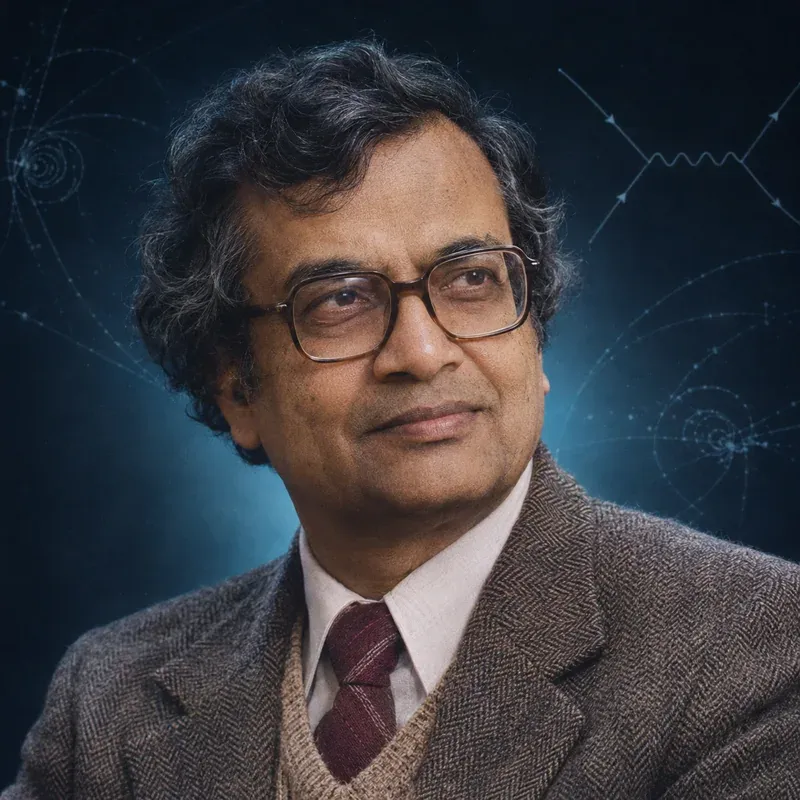
 Illustration
Rabindra Nath Mohapatra
In the 1970s Mohapatra, with Jogesh Pati and Goran Senjanović, developed left-right symmetric gauge theories in which parity is broken spontaneously and right-handed neutrinos appear naturally. In their 1980 paper Mohapatra and Senjanović showed that the breaking of left-right symmetry gives a seesaw relation linking the smallness of neutrino mass to the maximal parity violation of weak interactions.
- Born
- 1 September 1944
Musagadia, Mayurbhanj, India - Nationality
- Indian-American
- Field
- Theoretical particle physics; neutrino mass models
- Institutions
- University of Rochester (PhD 1969), City College of New York, University of Maryland
Early life and education
Rabindra Nath Mohapatra was born on 1 September 1944 in Musagadia, in the Mayurbhanj district of Odisha, India. He received his bachelor's degree from Utkal University in Bhubaneswar in 1964 and a master's degree from the University of Delhi in 1966. He then went to the University of Rochester, where he completed his PhD in 1969 under Robert Marshak, one of the authors of the V−A theory of the weak interaction. After postdoctoral positions at Stony Brook University and the University of Maryland, he joined the City College of New York as assistant professor in 1974 and became associate professor in 1976. Since 1983 he has been a professor at the University of Maryland.
Path to neutrino physics
In the Standard Model the weak interaction acts only on left-handed particles; parity violation is simply written into the theory. In 1974 Jogesh Pati and Abdus Salam proposed extending the gauge symmetry so that left- and right-handed particles enter on an equal footing. In 1975 Mohapatra developed this idea with Pati and then with his student Goran Senjanović into left-right symmetric models. In these models the laws of physics are fundamentally symmetric between left and right, and the observed parity violation arises spontaneously: a Higgs field breaks the symmetry at a high energy, giving the right-handed W boson a much larger mass than the ordinary one. Because the theory needs a right-handed partner for every left-handed fermion, it contains a right-handed neutrino in each generation.
Key contributions
In 1979 Mohapatra and Senjanović showed that in left-right models the same symmetry breaking that makes the right-handed W heavy also gives the right-handed neutrino a large Majorana mass. Through the seesaw mechanism the ordinary neutrinos then become very light. Their paper 'Neutrino mass and spontaneous parity nonconservation', published in Physical Review Letters in 1980, thus tied the smallness of neutrino mass directly to the near-maximal parity violation of the weak interaction: the heavier the right-handed sector, the lighter the neutrinos and the more left-handed the weak force appears at low energy. The same idea was proposed in the same period by Peter Minkowski, by Murray Gell-Mann, Pierre Ramond and Richard Slansky, by Tsutomu Yanagida and by Sheldon Glashow.
In their longer 1981 paper in Physical Review D, Mohapatra and Senjanović analysed neutrino masses and mixings in these models in detail. They included the contribution of a Higgs triplet that couples directly to the left-handed neutrinos, an ingredient of what is now called the type-II seesaw. In 1980, with Marshak, Mohapatra also proposed that the violation of baryon number by two units in left-right unified theories could appear as oscillations of free neutrons into antineutrons, a process still searched for in experiments.
Left-right models make predictions that can be tested in the laboratory. A heavy right-handed W boson and heavy Majorana neutrinos could be produced at hadron colliders and reveal themselves through two leptons of the same electric charge, a signature of lepton number violation. The ATLAS and CMS experiments at the LHC have searched for such events and now exclude right-handed W bosons below several TeV in the simplest scenarios. The same new particles can also contribute to neutrinoless double beta decay.
Later work and books
Mohapatra has written widely used books on unification and neutrinos: 'Unification and Supersymmetry' (first edition 1986), 'Massive Neutrinos in Physics and Astrophysics' with Palash Pal (first edition 1991) and 'The Neutrino Story' (2020). His later research has covered grand unified theories such as SO(10), neutrino mass models, leptogenesis, sterile neutrinos and baryon-number violation. He received a Humboldt Prize in 2005 and is a member of the Indian Academy of Sciences.
Known for
- Left-right symmetric models
- Seesaw mechanism with Senjanović (1979/80)
- Neutrino mass and parity violation
- Textbooks on neutrino physics and unification
Chronology
- 1969PhD under Robert Marshak
- 1975Left-right models with Pati and Senjanović
- 1980'Neutrino mass and spontaneous parity nonconservation'
- 1983Professor at University of Maryland
- 2005Humboldt Prize
Original papers
- R. N. Mohapatra, G. Senjanović, Neutrino mass and spontaneous parity nonconservation, Phys. Rev. Lett. 44, 912 (1980)DOI 10.1103/PhysRevLett.44.912
- R. N. Mohapatra, G. Senjanović, Neutrino masses and mixings in gauge models with spontaneous parity violation, Phys. Rev. D 23, 165 (1981)DOI 10.1103/PhysRevD.23.165
Experiments
- LHC
Connected people
Frequently asked questions
What is a left-right symmetric model?
An extension of the Standard Model in which left- and right-handed particles are treated symmetrically at high energies. Parity is broken spontaneously, which makes the right-handed W boson heavy and the observed weak interaction left-handed. Such models contain right-handed neutrinos.
How is parity violation linked to neutrino mass?
In the Mohapatra–Senjanović picture, both come from the same symmetry breaking. A high breaking scale makes the right-handed neutrino heavy and, through the seesaw mechanism, the ordinary neutrino light.
Can these ideas be tested?
Yes. Searches at the LHC for heavy right-handed W bosons and Majorana neutrinos, searches for neutrinoless double beta decay and searches for neutron–antineutron oscillations all probe left-right models.
On the timeline
Mentioned in 24 pages
Milestones 2
People 11
Last updated: · Editorial standard
Cite this page
Text
Neutrino Atlas (2026). “Rabindra Nath Mohapatra”. Retrieved 22 November 2026, from https://neutrino-atlas.com/people/rabindra-mohapatra/BibTeX
@misc{neutrinoatlas2026peoplerabindramohapatra,
  title        = {Rabindra Nath Mohapatra},
  author       = {{Neutrino Atlas}},
  year         = {2026},
  url          = {https://neutrino-atlas.com/people/rabindra-mohapatra/},
  note         = {Accessed 2026-11-22},
  language     = {english}
}