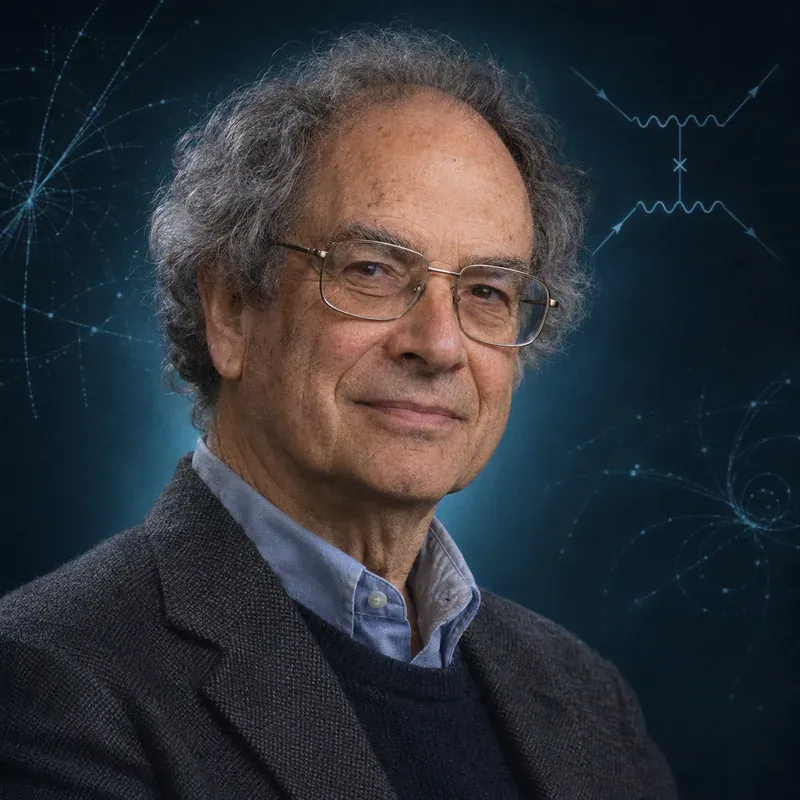
 Illustration
Joseph Schechter
With José Valle, Schechter wrote the 1980 survey of how neutrino masses arise in SU(2)×U(1) gauge theories, covering Majorana masses, Higgs triplets and seesaw-type structures. Their 1982 'black-box' theorem shows that any observation of neutrinoless double beta decay implies a non-zero Majorana neutrino mass.
- Field
- Theoretical particle physics
- Institutions
- Syracuse University
Education and career
Joseph Schechter trained first as an engineer: he received a bachelor's degree in electrical engineering from the Cooper Union in New York in 1959, then turned to physics and obtained his PhD at the University of Rochester in 1965. He spent his academic career at Syracuse University, where he is now professor emeritus of physics. He is a Fellow of the American Physical Society, and Syracuse honoured him with the William Wasserstrom Award for excellence in graduate teaching.
His research covers the phenomenology of the unified weak and electromagnetic interactions, neutrino theory, and effective Lagrangians for the strong interaction. In the last of these areas he is known for work on chiral effective theories of light mesons, including the role of the axial anomaly for the η′ meson and the nature of the light scalar σ meson.
Path to neutrino physics
In the late 1970s the electroweak theory had been confirmed, but in its minimal form it contains only left-handed, massless neutrinos. Several ways of giving neutrinos mass were being discussed at the same time, among them the seesaw mechanism of Peter Minkowski, Murray Gell-Mann, Pierre Ramond, Richard Slansky, Tsutomu Yanagida, Rabindra Mohapatra and Goran Senjanović. Schechter, together with José Valle, then a graduate student at Syracuse, set out to describe these possibilities within one framework.
Key contributions
Their 1980 paper “Neutrino masses in SU(2)⊗U(1) theories” in Physical Review D treats the general case in which both Dirac and Majorana mass terms are present. It includes masses generated by right-handed singlet neutrinos, the type-I seesaw, and by an electroweak Higgs triplet, the structure now called the type-II seesaw. The paper also showed that if neutrinos are Majorana particles, the lepton mixing matrix contains additional CP-violating phases that have no counterpart in the quark sector, the Majorana phases. These phases do not affect oscillations but do enter neutrinoless double beta decay.
In 1982 the two authors published the result now called the Schechter–Valle or “black-box” theorem. Neutrinoless double beta decay could in principle be caused by many mechanisms besides the exchange of a light Majorana neutrino. Schechter and Valle showed that whatever the mechanism, the same diagram, closed into a loop, generates a Majorana mass for the electron neutrino. Observing the decay therefore proves that neutrinos are Majorana particles and that lepton number is violated. Later calculations, for example by Duerr, Lindner and Merle in 2011, showed that the mass guaranteed in this way is extremely small, so the theorem settles the nature of the neutrino but not the size of its mass.
Legacy
The 1980 analysis remains a standard reference in the literature on neutrino mass models, and the black-box theorem is the main reason why the search for neutrinoless double beta decay is regarded as the decisive test of the Dirac or Majorana question.
Known for
- Schechter–Valle neutrino mass analysis (1980)
- Schechter–Valle theorem (1982)
- Chiral effective Lagrangians
Chronology
- 1980Neutrino masses in SU(2)⊗U(1) theories
- 1982Schechter–Valle theorem
Original papers
- J. Schechter, J. W. F. Valle, Neutrino masses in SU(2)⊗U(1) theories, Phys. Rev. D 22, 2227 (1980)DOI 10.1103/PhysRevD.22.2227
- J. Schechter, J. W. F. Valle, Neutrinoless double-β decay in SU(2)×U(1) theories, Phys. Rev. D 25, 2951 (1982)DOI 10.1103/PhysRevD.25.2951
Connected people
Frequently asked questions
What is the Schechter–Valle theorem?
It states that any observation of neutrinoless double beta decay, whatever process causes it, implies that neutrinos have a non-zero Majorana mass and are therefore their own antiparticles.
Did Schechter invent the seesaw mechanism?
He was one of several authors who developed neutrino mass mechanisms around 1979–80. With Valle he gave a general treatment that includes the type-I seesaw and the Higgs-triplet structure now called the type-II seesaw.
On the timeline
Mentioned in 9 pages
Last updated: · Editorial standard
Cite this page
Text
Neutrino Atlas (2026). “Joseph Schechter”. Retrieved 22 November 2026, from https://neutrino-atlas.com/people/joseph-schechter/BibTeX
@misc{neutrinoatlas2026peoplejosephschechter,
  title        = {Joseph Schechter},
  author       = {{Neutrino Atlas}},
  year         = {2026},
  url          = {https://neutrino-atlas.com/people/joseph-schechter/},
  note         = {Accessed 2026-11-22},
  language     = {english}
}