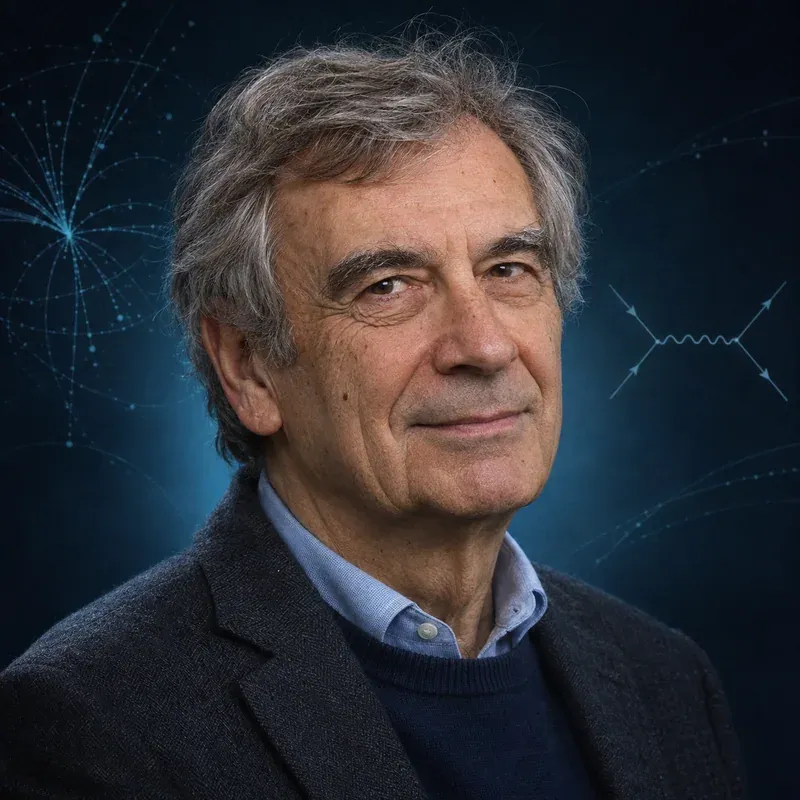
 Illustration
Goran Senjanović
With his PhD adviser Rabindra Mohapatra, Senjanović proposed in 1979 (published 1980) a seesaw mechanism in left-right symmetric theories, where neutrino mass smallness is tied to the scale of parity restoration. In 1983, with Wai-Yee Keung, he proposed producing heavy right-handed Majorana neutrinos at hadron colliders, with same-sign dilepton signals of lepton-number violation, now searched for at the LHC.
- Born
- 9 June 1950
Split, Yugoslavia (now Croatia) - Nationality
- Croatian
- Field
- Theoretical particle physics
- Institutions
- City College of New York (PhD 1978), Brookhaven National Laboratory, ICTP Trieste, University of Zagreb
Early life and education
Goran Senjanović was born on 9 June 1950 in Split, then in Yugoslavia and now in Croatia. He took his first degree in physics in Belgrade and moved to the United States for graduate studies at the City College of New York. There he worked with Rabindra Mohapatra, who supervised his PhD, completed in 1978. Several of his most influential papers date from his time as a doctoral student.
Path to neutrino physics
In the mid-1970s the electroweak theory had just become established, with a weak interaction that acts only on left-handed particles. Jogesh Pati and Abdus Salam had proposed a larger gauge symmetry in which left and right are treated alike, and Mohapatra and Pati had developed it further. In 1975 Senjanović and Mohapatra published 'Exact left-right symmetry and spontaneous violation of parity', showing how a Higgs sector can break the symmetry so that the right-handed W boson becomes heavy and the observed parity violation emerges at low energies. This made the minimal left-right symmetric model a complete, self-consistent theory.
Key contributions
Left-right models need a right-handed neutrino in every generation. In 1979 Mohapatra and Senjanović showed that the same Higgs field that breaks left-right symmetry gives these right-handed neutrinos large Majorana masses. The ordinary neutrinos then become light through the seesaw mechanism, with their mass inversely proportional to the scale at which parity is restored. Their paper, published in Physical Review Letters in 1980, has become one of the most cited papers in particle physics. A longer 1981 paper worked out neutrino masses and mixings, including the contribution of a Higgs triplet that couples directly to left-handed neutrinos, now called the type-II seesaw. Peter Minkowski, Gell-Mann, Ramond and Slansky, Tsutomu Yanagida and Sheldon Glashow arrived at the seesaw independently in the same years.
In 1983, with Wai-Yee Keung, Senjanović proposed a way to test the idea directly at hadron colliders. A heavy right-handed W boson produced in a proton collision decays into a charged lepton and a heavy right-handed neutrino. If that neutrino is a Majorana particle, it decays with equal probability into a lepton of either charge, so about half of the events contain two leptons of the same charge and two jets, with no missing energy. Such events would directly show lepton number violation, the same property probed at low energy by neutrinoless double beta decay. The 'Keung–Senjanović process' is a standard search channel of the ATLAS and CMS experiments at the LHC, which so far exclude right-handed W bosons up to several TeV in the simplest scenarios.
In 1981, with William Marciano, Senjanović showed that supersymmetric grand unification requires a heavy top quark, years before the top was discovered in 1995 with a mass of about 175 GeV.
Later work
Senjanović was a staff member at Brookhaven National Laboratory and professor at the University of Zagreb before joining the International Centre for Theoretical Physics (ICTP) in Trieste in 1991, where he became professor emeritus. He later took up a professorship at the Ludwig-Maximilians-Universität in Munich. His later research continued on neutrino mass models, grand unification, baryon- and lepton-number violation and supersymmetry. A recurring theme has been to make the minimal left-right model predictive, so that the heavy-neutrino masses and mixings measured at colliders would fix the light-neutrino mass matrix and the rate of rare processes. In 2010 a conference in Split was held in his honour on the occasion of his 60th birthday.
Legacy
Senjanović's work connects two scales: the tiny masses of the light neutrinos and a possible restoration of left–right symmetry at energies that may be within reach of colliders. If heavy right-handed neutrinos are light enough to be produced, the seesaw would become a directly testable theory rather than an indirect explanation.
Known for
- Left-right symmetric theory
- Seesaw mechanism with Mohapatra (1979/80)
- Keung–Senjanović collider test of Majorana right-handed neutrinos (1983)
Chronology
- 1975Spontaneous parity violation in left-right models
- 1980Seesaw paper with Mohapatra
- 1983Keung–Senjanović process
- 1991Joins ICTP
Original papers
- R. N. Mohapatra, G. Senjanović, Neutrino mass and spontaneous parity nonconservation, Phys. Rev. Lett. 44, 912 (1980)DOI 10.1103/PhysRevLett.44.912
- W.-Y. Keung, G. Senjanović, Majorana neutrinos and the production of the right-handed charged gauge boson, Phys. Rev. Lett. 50, 1427 (1983)DOI 10.1103/PhysRevLett.50.1427
Experiments
- LHC
Connected people
Frequently asked questions
What is the Keung–Senjanović process?
The production of a heavy right-handed W boson at a collider that decays into a lepton and a heavy Majorana neutrino, which in turn decays into a second lepton and two jets. Same-sign lepton pairs in this channel would show that lepton number is violated.
What did Senjanović contribute to the seesaw mechanism?
With Mohapatra he showed in 1979–80 that in left-right symmetric theories the breaking of parity naturally gives right-handed neutrinos large masses, so that ordinary neutrinos become light. See seesaw mechanism.
Has the right-handed W boson been found?
No. Searches at the LHC have not found it and set lower limits on its mass of several TeV in the simplest versions of the model.
On the timeline
Mentioned in 21 pages
Milestones 2
People 8
Last updated: · Editorial standard
Cite this page
Text
Neutrino Atlas (2026). “Goran Senjanović”. Retrieved 22 November 2026, from https://neutrino-atlas.com/people/goran-senjanovic/BibTeX
@misc{neutrinoatlas2026peoplegoransenjanovic,
  title        = {Goran Senjanović},
  author       = {{Neutrino Atlas}},
  year         = {2026},
  url          = {https://neutrino-atlas.com/people/goran-senjanovic/},
  note         = {Accessed 2026-11-22},
  language     = {english}
}