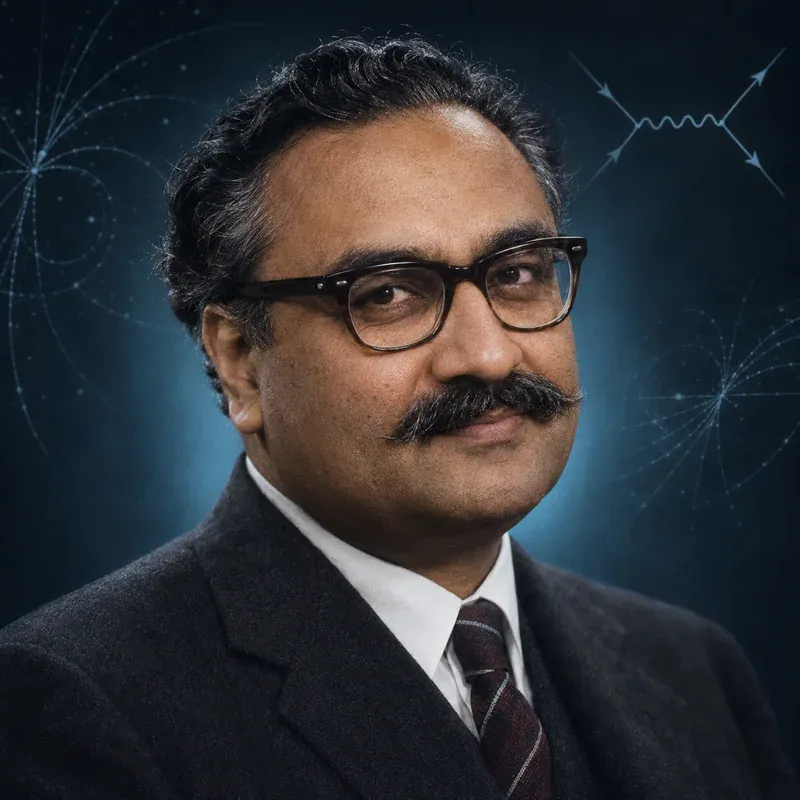
 Illustration
Abdus Salam
In a paper received by Il Nuovo Cimento on 15 November 1956, before the Wu result, Salam linked parity violation to a vanishing neutrino mass: a massless neutrino obeying the two-component (chiral) Weyl equation would naturally violate parity maximally. This was one of the three independent formulations of the two-component neutrino theory (with Landau and Lee-Yang). He later shared the Nobel Prize for the electroweak theory, which predicted the weak neutral current discovered with neutrino beams.
- Born
- 29 January 1926
Jhang, Punjab, British India (now Pakistan) - Died
- 21 November 1996
Oxford, England - Nationality
- Pakistani
- Field
- theoretical physics
- Nobel Prize
- Physics 1979 (shared with S. Glashow and S. Weinberg) – for their contributions to the theory of the unified weak and electromagnetic interaction between elementary particles, including, inter alia, the prediction of the weak neutral current
- Institutions
- University of Cambridge, Imperial College London, International Centre for Theoretical Physics, Trieste (founder 1964), International Centre for Theoretical Physics (ICTP), Trieste
Early life and education
Abdus Salam was born on 29 January 1926 in Jhang, in the Punjab of British India, now Pakistan. He studied at Government College Lahore, completing an MA in mathematics in 1946 with record marks, and then won a scholarship to St John's College, Cambridge, where he took a double first in mathematics and physics in 1949. Under Nicholas Kemmer he worked on the renormalisation of meson theories and earned his PhD with a thesis on developments in quantum field theory. After three years as professor of mathematics in Lahore (1951–1954) he returned to Cambridge as a lecturer and in 1957 became professor of theoretical physics at Imperial College London.
The two-component neutrino
In 1956 Tsung-Dao Lee and Chen-Ning Yang asked whether parity, the symmetry between a process and its mirror image, is conserved in weak interactions. Salam saw a reason why it might fail. If the neutrino is exactly massless, its equation of motion splits into two independent halves, a two-component spinor of the kind Hermann Weyl had written down in 1929. Weyl's equation had been set aside because it is not mirror-symmetric. Salam argued that a massless neutrino described by such an equation exists in only one helicity state, so every weak process involving it would violate parity maximally.
His paper "On parity conservation and neutrino mass" was received by Il Nuovo Cimento on 15 November 1956, before Chien-Shiung Wu's experiment on cobalt-60 demonstrated parity violation, and published in 1957. Lev Landau and Lee and Yang reached the same theory independently. The Goldhaber experiment of 1958 found that neutrinos are left-handed, and the two-component idea was absorbed into the V−A form of the weak interaction. In this picture the neutrino's chirality is linked to its masslessness, which is why the later discovery of neutrino mass requires an extension of the original theory.
Electroweak unification
From 1959 Salam worked with John Ward on unifying the weak and electromagnetic forces in a single gauge theory. Their 1964 model was based on the group SU(2)×U(1), the same structure Sheldon Glashow had proposed in 1961, but the problem of giving masses to the weak bosons remained. After Steven Weinberg's 1967 paper, Salam independently presented a version with spontaneous symmetry breaking through the Higgs mechanism at the Nobel Symposium in Sweden in 1968.
The resulting electroweak theory predicted, besides the W bosons, a heavy neutral Z boson and with it weak neutral currents: processes in which a neutrino scatters without changing into a charged lepton. These were discovered in 1973 with a neutrino beam in the Gargamelle bubble chamber at CERN. Glashow, Salam and Weinberg shared the 1979 Nobel Prize in Physics. Salam was the first Pakistani to receive a Nobel Prize.
Unification of quarks and leptons
In 1974 Salam and Jogesh Pati proposed treating lepton number as a fourth "colour" of quarks, unifying quarks and leptons in the group SU(4)×SU(2)×SU(2). The model is left-right symmetric and contains a right-handed neutrino in each generation, so it naturally accommodates neutrino masses. It became a starting point for left-right symmetric models developed by Rabindra Mohapatra and Goran Senjanović, and for the grand unified theories in which the seesaw mechanism arises.
ICTP and science in developing countries
In 1964 Salam founded the International Centre for Theoretical Physics in Trieste and directed it until 1993. The centre gave physicists from developing countries a place to work and keep in contact with research, and it remains a major centre for neutrino theory. In Pakistan he was scientific adviser to the government from 1960 to 1974 and founding director of the space agency SUPARCO in 1961. In 1974, when parliament declared members of the Ahmadiyya community, to which he belonged, to be non-Muslims, he left Pakistan in protest. His other honours included the Hughes Medal (1964), the Royal Medal (1978) and the Copley Medal (1990).
Salam died in Oxford on 21 November 1996 and was buried in Rabwah, Pakistan, beside his parents.
Known for
- Two-component neutrino and parity violation (1957)
- Founding the ICTP
- Electroweak unification (Glashow–Weinberg–Salam model)
- Pati–Salam model (1974)
Chronology
- 1956Submits two-component neutrino paper (15 November)
- 1957Paper published in Nuovo Cimento
- 1957Two-component neutrino theory
- 1964Founds ICTP in Trieste
- 1968Electroweak model at the Nobel Symposium
- 1974Pati–Salam unification
- 1979Nobel Prize in Physics
Original papers
- A. Salam, On parity conservation and neutrino mass, Nuovo Cimento 5, 299 (1957)DOI 10.1007/BF02812841
- A. Salam, On parity conservation and neutrino mass, Il Nuovo Cimento 5, 299 (1957)
- A. Salam, Weak and electromagnetic interactions, in Elementary Particle Theory (Nobel Symposium No. 8), ed. N. Svartholm, Almqvist & Wiksell, p. 367 (1968)
Experiments
- Goldhaber experiment
- Gargamelle
Connected people
- Chen-Ning Yang
- Goran Senjanović
- Hermann Weyl
- Lev Landau
- Sheldon Lee Glashow
- Steven Weinberg
- Tsung-Dao Lee
- Wolfgang Pauli
- Gerardus 't Hooft
- Jogesh C. Pati
- John Clive Ward
- Julian Seymour Schwinger
- Martinus J. G. Veltman
Frequently asked questions
What did Abdus Salam contribute to neutrino physics?
In 1956–57 he proposed that a massless neutrino is described by a two-component equation and therefore violates parity maximally, one of three independent formulations of the two-component neutrino theory. His electroweak theory predicted the weak neutral currents first seen with neutrino beams, and the Pati–Salam model introduced right-handed neutrinos into unified theories.
Did Abdus Salam win a Nobel Prize?
Yes. He shared the 1979 Nobel Prize in Physics with Sheldon Glashow and Steven Weinberg for the unified theory of weak and electromagnetic interactions, including the prediction of the weak neutral current.
Is the two-component neutrino theory still valid now that neutrinos have mass?
Not exactly. The theory assumed a massless neutrino. The observed left-handedness of neutrinos in weak interactions survives, but oscillations show that neutrinos have small masses, so the Standard Model must be extended, for example with right-handed neutrinos or a Majorana mass term.
On the timeline
Mentioned in 35 pages
Lessons 1
Comparisons 1
Milestones 6
People 16
Last updated: · Editorial standard
Cite this page
Text
Neutrino Atlas (2026). “Abdus Salam”. Retrieved 22 November 2026, from https://neutrino-atlas.com/people/abdus-salam/BibTeX
@misc{neutrinoatlas2026peopleabdussalam,
  title        = {Abdus Salam},
  author       = {{Neutrino Atlas}},
  year         = {2026},
  url          = {https://neutrino-atlas.com/people/abdus-salam/},
  note         = {Accessed 2026-11-22},
  language     = {english}
}