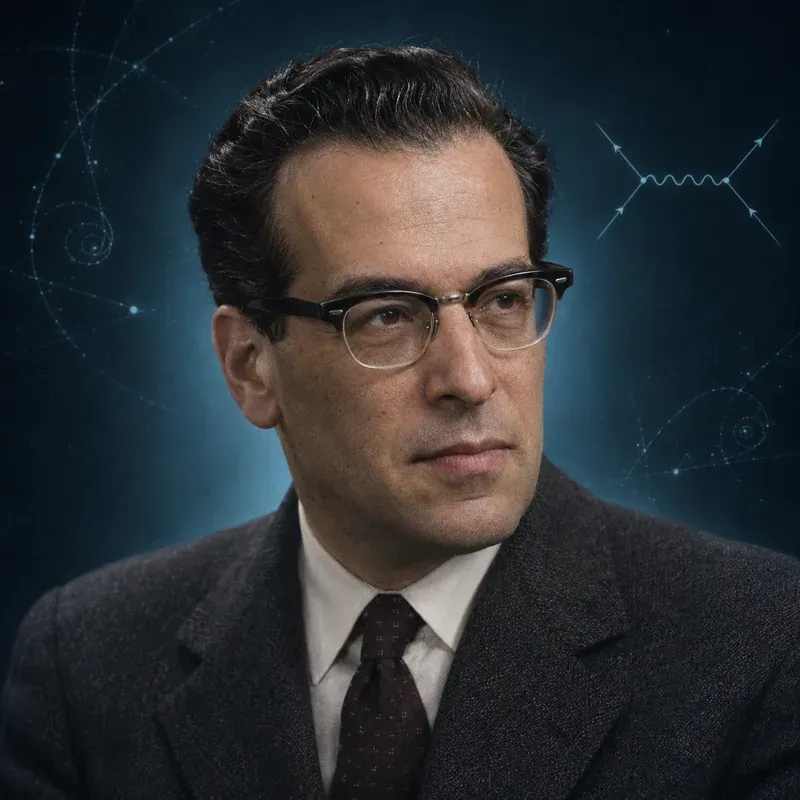
 Illustration
Julian Seymour Schwinger
In his 1957 paper "A theory of the fundamental interactions" Schwinger proposed that the weak interaction is carried by two charged vector bosons that form a family with the photon, an early step towards electroweak unification. The paper also contained the idea that the neutrinos accompanying electrons and muons are different particles and pointed towards the V−A structure of the weak current, although experiments at the time seemed to disfavour it. His student Sheldon Glashow took up the programme, adding a neutral heavy boson, which led to the electroweak theory and the prediction of neutral currents later seen in neutrino scattering.
- Born
- 12 February 1918
New York City, USA - Died
- 16 July 1994
Los Angeles, California, USA - Nationality
- American
- Field
- Theoretical physics (quantum field theory)
- Nobel Prize
- Physics 1965 – "for their fundamental work in quantum electrodynamics, with deep-ploughing consequences for the physics of elementary particles" (shared with Sin-Itiro Tomonaga and Richard P. Feynman)
- Institutions
- Columbia University (PhD 1939), University of California, Berkeley, MIT Radiation Laboratory, Harvard University
Early life and career
Julian Schwinger was born in Manhattan on 12 February 1918. A prodigy, he was writing research papers in his teens and received his PhD from Columbia University in 1939. He then worked with J. Robert Oppenheimer at Berkeley and, during the Second World War, on microwave radar theory at the MIT Radiation Laboratory. In 1947, aged 29, he became a professor at Harvard, where he stayed until he moved to UCLA in 1972. He supervised a large number of doctoral students, among them Sheldon Glashow.
Quantum electrodynamics
Schwinger's best-known achievement is the renormalised formulation of quantum electrodynamics. In 1948 he calculated the first correction to the magnetic moment of the electron, the famous α/2π, in agreement with new measurements. For this work he shared the 1965 Nobel Prize in Physics with Sin-Itiro Tomonaga and Richard Feynman. The methods developed for QED became the template for the later gauge theories of the weak and strong interactions.
A theory of the fundamental interactions
In 1957, the year parity violation was discovered, Schwinger published a long paper in Annals of Physics that tried to describe all known interactions in a single framework. For the weak interaction he replaced Fermi's point-like four-fermion coupling with the exchange of two electrically charged vector bosons, the ancestors of the W boson, and suggested that they belong to one family with the photon. Historians of physics see this as a first step towards electroweak unification; one biographical assessment counts Schwinger, on the basis of this paper, as the grandfather of the Standard Model.
The same paper contains two further ideas important for neutrino physics. One is that the neutrino emitted with an electron and the neutrino emitted with a muon are different particles, the hypothesis later confirmed by the 1962 Brookhaven two-neutrino experiment of Leon Lederman, Melvin Schwartz and Jack Steinberger. The other is a structure of the weak current that corresponds to V−A; Schwinger did not press it because several experiments of the time appeared to contradict it.
Legacy
Schwinger did not complete the electroweak theory himself. He gave Glashow the problem of unifying weak and electromagnetic interactions as a thesis topic, and in 1961 Glashow added a neutral heavy boson, the Z boson, to close the symmetry group. Once Steven Weinberg and Abdus Salam built the Higgs mechanism into it in 1967–68, this became the theory that predicted the neutral currents discovered in neutrino scattering at Gargamelle in 1973. In his later career Schwinger developed his own "source theory" as an alternative formulation of field theory. He died in Los Angeles on 16 July 1994.
Known for
- Renormalised quantum electrodynamics; electron anomalous magnetic moment α/2π
- Intermediate vector boson theory of weak interactions (1957)
- Early suggestion of distinct electron and muon neutrinos
- Doctoral adviser of Sheldon Glashow
- Nobel Prize in Physics 1965
Chronology
- 1939PhD, Columbia University
- 1947Professor at Harvard
- 1948Calculates the electron's anomalous magnetic moment, α/2π
- 1957"A theory of the fundamental interactions": charged weak bosons and two neutrinos
- 1965Nobel Prize in Physics with Tomonaga and Feynman
- 1972Moves to UCLA
Original papers
- J. Schwinger, A theory of the fundamental interactions, Ann. Phys. 2, 407 (1957)DOI 10.1016/0003-4916(57)90015-5
- J. Schwinger, On quantum-electrodynamics and the magnetic moment of the electron, Phys. Rev. 73, 416 (1948)DOI 10.1103/PhysRev.73.416
Connected people
Frequently asked questions
What did Julian Schwinger contribute to neutrino physics?
His 1957 theory of weak interactions mediated by charged vector bosons, with the suggestion of two distinct neutrinos, prepared the ground for the electroweak theory developed by his student Glashow and by Weinberg and Salam.
Why did Schwinger win the Nobel Prize?
For his work on quantum electrodynamics, shared in 1965 with Tomonaga and Feynman.
Mentioned in 1 page
People 1
Last updated: · Editorial standard
Cite this page
Text
Neutrino Atlas (2026). “Julian Seymour Schwinger”. Retrieved 22 November 2026, from https://neutrino-atlas.com/people/julian-schwinger/BibTeX
@misc{neutrinoatlas2026peoplejulianschwinger,
  title        = {Julian Seymour Schwinger},
  author       = {{Neutrino Atlas}},
  year         = {2026},
  url          = {https://neutrino-atlas.com/people/julian-schwinger/},
  note         = {Accessed 2026-11-22},
  language     = {english}
}