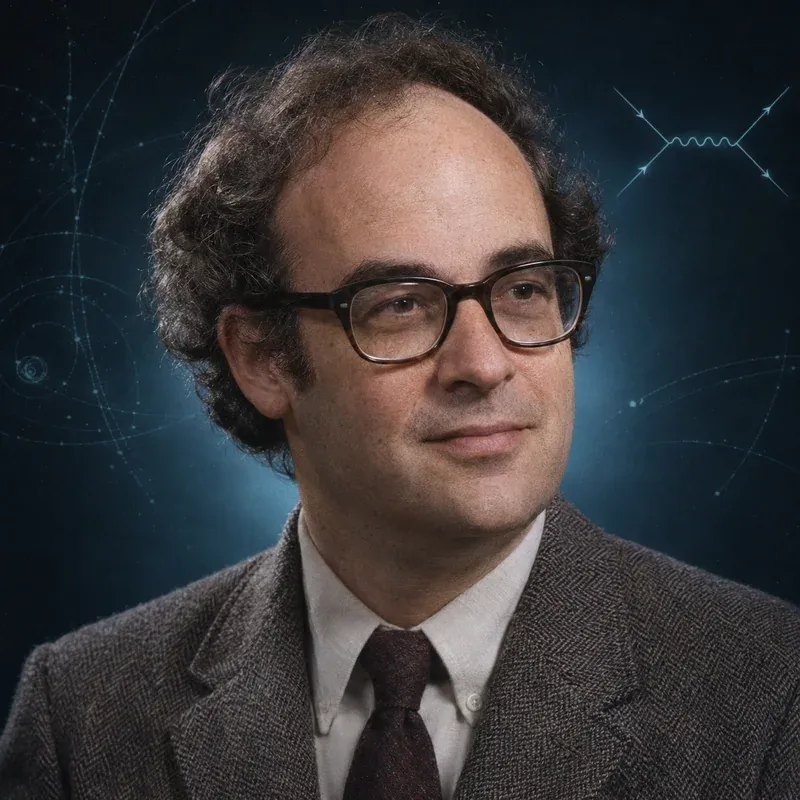
 Illustration
Gerald Feinberg
In 1958 Feinberg showed that if the weak interaction were carried by a charged intermediate boson and there were only one kind of neutrino, the decay μ → eγ would occur through a loop with a branching ratio of order 10⁻⁴, far above what experiments allowed. The absence of the decay therefore suggested that the neutrino coupled to the muon differs from the one coupled to the electron, the two-neutrino hypothesis confirmed at Brookhaven in 1962. With Steven Weinberg he then formulated the conservation of a separate muon number, the forerunner of lepton flavour numbers, and he later studied neutrino electromagnetic properties and forces from neutrino-pair exchange.
- Born
- 27 May 1933
New York City, USA - Died
- 21 April 1992
New York City, USA - Nationality
- American
- Field
- Theoretical particle physics
- Institutions
- Columbia University (PhD 1957), Institute for Advanced Study, Brookhaven National Laboratory, Columbia University
Education and career
Gerald Feinberg was born in New York City on 27 May 1933 and spent almost his whole career at Columbia University, where he received his BA in 1953, his MA in 1954 and his PhD in physics in 1957. After a year as a member of the Institute for Advanced Study in Princeton (1956–1957) and two years as a research associate at Brookhaven National Laboratory, he joined the Columbia faculty in 1959 and became full professor in 1965. He chaired the physics department from 1980 to 1983 and spent 1963–1964 as a Sloan Fellow at Churchill College, Cambridge.
Why μ → eγ pointed to two neutrinos
After the discovery of parity violation in 1957 several theorists, among them Julian Schwinger, proposed that the weak interaction is carried by a heavy charged boson, the later W boson. Feinberg, then at Brookhaven, worked out a consequence. If such a boson existed and there were only one neutrino, a muon could emit a W and a neutrino, the neutrino could reabsorb the W and turn into an electron, and a photon radiated along the way would give the decay μ → eγ. His estimate of the branching ratio was of order 10⁻⁴, while searches had found no such decay.
One way out was that the decay is forbidden because the neutrino produced with a muon, the muon neutrino, is not the same particle as the electron neutrino, so the loop cannot close. This two-neutrino hypothesis, also argued on other grounds by Bruno Pontecorvo and others, was tested in 1962 by Leon Lederman, Melvin Schwartz and Jack Steinberger at Brookhaven, whose accelerator neutrinos produced muons but not electrons (see BNL two-neutrino experiment). Feinberg's calculation is also the starting point of the long series of searches for charged lepton flavour violation, which in the Standard Model with neutrino masses is suppressed far below any experimental reach.
Muon number and beyond
In 1961 Feinberg and Steven Weinberg formulated a "law of conservation of muons". They compared an additive muon number, of the kind now included in the separate lepton flavour numbers, with a multiplicative parity-like version, and showed that the two could be distinguished by processes such as the conversion of muonium into antimuonium. Feinberg also studied the electromagnetic properties of neutrinos and, with Joseph Sucher, the weak long-range force produced by the exchange of neutrino pairs.
He is widely known for his 1967 paper on the possibility of particles that always move faster than light, for which he coined the name tachyons. He also wrote popular books on physics and on the future of science. Feinberg died in New York on 21 April 1992; his obituary in Physics Today was written by T. D. Lee and Joseph Sucher.
Known for
- μ → eγ argument for two distinct neutrinos (1958)
- Law of conservation of muons (with Steven Weinberg, 1961)
- Muonium–antimuonium conversion
- Tachyons: the possibility of faster-than-light particles (1967)
- Long-range forces from neutrino-pair exchange
Chronology
- 1957PhD, Columbia University; Brookhaven research associate (to 1959)
- 1958Shows that μ → eγ would be too frequent with a single neutrino
- 1959Joins the Columbia physics faculty
- 1961"Law of conservation of muons" with Steven Weinberg
- 1967"Possibility of faster-than-light particles" (tachyons)
- 1980Chair of the Columbia physics department (to 1983)
Original papers
- G. Feinberg, Decays of the μ meson in the intermediate-meson theory, Phys. Rev. 110, 1482 (1958)DOI 10.1103/PhysRev.110.1482
- G. Feinberg, S. Weinberg, Law of conservation of muons, Phys. Rev. Lett. 6, 381 (1961)DOI 10.1103/PhysRevLett.6.381
- G. Feinberg, Possibility of faster-than-light particles, Phys. Rev. 159, 1089 (1967)DOI 10.1103/PhysRev.159.1089
Experiments
Connected people
Frequently asked questions
How did Gerald Feinberg contribute to the discovery of the muon neutrino?
His 1958 calculation showed that with a single neutrino and a charged weak boson, μ → eγ would be far too frequent. That pointed to a distinct muon neutrino, found at Brookhaven in 1962.
Did Feinberg invent the word tachyon?
Yes. He introduced the name in his 1967 paper on hypothetical faster-than-light particles.
Last updated: · Editorial standard
Cite this page
Text
Neutrino Atlas (2026). “Gerald Feinberg”. Retrieved 22 November 2026, from https://neutrino-atlas.com/people/gerald-feinberg/BibTeX
@misc{neutrinoatlas2026peoplegeraldfeinberg,
  title        = {Gerald Feinberg},
  author       = {{Neutrino Atlas}},
  year         = {2026},
  url          = {https://neutrino-atlas.com/people/gerald-feinberg/},
  note         = {Accessed 2026-11-22},
  language     = {english}
}