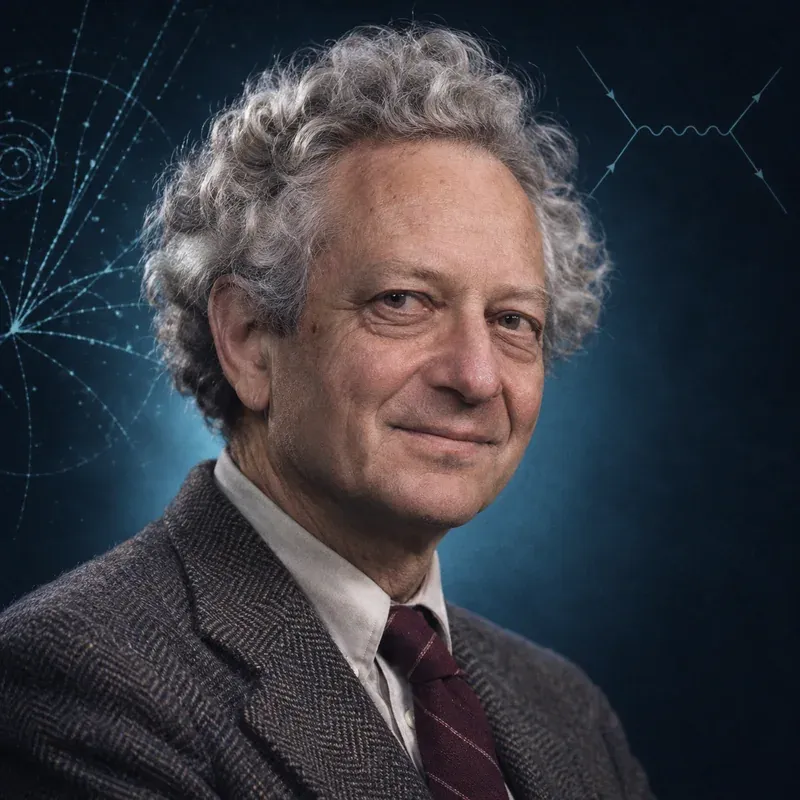
 Illustration
Leon M. Lederman
With Melvin Schwartz and Jack Steinberger, Lederman carried out the 1962 Brookhaven AGS experiment that used the first accelerator neutrino beam. The neutrinos produced in pion decay made muons but not electrons, showing that the muon neutrino is distinct from the electron neutrino and establishing the doublet structure of the leptons.
- Born
- 15 July 1922
New York City, USA - Died
- 3 October 2018
Rexburg, Idaho, USA - Nationality
- American
- Field
- Experimental particle physics
- Nobel Prize
- Physics 1988 – for the neutrino beam method and the demonstration of the doublet structure of the leptons through the discovery of the muon neutrino (shared with Schwartz and Steinberger)
- Institutions
- Columbia University, Fermilab, University of Chicago, Illinois Institute of Technology
Early life and education
Leon Max Lederman was born in New York City in 1922 to Russian-Jewish immigrant parents. He studied chemistry at the City College of New York, graduating in 1943, and then served for three years in the US Army Signal Corps during the Second World War. On his return he entered graduate school at Columbia University, where he received his PhD in 1951 and stayed on the faculty, becoming a full professor in 1958.
Path to neutrino physics
Columbia in the 1950s was a centre of weak-interaction physics, and Lederman was drawn into its most famous question almost at once. In January 1957, within days of hearing about Chien-Shiung Wu’s cobalt-60 result, he, Richard Garwin and Marcel Weinrich used the Columbia cyclotron to show that muons from pion decay are polarized and that their own decay is asymmetric. This was an independent confirmation of parity violation, in a system of pions, muons and neutrinos rather than nuclei, and it introduced Lederman to the physics of the muon and its neutrinos.
Key contributions
By 1960 a puzzle had emerged. If the neutrino emitted together with a muon were the same as the one emitted with an electron, the decay of a muon into an electron and a photon should occur at an observable rate. It was never seen. Perhaps there were two different neutrinos. Testing this required a source of high-energy neutrinos, and Melvin Schwartz proposed creating one at an accelerator: protons hit a target, the pions produced decay in flight into muons and neutrinos, and thick shielding stops everything except the neutrinos.
Lederman, Schwartz and Jack Steinberger, together with Gordon Danby, Jean-Marc Gaillard, Konstantin Goulianos and Nariman Mistry, built this experiment at Brookhaven’s new Alternating Gradient Synchrotron. The beam passed through about 13 metres of steel, much of it armour plate from a scrapped warship, before reaching a 10-tonne aluminium spark chamber. Over months of running, the chamber recorded a few dozen neutrino interactions. In practically all of them a long, penetrating muon track appeared; showers characteristic of electrons were essentially absent. The neutrinos born with muons produced only muons. The result, published in 1962, established the muon neutrino as a particle distinct from the electron neutrino, and with it the conservation of separate lepton flavour numbers. The experiment is described in detail on the page of the Brookhaven two-neutrino experiment.
Just as important was the method. The accelerator neutrino beam became the standard tool for studying neutrino interactions, from Gargamelle at CERN, which discovered neutral currents, to today’s long-baseline experiments NOvA, T2K and DUNE. The 1988 Nobel Prize in Physics honoured Lederman, Schwartz and Steinberger for the neutrino beam method and for demonstrating the doublet structure of the leptons.
Later work
Lederman continued to look for new particles in high-energy collisions. In 1977 his group’s experiment E288 at Fermilab discovered the upsilon meson, a bound state of a new, heavy quark, the bottom quark. A year earlier the same group had reported a resonance that did not survive more data, which colleagues nicknamed the “Oops-Leon”; the upsilon was real and marked the start of the third generation of quarks.
From 1979 to 1989 he directed Fermilab. Under his leadership the laboratory built the Tevatron, then the world’s highest-energy collider, which later discovered the top quark and also delivered neutrino beams, including those of the DONuT experiment that observed the tau neutrino in 2000. He was a prominent advocate of the Superconducting Super Collider.
Science education and legacy
Lederman was widely known as a communicator. His 1993 book The God Particle, written with Dick Teresi, popularised that name for the Higgs boson. He founded the Illinois Mathematics and Science Academy in 1986 and promoted the Physics First curriculum, which teaches physics before chemistry and biology in high school. His honours included the National Medal of Science (1965), the Wolf Prize in Physics (1982) and the Enrico Fermi Award (1992). In 2015 he sold his Nobel medal to help pay medical bills. He died in Rexburg, Idaho, in 2018, at the age of 96.
Known for
- Discovery of the muon neutrino (1962)
- Neutrino beam method
- Director of Fermilab 1979–1989
- Coined the phrase 'God particle'
Chronology
- 1962Two-neutrino experiment at Brookhaven AGS
- 1979Becomes Director of Fermilab (to 1989)
- 1988Nobel Prize in Physics
Original papers
- G. Danby, J.-M. Gaillard, K. Goulianos, L. M. Lederman, N. Mistry, M. Schwartz, J. Steinberger, Observation of High-Energy Neutrino Reactions and the Existence of Two Kinds of Neutrinos, Phys. Rev. Lett. 9, 36 (1962)DOI 10.1103/PhysRevLett.9.36
Experiments
Connected people
Frequently asked questions
What did Leon Lederman discover?
With Melvin Schwartz and Jack Steinberger he showed in 1962 that the muon neutrino is different from the electron neutrino. In 1977 his Fermilab group discovered the upsilon meson, the first evidence of the bottom quark.
Why is the neutrino beam method important?
It produces intense, controllable beams of high-energy neutrinos at accelerators. Almost every study of neutrino interactions and every accelerator oscillation experiment since then has used this technique.
Where does the term “God particle” come from?
It comes from the title of Lederman’s 1993 popular-science book about the Higgs boson, written with Dick Teresi.
On the timeline
- 1957Wu experiment shows parity violation
- 1962Brookhaven experiment discovers the muon neutrino
- 1988Nobel Prize for the muon neutrino
Mentioned in 34 pages
FAQ 3
Milestones 8
- 1956 · Lee and Yang question parity in weak decays
- 1957 · Nobel Prize for Lee and Yang
- 1957 · Wu experiment shows parity violation
- 1960 · Proposals for accelerator neutrino beams
- 1962 · Brookhaven experiment discovers the muon neutrino
- 1975 · Tau lepton discovery implies a third neutrino
- 1988 · Nobel Prize for the muon neutrino
- 2026 · Nobel Prize for Francis Halzen and IceCube
People 13
Last updated: · Editorial standard
Cite this page
Text
Neutrino Atlas (2026). “Leon M. Lederman”. Retrieved 22 November 2026, from https://neutrino-atlas.com/people/leon-lederman/BibTeX
@misc{neutrinoatlas2026peopleleonlederman,
  title        = {Leon M. Lederman},
  author       = {{Neutrino Atlas}},
  year         = {2026},
  url          = {https://neutrino-atlas.com/people/leon-lederman/},
  note         = {Accessed 2026-11-22},
  language     = {english}
}