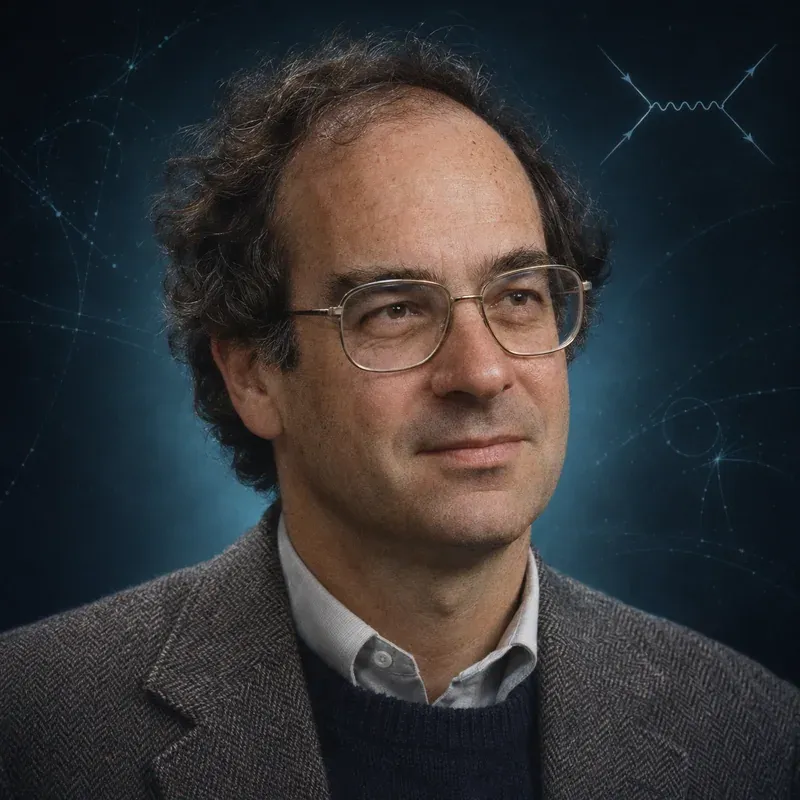
 Illustration
David Norman Schramm
Schramm showed how the primordial abundances of light elements constrain particle physics. Each additional light neutrino species speeds up the expansion of the early Universe, so more neutrons survive and more helium-4 forms; with Gary Steigman and James Gunn he turned the observed helium abundance into an upper limit on the number of neutrino types in 1977. As the abundance data improved, the limit tightened to about four, and the measurement of three light neutrino species from the Z-boson width at SLC and LEP in 1989 confirmed the cosmological argument. He also argued that the baryon density allowed by nucleosynthesis is too small to account for all matter, which made neutrinos and other particles candidates for dark matter.
- Born
- 25 October 1945
St. Louis, Missouri, USA - Died
- 19 December 1997
near Denver, Colorado, USA - Nationality
- American
- Field
- Theoretical astrophysics and cosmology
- Institutions
- Massachusetts Institute of Technology, California Institute of Technology, University of Texas at Austin, University of Chicago
Early life and education
David Norman Schramm was born in St. Louis, Missouri, in 1945. He studied physics at the Massachusetts Institute of Technology and went on to Caltech, where he worked with William Fowler and Gerald Wasserburg on nuclear astrophysics and cosmochronology, the dating of the elements, and received his doctorate in 1971. After a short time on the faculty of the University of Texas at Austin he moved to the University of Chicago, where he stayed for the rest of his career.
Counting neutrinos with helium
Schramm's best-known work turned Big Bang nucleosynthesis into a laboratory for particle physics. In the first minutes after the Big Bang, the ratio of neutrons to protons froze out once the weak reactions that convert one into the other became slower than the expansion of the Universe; this freeze-out fixes how much helium-4 can later form. The expansion rate depends on the total energy density of relativistic particles, and every light neutrino species adds to it. More species mean faster expansion, an earlier freeze-out, more surviving neutrons and therefore more helium.
In 1977 Schramm, Gary Steigman and James Gunn used the observed helium abundance to set an upper limit on the number of neutrino types. Their first bound allowed only a few species beyond those known, at a time when laboratory experiments could not exclude thousands. Throughout the 1980s Schramm and his collaborators refined the analysis with better measurements of helium, deuterium and lithium and of the neutron lifetime, and the limit tightened to about four. In 1989 the SLC at SLAC and the LEP collider at CERN measured the number of light neutrinos directly from the width of the Z boson and found three, in agreement with the cosmological prediction. The comparison became one of the standard examples of how cosmology and particle physics test each other; its modern form is the parameter Neff.
Dark matter and the baryon density
The same calculations fix the density of ordinary matter. The amount of deuterium that survives is very sensitive to the baryon density, and Schramm argued that the value implied by nucleosynthesis was well below the total mass density suggested by galaxy dynamics. Much of the matter in the Universe therefore had to be non-baryonic. With Steigman he explored a hot dark matter universe dominated by massive neutrinos, in a 1981 essay that won the Gravity Research Foundation competition. Neutrinos later turned out to be far too light to be the main component, but the argument for non-baryonic dark matter has held.
Building particle astrophysics
Schramm was an organiser as much as a researcher. With Leon Lederman he started a theoretical astrophysics group at Fermilab that brought astronomers and particle physicists together; with Lederman he also wrote the popular book 'From Quarks to the Cosmos'. He mentored many young researchers in the new field, chaired the Board of Physics and Astronomy of the US National Research Council and was chair of the board of the Aspen Center for Physics from 1992. At the time of his death he was Vice President for Research and Louis Block Distinguished Service Professor at Chicago.
His honours included the Helen B. Warner Prize of the American Astronomical Society (1978), election to the National Academy of Sciences (1986) and the Lilienfeld Prize of the American Physical Society (1993). An experienced pilot, he died on 19 December 1997, aged 52, when the aircraft he was flying alone crashed near Denver on the way to Aspen.
Known for
- Big Bang nucleosynthesis as a probe of particle physics
- Cosmological limit on the number of light neutrino species
- Case for non-baryonic dark matter from the deuterium abundance
- Building the field of particle astrophysics
Chronology
- 1971PhD at Caltech under William Fowler and Gerald Wasserburg
- 1977Limit on the number of neutrino species with Steigman and Gunn
- 1978Helen B. Warner Prize of the American Astronomical Society
- 1986Elected to the US National Academy of Sciences
- 1989SLC and LEP confirm three light neutrino species
- 1993Lilienfeld Prize of the American Physical Society
- 1997Dies in the crash of the aircraft he was piloting
Original papers
- G. Steigman, D. N. Schramm, J. E. Gunn, Cosmological limits to the number of massive leptons, Phys. Lett. B 66, 202 (1977)DOI 10.1016/0370-2693(77)90176-9
- T. P. Walker, G. Steigman, D. N. Schramm, K. A. Olive, H.-S. Kang, Primordial nucleosynthesis redux, Astrophys. J. 376, 51 (1991)DOI 10.1086/170255
- D. N. Schramm, G. Steigman, A neutrino-dominated universe, Gen. Relativ. Gravit. 13, 101 (1981)
Experiments
- LEP
- SLC
Connected people
Frequently asked questions
How can the Big Bang count neutrinos?
Each light neutrino species adds energy density, which speeds up the early expansion. Faster expansion leaves more neutrons and hence more helium-4. Comparing the predicted and observed helium abundance therefore limits the number of light neutrinos.
Was Schramm's prediction confirmed?
Yes. By the late 1980s nucleosynthesis allowed at most about four species, and in 1989 the Z-boson measurements at SLC and LEP found three.
Did Schramm think neutrinos were the dark matter?
He considered massive neutrinos a serious candidate around 1980. Later data showed that neutrinos are too light to make up most of the dark matter, but his argument that most matter is non-baryonic remains part of standard cosmology.
Mentioned in 1 page
People 1
Last updated: · Editorial standard
Cite this page
Text
Neutrino Atlas (2026). “David Norman Schramm”. Retrieved 22 November 2026, from https://neutrino-atlas.com/people/david-schramm/BibTeX
@misc{neutrinoatlas2026peopledavidschramm,
  title        = {David Norman Schramm},
  author       = {{Neutrino Atlas}},
  year         = {2026},
  url          = {https://neutrino-atlas.com/people/david-schramm/},
  note         = {Accessed 2026-11-22},
  language     = {english}
}