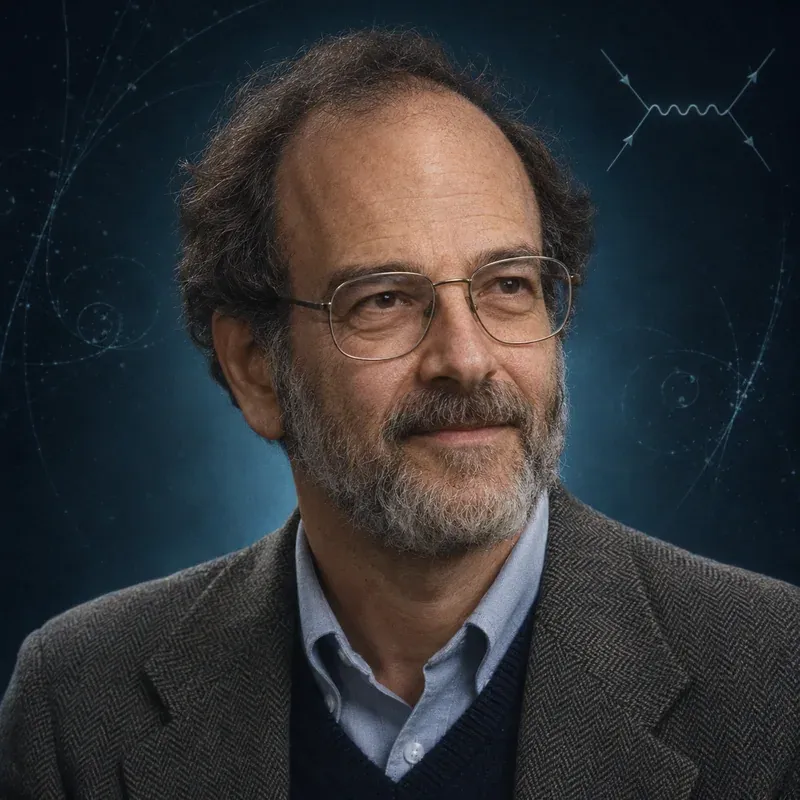
 Illustration
Gary Steigman
In 1977 Steigman, David Schramm and James Gunn showed that the primordial helium-4 abundance limits the number of light neutrino species, because each extra species speeds up the early expansion and leaves more helium. Over the next decade the bound was tightened to fewer than about four species, in agreement with the three found at SLC and LEP in 1989. Steigman continued to refine nucleosynthesis constraints on extra relativistic species, the quantity now expressed as N_eff. With Schramm he also studied a universe dominated by massive neutrinos as hot dark matter.
- Born
- 23 February 1941
New York City, USA - Died
- 9 April 2017
Columbus, Ohio, USA - Nationality
- American
- Field
- Theoretical astrophysics and cosmology
- Institutions
- City College of New York, New York University, Institute of Theoretical Astronomy, Cambridge, California Institute of Technology
Early life and education
Gary Steigman was born in New York City in 1941 and grew up in the Bronx. He studied physics at the City College of New York (BS 1961) and received his doctorate from New York University in 1968 under the astrophysicist Malvin Ruderman. Postdoctoral years at Fred Hoyle's Institute of Theoretical Astronomy in Cambridge and at Caltech brought him into contact with the nuclear astrophysics of the early Universe.
Matter, antimatter and the early Universe
Steigman's first major theme was antimatter. In papers from 1969 and a review in 1976 he examined whether the Universe could contain equal amounts of matter and antimatter in separated regions, and concluded that the absence of annihilation signals rules this out on all observable scales. The Universe must instead carry a small net excess of baryons, about one for every ten billion photons. That number, the matter-antimatter asymmetry, later became the target of baryogenesis and leptogenesis theories, in which neutrinos can play a central part.
Limiting the number of neutrinos
At Yale, where he taught from 1972, Steigman worked with David Schramm and James Gunn on Big Bang nucleosynthesis. Their 1977 paper in Physics Letters B noted that each additional light neutrino species increases the expansion rate a few minutes after the Big Bang. The neutron-to-proton ratio then freezes out earlier, more neutrons survive and more helium-4 is made. Because the observed helium fraction is close to 25 per cent by mass, only a few species could be allowed. Steigman spent much of the following decades refining this bound with improved abundances of helium, deuterium and lithium; by the late 1980s it stood at fewer than about four, and in 1989 the colliders SLC and LEP measured three light neutrino species from the Z width.
He kept returning to the subject as the data improved, treating the number of species as a general measure of extra radiation in the early Universe. In modern language this is the effective number of neutrino species, Neff, which is now constrained by both nucleosynthesis and the cosmic microwave background.
Dark matter and later career
The deuterium abundance fixes the density of ordinary matter, and Steigman and collaborators used it to argue that most matter must be non-baryonic. In a 1981 essay with Schramm, 'A neutrino-dominated Universe', he explored massive neutrinos as hot dark matter; the essay won the 1980 Gravity Research Foundation competition. After a period at the Bartol Research Institute of the University of Delaware he moved to Ohio State University in 1986, where the cosmology group he built grew into the Center for Cosmology and Astro-Particle Physics (CCAPP). He retired in 2012 and died in Columbus in 2017 after a fall on campus.
Known for
- Cosmological limit on the number of neutrino species (1977, with Schramm and Gunn)
- Big Bang nucleosynthesis and the baryon density
- Observational case against matter-antimatter symmetric cosmologies
- Neutrino-dominated (hot dark matter) universe models
Chronology
- 1968PhD at New York University under Malvin Ruderman
- 1972Joins the faculty of Yale University
- 1977Neutrino-species limit with Schramm and Gunn
- 1978Moves to the Bartol Research Institute
- 1986Professor at Ohio State University
- 2012Retires as professor emeritus
Original papers
- G. Steigman, D. N. Schramm, J. E. Gunn, Cosmological limits to the number of massive leptons, Phys. Lett. B 66, 202 (1977)DOI 10.1016/0370-2693(77)90176-9
- D. N. Schramm, G. Steigman, A neutrino-dominated universe, Gen. Relativ. Gravit. 13, 101 (1981)
- T. P. Walker, G. Steigman, D. N. Schramm, K. A. Olive, H.-S. Kang, Primordial nucleosynthesis redux, Astrophys. J. 376, 51 (1991)DOI 10.1086/170255
Experiments
- LEP
Connected people
Frequently asked questions
What is Gary Steigman known for?
Above all for the 1977 cosmological limit on the number of neutrino species, derived with David Schramm and James Gunn from the helium produced in the Big Bang, and for decades of work on Big Bang nucleosynthesis.
Was the nucleosynthesis limit correct?
Yes. It tightened to fewer than about four species before laboratory experiments at SLC and LEP measured exactly three light neutrinos in 1989.
Mentioned in 1 page
People 1
Last updated: · Editorial standard
Cite this page
Text
Neutrino Atlas (2026). “Gary Steigman”. Retrieved 22 November 2026, from https://neutrino-atlas.com/people/gary-steigman/BibTeX
@misc{neutrinoatlas2026peoplegarysteigman,
  title        = {Gary Steigman},
  author       = {{Neutrino Atlas}},
  year         = {2026},
  url          = {https://neutrino-atlas.com/people/gary-steigman/},
  note         = {Accessed 2026-11-22},
  language     = {english}
}