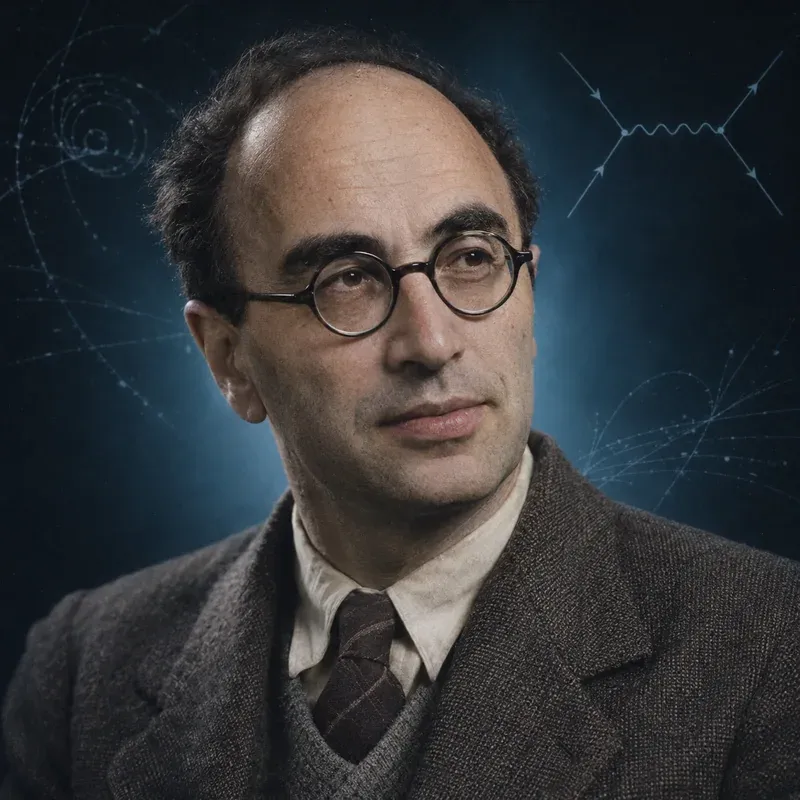
 Illustration
Yakov Borisovich Zeldovich
With Semyon Gershtein, Zeldovich noted the analogy between weak and electromagnetic currents (conserved vector current). In 1966 they made the first cosmological estimate of the relic neutrino density and, from the age and expansion of the universe, bounded the masses of the electron and muon neutrinos to below about 400 eV. In the late 1970s his Moscow group explored neutrinos as the dark matter.
- Born
- 8 March 1914
Minsk, Russian Empire (now Belarus) - Died
- 2 December 1987
Moscow, USSR - Nationality
- Soviet
- Field
- Theoretical physics; cosmology; astrophysics
- Institutions
- Institute of Chemical Physics, Arzamas-16, Institute of Applied Mathematics, Moscow State University / Sternberg Astronomical Institute
Early life and education
Yakov Borisovich Zeldovich was born in Minsk in 1914. He never completed a regular university degree. In 1931 he became a laboratory assistant at the Institute of Chemical Physics in Leningrad and attended physics and mathematics courses at Leningrad University and lectures at the Polytechnic. He received the Candidate of Sciences degree in 1936 for work on adsorption and catalysis, and in 1939 the Doctor of Sciences for work on the oxidation of nitrogen.
From combustion to the bomb
Zeldovich first became known for combustion and detonation theory; the thermal mechanism of nitrogen-oxide formation in flames and the Zeldovich–von Neumann–Döring model of detonation waves carry his name. With Yulii Khariton he analysed the kinetics of nuclear chain reactions in 1939–41. He then became a leading theorist of the Soviet nuclear programme, heading the theoretical department at Arzamas-16 from 1946 and working on the first Soviet atomic test in 1949 and on the hydrogen bomb.
Neutrinos and particle physics
From the early 1950s Zeldovich turned to particle physics. He was among those who, around 1952–53, introduced a conserved lepton number, independently of Emil Konopinski and Hormoz Mahmoud and of George Marx. In 1955, with Semyon Gershtein, he pointed out that the vector part of the weak current might be conserved just like the electromagnetic current, an idea later developed by Feynman and Gell-Mann as the conserved-vector-current hypothesis of V−A theory.
Neutrinos in cosmology
Shortly after the discovery of the cosmic microwave background in 1965, Gershtein and Zeldovich realised that the hot Big Bang must also have left a background of relic neutrinos with a calculable number density. In 1966 they argued that if these neutrinos were heavy, their energy density would slow the cosmic expansion more than the observed age allows, and derived the first cosmological mass bound: below about 400 eV for both the electron and the muon neutrino. For the muon neutrino this was far stronger than laboratory limits of the time. Ramanath Cowsik and J. McClelland sharpened the argument in 1972, and Zeldovich updated it in 1977 with Vysotskii and Alexander Dolgov.
When Valentin Lyubimov's group at ITEP reported in 1980 a non-zero electron-neutrino mass of some tens of eV, Zeldovich's Moscow school developed the scenario of neutrinos as hot dark matter. Because fast neutrinos free-stream out of small density peaks, the first structures would be huge flattened sheets, the 'Zeldovich pancakes', which later fragment into galaxies. Simulations in the early 1980s showed that galaxies would form too late in this picture, and the ITEP mass claim was not confirmed. The physics of free streaming remains central today: it is how cosmological data limit the sum of neutrino masses.
Legacy
Zeldovich's range was unusual. With Rashid Sunyaev he predicted the Sunyaev–Zeldovich effect, the scattering of microwave background photons by hot gas in galaxy clusters; he proposed independently of Salpeter that accretion onto black holes powers quasars, and with Alexei Starobinsky showed that rotating black holes should emit particles. He received the Bruce Medal (1983) and the ICTP Dirac Medal (1985). Stephen Hawking wrote that before meeting him he had suspected Zeldovich was a collective pseudonym, like Bourbaki. Zeldovich died in Moscow in December 1987.
Known for
- Cosmological bound on neutrino mass (Gershtein & Zeldovich 1966)
- Weak–electromagnetic current analogy (CVC) with Gershtein
- Zeldovich pancakes and large-scale structure
- Sunyaev–Zeldovich effect
Chronology
- 1966Gershtein–Zeldovich cosmological neutrino-mass bound
- 1977Updated cosmological bounds with Vysotskii and Dolgov
- 1983Bruce Medal
- 1985ICTP Dirac Medal
Original papers
- S. S. Gershtein, Ya. B. Zeldovich, Rest mass of muonic neutrino and cosmology, JETP Lett. 4, 120 (1966)
Experiments
- Planck
- KATRIN
Connected people
- Alexander Dmitrievich Dolgov
- Ramanath Cowsik
- Semyon Solomonovich Gershtein
- David Norman Schramm
- Gary Steigman
Frequently asked questions
What neutrino mass bound did Zeldovich derive?
With Semyon Gershtein in 1966 he showed that relic neutrinos from the Big Bang would overclose the universe if their masses exceeded about 400 eV. It was the first use of cosmology to limit a particle mass.
What are Zeldovich pancakes?
Flattened sheets of matter that form first when gravitational collapse proceeds faster along one axis. In a universe dominated by hot dark matter such as neutrinos, these large pancakes would be the first structures, with galaxies forming later by fragmentation.
Did Zeldovich receive a Nobel Prize?
No. His awards include four Stalin Prizes, the Lenin Prize, the Bruce Medal and the ICTP Dirac Medal.
On the timeline
Mentioned in 14 pages
Milestones 1
People 8
Last updated: · Editorial standard
Cite this page
Text
Neutrino Atlas (2026). “Yakov Borisovich Zeldovich”. Retrieved 22 November 2026, from https://neutrino-atlas.com/people/yakov-zeldovich/BibTeX
@misc{neutrinoatlas2026peopleyakovzeldovich,
  title        = {Yakov Borisovich Zeldovich},
  author       = {{Neutrino Atlas}},
  year         = {2026},
  url          = {https://neutrino-atlas.com/people/yakov-zeldovich/},
  note         = {Accessed 2026-11-22},
  language     = {english}
}