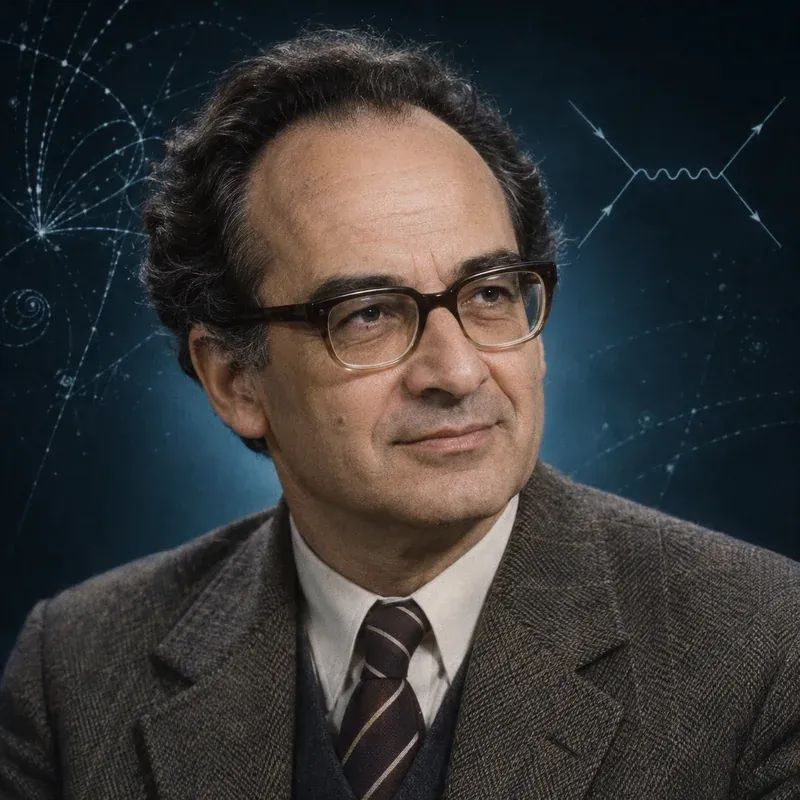
 Illustration
George Marx (Marx György)
Marx was among the first to postulate lepton-charge conservation in the early 1950s. In 1960, with N. Menyhárd, he first pointed out that the Earth is a source of antineutrinos from uranium, thorium and potassium-40 decays and estimated their flux, refining the models in 1969 – predating Eder's 1966 paper. He and his students were also among the first to propose massive neutrinos as dark-matter candidates, and he organised the first neutrino conference in Hungary in 1972.
- Born
- 25 May 1927
Budapest, Hungary - Died
- 2 December 2002
Budapest, Hungary - Nationality
- Hungarian
- Field
- Theoretical physics
- Institutions
- Eötvös Loránd University, Budapest
Education and career
George Marx (Marx György) was born in Budapest on 25 May 1927. He studied physics, mathematics and astronomy at Eötvös Loránd University (ELTE), graduating in 1950, and received his PhD the same year with a thesis on non-static gravitational fields supervised by Károly Novobátzky. He spent his whole career at ELTE, first in theoretical physics and from 1970 in nuclear physics, and became a member of the Hungarian Academy of Sciences in 1970. He took part in the 1956 revolution and was briefly imprisoned in 1957; for decades afterwards foreign travel was difficult for him.
Contributions to neutrino physics
In the early 1950s Marx was among the first to propose that leptons carry a conserved charge, the idea now called lepton number conservation, alongside Yakov Zeldovich and Emil Konopinski with H. M. Mahmoud.
In 1960, with N. Menyhárd, he was the first to point out that the Earth is a source of antineutrinos from the beta decays of uranium and thorium daughters and of potassium-40, and to estimate the flux at the surface. In 1969 he compared several models of how these elements are distributed and noted that inverse beta decay could detect them. These geoneutrinos were first observed by KamLAND in 2005 and by Borexino in 2010; they now measure the Earth's radiogenic heat. His work predates Gernot Eder's 1966 paper on the same subject.
Marx and his students were also among the first to consider massive neutrinos as dark matter. In 1976 Alex Szalay and Marx derived a cosmological upper limit on neutrino masses and suggested that neutrinos of about 10 eV could account for the missing mass in galaxy clusters, an early version of hot dark matter. In 1972 he organised the first neutrino conference in Hungary, which for about a decade served as a meeting point for physicists from both sides of the Iron Curtain.
Physics education
Marx is equally remembered as a reformer of physics teaching. He argued that school curricula should include quantum physics, nuclear physics and statistical ideas, used computer simulations early and founded the Danube Seminars for teachers from East and West. In 2001 he became the first non-British recipient of the Institute of Physics' Bragg Medal. He died in Budapest on 2 December 2002.
Known for
- Early postulate of lepton-number (lepton-charge) conservation (1950s)
- First estimate of the Earth's antineutrino (geoneutrino) flux (1960, with N. Menyhárd)
- Massive neutrinos as dark matter candidates
- Physics education (IOP Bragg Medal 2001)
- Organiser of the first Hungarian neutrino conference (1972)
Chronology
- 1950Degree and PhD, Eötvös Loránd University
- 1953Kossuth Prize
- 1960Marx & Menyhárd: Earth as antineutrino source
- 1969'Geophysics by neutrinos' (Czech. J. Phys.)
- 1972Organises first neutrino conference in Hungary
- 2001IOP Bragg Medal
Original papers
- G. Marx and N. Menyhárd, Mitteilungen der Sternwarte Budapest 48 (1960)
- G. Marx, Geophysics by neutrinos, Czech. J. Phys. B 19, 1471 (1969)
Connected people
Frequently asked questions
Who first predicted geoneutrinos?
George Marx and N. Menyhárd in 1960 were the first to point out that radioactive decays inside the Earth produce a measurable antineutrino flux and to estimate it.
Did Marx propose neutrinos as dark matter?
Yes. In 1976 he and Alex Szalay suggested that neutrinos with masses around 10 eV could make up the missing mass in galaxy clusters, while also deriving a cosmological mass limit.
On the timeline
Mentioned in 9 pages
Last updated: · Editorial standard
Cite this page
Text
Neutrino Atlas (2026). “George Marx (Marx György)”. Retrieved 22 November 2026, from https://neutrino-atlas.com/people/george-marx/BibTeX
@misc{neutrinoatlas2026peoplegeorgemarx,
  title        = {George Marx (Marx György)},
  author       = {{Neutrino Atlas}},
  year         = {2026},
  url          = {https://neutrino-atlas.com/people/george-marx/},
  note         = {Accessed 2026-11-22},
  language     = {english}
}