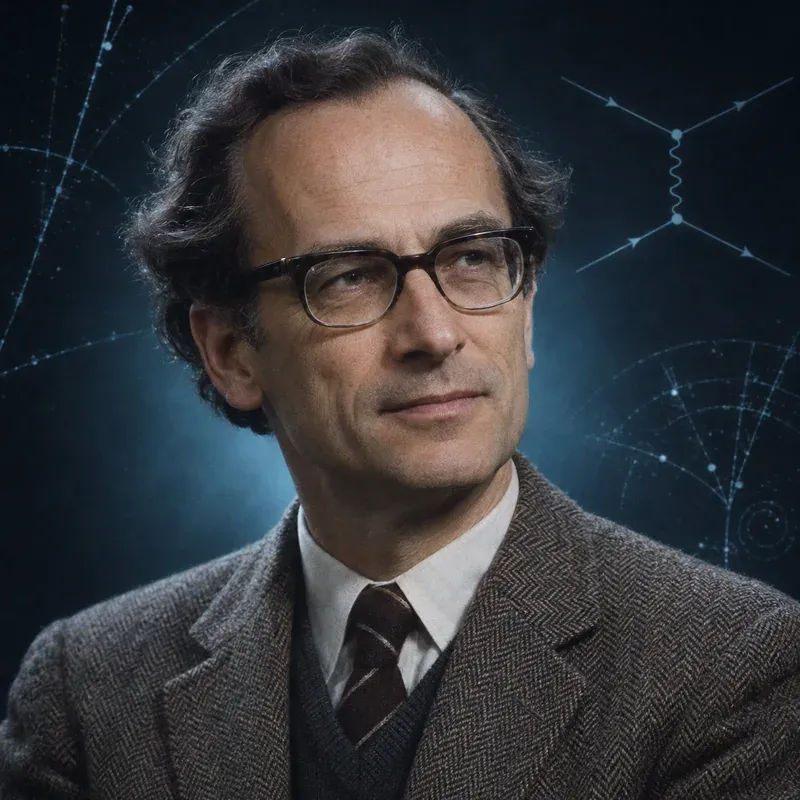
 Illustration
Gernot Eder
In 'Terrestrial neutrinos' (1966) Eder linked the Earth's radiogenic heat to its evolution, estimated a geoneutrino flux about two orders of magnitude above Marx and Menyhárd's 1960 estimate, and proposed inverse beta decay on protons as the detection reaction – the method by which KamLAND (2005) and Borexino (2010) later observed geoneutrinos.
- Born
- 9 May 1929
Vienna, Austria - Died
- 9 November 2000
Vienna, Austria - Nationality
- Austrian
- Field
- Theoretical nuclear physics
- Institutions
- University of Giessen, Vienna University of Technology (Atominstitut)
Career
Gernot Eder was born in Vienna on 9 May 1929 and died there on 9 November 2000. He was a theoretical physicist who lectured on theoretical physics in Vienna from 1957, held a professorship of theoretical physics at the University of Giessen in Germany from 1963 to 1971, and was then professor of atomic physics at the Vienna University of Technology until 1997, where he chaired the Atominstitut of the Austrian universities. He was also known to students through his textbooks 'Elektrodynamik' (1967), 'Quantenmechanik' (1968) and 'Atomphysik' (1978).
Terrestrial neutrinos
Eder's lasting contribution to neutrino physics is a single paper, 'Terrestrial neutrinos', published in Nuclear Physics in 1966. The Earth radiates about 47 terawatts of heat into space, and a large part of it is radiogenic heat from the decay of uranium, thorium and potassium-40 in the crust and mantle. Each of these decay chains contains beta decays that emit electron antineutrinos. Measuring these geoneutrinos would therefore tell us how much radioactive material the planet contains, something no rock sample from the surface can determine for the deep interior.
Hungarian physicists George Marx and N. Menyhárd had raised the idea in 1960. Eder linked the antineutrino flux more closely to the Earth's heat budget and thermal evolution, arrived at an estimate about a hundred times higher than theirs, and proposed a practical way to detect it: inverse beta decay on free protons, the same reaction Cowan and Reines had used to discover reactor antineutrinos. Because that reaction has a threshold of 1.8 MeV, only the higher-energy antineutrinos from the uranium and thorium chains can be seen, while those from potassium-40 remain out of reach.
Legacy
Eder's suggestion was confirmed almost four decades later. In 2005 KamLAND, a large liquid scintillator detector in Japan with Kunio Inoue among its leading members, reported the first evidence for geoneutrinos, and in 2010 Borexino in Italy observed them with very low background. Both used exactly the inverse-beta-decay channel Eder had proposed. Their measurements now constrain the radiogenic share of the Earth's heat flow, and JUNO is expected to improve them further.
Known for
- 'Terrestrial neutrinos' (1966): geoneutrino flux and detection by inverse beta decay
Chronology
- 1957Lecturer in theoretical physics, University of Vienna
- 1963Professor of theoretical physics, University of Giessen
- 1966Publishes 'Terrestrial neutrinos'
- 1971Professor of atomic physics, TU Wien (to 1997)
Original papers
- G. Eder, Terrestrial neutrinos, Nucl. Phys. 78, 657 (1966)
Experiments
Connected people
Frequently asked questions
What are geoneutrinos?
Electron antineutrinos produced in the radioactive decay of uranium, thorium and potassium inside the Earth. Their flux reveals how much of the planet's internal heat comes from radioactivity.
Who first proposed detecting geoneutrinos?
George Marx and N. Menyhárd discussed the idea in 1960. Gernot Eder's 1966 paper refined the flux estimate and proposed inverse beta decay on protons as the detection method later used by KamLAND and Borexino.
On the timeline
Mentioned in 7 pages
Last updated: · Editorial standard
Cite this page
Text
Neutrino Atlas (2026). “Gernot Eder”. Retrieved 22 November 2026, from https://neutrino-atlas.com/people/gernot-eder/BibTeX
@misc{neutrinoatlas2026peoplegernoteder,
  title        = {Gernot Eder},
  author       = {{Neutrino Atlas}},
  year         = {2026},
  url          = {https://neutrino-atlas.com/people/gernot-eder/},
  note         = {Accessed 2026-11-22},
  language     = {english}
}