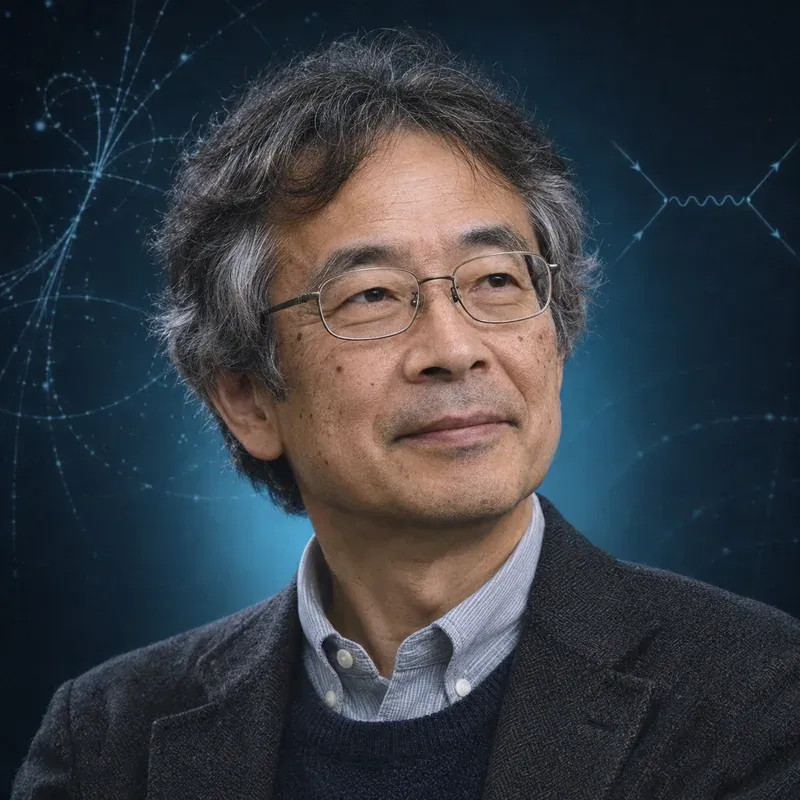
 Illustration
Kunio Inoue
As KamLAND spokesperson, Inoue led the 2005 first observation of geoneutrinos, antineutrinos from uranium and thorium decay inside the Earth. In 2011 KamLAND used geoneutrinos to estimate Earth's radiogenic heat at about 21 ± 9 TW, roughly half the measured surface heat flow, establishing 'neutrino geophysics'. He also leads the search for neutrinoless double beta decay with xenon-loaded KamLAND (KamLAND-Zen).
- Nationality
- Japanese
- Field
- Experimental neutrino physics
- Institutions
- Tohoku University (Research Center for Neutrino Science), Kavli IPMU, University of Tokyo
Path to neutrino physics
Kunio Inoue is an experimental particle physicist at Tohoku University in Sendai, where he is a professor and director of the Research Center for Neutrino Science, and a Principal Investigator at the Kavli Institute for the Physics and Mathematics of the Universe (Kavli IPMU) of the University of Tokyo. His career has been tied to the Kamioka mine in Gifu Prefecture, the underground laboratory that hosted Kamiokande, Super-Kamiokande and KamLAND. He shared the 1998 Asahi Prize awarded to the Super-Kamiokande group for the evidence that neutrinos have mass.
KamLAND, the Kamioka Liquid-scintillator Anti-Neutrino Detector, was built in the cavern of the original Kamiokande about 1,000 metres underground. Its heart is 1,000 tonnes of liquid scintillator in a nylon balloon, watched by large photomultipliers. It records electron antineutrinos through inverse beta decay, identified by the delayed coincidence of a positron flash and a neutron capture. Its first purpose was to watch reactor antineutrinos from Japan's nuclear power plants; its 2002 result confirmed the large-mixing-angle solution of the solar neutrino problem. Inoue became the experiment's spokesperson after these first reactor results.
Key contributions
Inoue's best-known work turned a particle detector into an instrument for Earth science. Uranium and thorium decay chains inside the planet emit electron antineutrinos, called geoneutrinos. Most of them lie below the inverse-beta-decay threshold of 1.8 MeV, and those above it compete with a much larger flux of reactor antineutrinos, so detecting them required a very good understanding of backgrounds and calibration. In 2005 the KamLAND collaboration reported the first experimental investigation of geologically produced antineutrinos in Nature.
In 2011 KamLAND published in Nature Geoscience a partial radiogenic heat model of the Earth. The measured geoneutrino flux implied that the decay of uranium and thorium generates about 21 ± 9 terawatts, roughly half of the total heat flow of about 47 terawatts measured at the surface. The result supports the view that the Earth still releases primordial heat from its formation and is slowly cooling. The Nishina Foundation called the accompanying model of the Earth's composition a first step toward neutrino geophysics and the study of radiogenic heat.
Inoue also helped turn KamLAND into a search for neutrinoless double beta decay. In KamLAND-Zen, a smaller balloon filled with xenon-loaded scintillator enriched in xenon-136 sits inside the detector. In 2016 the collaboration reported a half-life limit above 1.07 × 10²⁶ years, corresponding to an effective Majorana mass below about 61–165 meV, which reached into the region predicted for the inverted mass ordering. Inoue has explained that the aim is to learn whether neutrinos are Majorana or Dirac particles.
Recognition
Inoue received the JSPS Prize in 2008 and the Nishina Memorial Prize in 2012 for the geoneutrino observations and their use in estimating the Earth's heat budget. The idea that the Earth glows in antineutrinos goes back to theorists such as Gernot Eder and George Marx; KamLAND itself was built under Atsuto Suzuki.
In his own words
In a Tohoku University profile Inoue summarised his motivation: “Understanding the properties of neutrinos is understanding the universe.” On the geoneutrino programme he added: “We can thus use neutrinos in tests to see through and into things.”
Known for
- KamLAND spokesperson
- First observation of geoneutrinos (2005)
- Estimate of Earth's radiogenic heat
- KamLAND-Zen double beta decay search
- Nishina Memorial Prize 2012
Chronology
- 1998Asahi Prize (neutrino mass)
- 2005First observation of geoneutrinos
- 2011Geoneutrino estimate of Earth's radiogenic heat
- 2012Nishina Memorial Prize
Original papers
- KamLAND Collaboration (T. Araki et al.), Experimental investigation of geologically produced antineutrinos with KamLAND, Nature 436, 499 (2005)DOI 10.1038/nature03980
- KamLAND Collaboration, Partial radiogenic heat model for Earth revealed by geoneutrino measurements, Nature Geoscience 4, 647 (2011)DOI 10.1038/ngeo1205
Experiments
Connected people
Frequently asked questions
What did Kunio Inoue discover?
As part of the KamLAND collaboration, which he later led as spokesperson, he was central to the first observation of geoneutrinos in 2005, antineutrinos from uranium and thorium decay inside the Earth. The 2011 follow-up showed that radioactivity supplies only about half of the Earth's surface heat flow.
What is KamLAND-Zen?
KamLAND-Zen is a modification of the KamLAND detector in which xenon-136 dissolved in scintillator is placed in an inner balloon to search for neutrinoless double beta decay. It is among the most sensitive experiments of its kind.
Which prizes has Inoue received?
The 1998 Asahi Prize (shared with the Super-Kamiokande group), the JSPS Prize (2008) and the Nishina Memorial Prize (2012).
On the timeline
- 2005KamLAND detects geoneutrinos
- 2016KamLAND-Zen pushes 0νββ limits beyond 10²⁶ years
- 2023KamLAND-Zen 800 reaches 2.3 × 10²⁶ years
- 2024KamLAND-Zen's complete data set tightens the Majorana bound
Mentioned in 11 pages
Milestones 4
Terms 2
Last updated: · Editorial standard
Cite this page
Text
Neutrino Atlas (2026). “Kunio Inoue”. Retrieved 22 November 2026, from https://neutrino-atlas.com/people/kunio-inoue/BibTeX
@misc{neutrinoatlas2026peoplekunioinoue,
  title        = {Kunio Inoue},
  author       = {{Neutrino Atlas}},
  year         = {2026},
  url          = {https://neutrino-atlas.com/people/kunio-inoue/},
  note         = {Accessed 2026-11-22},
  language     = {english}
}