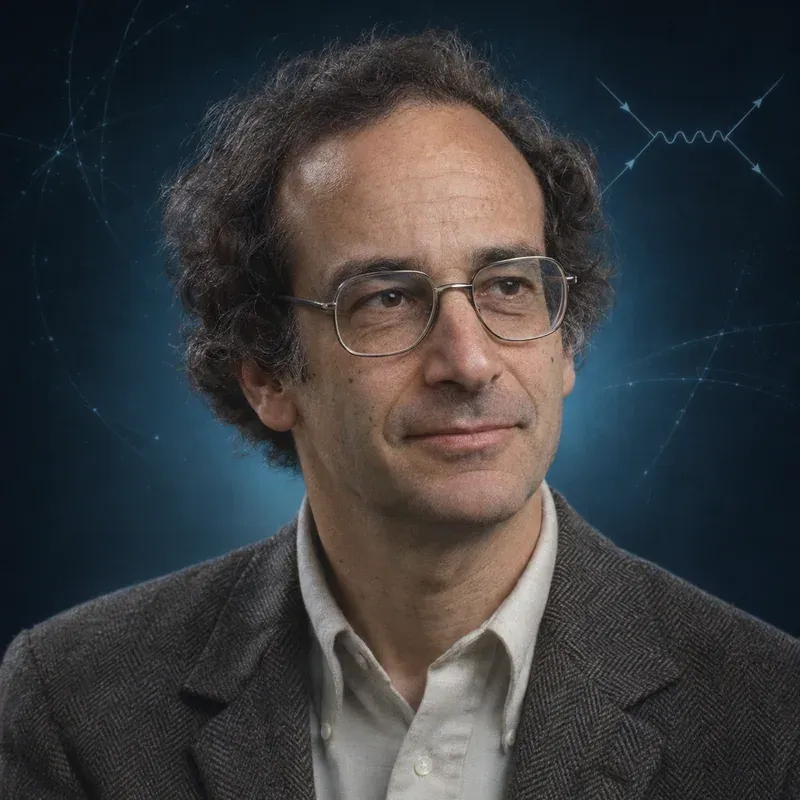
 Illustration
Stuart Jay Freedman
Freedman led the US participation in KamLAND, the reactor antineutrino experiment in the Kamioka mine, and was its American co-spokesperson from 1998. In 2002–03 KamLAND showed that electron antineutrinos from Japanese reactors about 180 km away disappear, which singled out the large-mixing-angle solution of the solar neutrino problem, and later data revealed the oscillatory dependence on L/E. KamLAND also made the first observation of geoneutrinos from radioactive decays inside the Earth. Earlier, his group's beta-spectrum measurement had found no sign of the claimed 17 keV neutrino, and at his death he was US spokesperson of the double-beta-decay experiment CUORE.
- Born
- 13 January 1944
Los Angeles, California, USA - Died
- 9 November 2012
Santa Fe, New Mexico, USA - Nationality
- American
- Field
- Experimental nuclear physics
- Institutions
- University of California, Berkeley, Princeton University, Stanford University, Argonne National Laboratory
Early life and education
Stuart Jay Freedman was born in Los Angeles in 1944 and studied at the University of California, Berkeley (BS 1965, PhD 1972). He began graduate school as a theorist but moved into experimental atomic physics under Eugene Commins. His thesis experiment, proposed to him by John Clauser, was one of the first tests of Bell's inequality: using pairs of photons from a calcium atomic cascade, Freedman and Clauser found correlations that agreed with quantum mechanics and violated the prediction of local hidden-variable theories by six standard deviations. The experiment was among the works cited for the 2022 Nobel Prize in Physics awarded to Clauser and others.
Weak interactions in nuclei
After positions at Princeton and Stanford, Freedman joined Argonne National Laboratory and the University of Chicago in 1982 and moved to Berkeley in 1991, where he led the Weak Interaction Group of the Nuclear Science Division. Much of his work used beta decay as a precision tool. He searched for second-class currents, measured the ratio of axial to vector coupling of the free neutron, and excluded very light Higgs bosons and other exotic particles. In the early 1990s several experiments reported a kink in beta spectra that seemed to indicate a heavy neutrino of 17 keV mixed with the electron neutrino. Freedman's group measured the spectrum of sulfur-35 with a silicon detector and checked its sensitivity by mixing in a carbon-14 source that produced an artificial kink. They saw no effect, and the claim faded.
KamLAND
In 1998 Freedman and Giorgio Gratta became American co-spokespersons of KamLAND, the 1,000-tonne liquid scintillator detector built under the leadership of Atsuto Suzuki in the cavern of the old Kamiokande. Japan's power reactors lie at a flux-weighted average distance of about 180 km, ideal for probing the solar mass splitting Δm²₂₁ with reactor antineutrinos. The first results, announced in December 2002, showed a clear deficit. Together with the solar measurements this identified the large-mixing-angle solution of the solar neutrino problem. Later data showed the oscillation pattern as a function of L/E, and in 2005 KamLAND reported the first evidence for geoneutrinos. Colleagues described the experiment as one of his proudest achievements.
Later work and honours
Freedman also served as US spokesperson for the CUORE search for neutrinoless double beta decay at Gran Sasso and was involved in KamLAND-Zen. He co-chaired the American Physical Society's multi-divisional neutrino study 'The Neutrino Matrix' and a National Academies decadal survey of nuclear physics. He was elected to the National Academy of Sciences in 2001 and received the APS Tom W. Bonner Prize in 2007. He died suddenly in November 2012 while attending a conference in Santa Fe; the APS later named its Stuart Jay Freedman Award in Experimental Nuclear Physics after him.
Known for
- Freedman–Clauser test of Bell's inequality (1972)
- US co-spokesperson of KamLAND
- Refutation of the 17 keV neutrino claim
- US spokesperson of CUORE
- Precision tests of the weak interaction in nuclear beta decay
Chronology
- 1972PhD at Berkeley; Freedman–Clauser Bell test
- 1991Joins UC Berkeley and Lawrence Berkeley Laboratory
- 1993Beta-spectrum measurement rules out a 17 keV neutrino
- 1998Becomes US co-spokesperson of KamLAND
- 2002KamLAND reports reactor antineutrino disappearance
- 2007Tom W. Bonner Prize in Nuclear Physics
Original papers
- KamLAND Collaboration (K. Eguchi et al.), First results from KamLAND: evidence for reactor antineutrino disappearance, Phys. Rev. Lett. 90, 021802 (2003)DOI 10.1103/PhysRevLett.90.021802
- S. J. Freedman, J. F. Clauser, Experimental test of local hidden-variable theories, Phys. Rev. Lett. 28, 938 (1972)DOI 10.1103/PhysRevLett.28.938
Experiments
Connected people
Frequently asked questions
What was Stuart Freedman's role in KamLAND?
He organised the US participation and was the American co-spokesperson from 1998. KamLAND's reactor antineutrino data established the large-mixing-angle oscillation solution and recorded the first geoneutrinos.
What was the 17 keV neutrino?
A claimed heavy neutrino state, suggested by kinks in several beta spectra around 1990. Freedman's carefully calibrated measurement found no such kink, and the claim was abandoned.
Last updated: · Editorial standard
Cite this page
Text
Neutrino Atlas (2026). “Stuart Jay Freedman”. Retrieved 22 November 2026, from https://neutrino-atlas.com/people/stuart-freedman/BibTeX
@misc{neutrinoatlas2026peoplestuartfreedman,
  title        = {Stuart Jay Freedman},
  author       = {{Neutrino Atlas}},
  year         = {2026},
  url          = {https://neutrino-atlas.com/people/stuart-freedman/},
  note         = {Accessed 2026-11-22},
  language     = {english}
}