Laboratori Nazionali del Gran Sasso (LNGS)
Italy's INFN laboratory under the Gran Sasso massif, the largest underground research centre in the world.
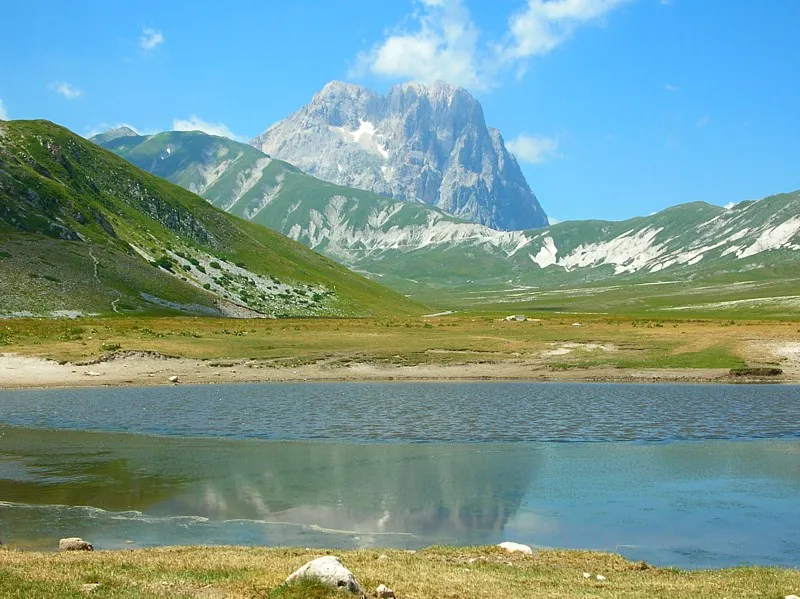
LNGS has three large experimental halls beside the A24 motorway tunnel, under about 1400 m of rock (about 3800 m.w.e.). It hosted GALLEX/GNO, Borexino, OPERA, ICARUS (CNGS phase), Heidelberg–Moscow, GERDA and CUORE, and today hosts LEGEND-200, CUORE/CUPID and the XENONnT dark matter experiment.
- 1Boulby Underground LaboratoryUnderground laboratory
- 2Laboratorio Subterráneo de Canfranc (LSC)Underground laboratory
- 3Laboratoire Souterrain de Modane (LSM)Underground laboratory
- 4Laboratori Nazionali del Gran Sasso (LNGS)Underground laboratory
- 5KM3NeTNeutrino telescope
- 6Neutrino Energy Group, BerlinNeutrinovoltaic research
- 7Baksan Neutrino ObservatoryUnderground laboratory
- 8Baikal-GVDNeutrino telescope
- 9China Jinping Underground Laboratory (CJPL)Underground laboratory
- 10JUNOReactor experiment
- 11Kamioka ObservatoryUnderground laboratory
- 12SNOLABUnderground laboratory
- 13Sanford Underground Research Facility (SURF)Underground laboratory
- 14IceCube Neutrino ObservatoryNeutrino telescope
Compare all experiments → · World map →
In plain words
Halfway through the 10 km motorway tunnel that crosses the Gran Sasso, Italy's highest Apennine massif, a side road leads to three enormous halls carved into the limestone. This is the Laboratori Nazionali del Gran Sasso, run by the Italian National Institute for Nuclear Physics (INFN). Scientists can drive in by car, and trucks can bring in large detector components, while some 1400 m of rock overhead keep most cosmic rays out.
The laboratory
The laboratory was proposed in 1979 by Antonino Zichichi, built alongside the motorway tunnel and opened for experiments in 1987. Each of the three main halls is about 100 m long, 20 m wide and 18 m high. The overburden of about 3800 m.w.e. reduces the muon flux by about a factor of a million, to roughly one muon per square metre per hour. Surface buildings at Assergi house offices, workshops and computing.
Key results
- GALLEX and GNO (1991–2003) measured pp neutrinos from the Sun with gallium, led by Till Kirsten.
- Borexino (2007–2021) measured the solar spectrum in real time, from ⁷Be to the first detection of CNO neutrinos, and observed geoneutrinos.
- OPERA and ICARUS recorded the CNGS beam from CERN; OPERA observed tau-neutrino appearance.
- Heidelberg–Moscow, GERDA, CUORE and now LEGEND-200 have set leading limits on neutrinoless double beta decay.
- The LVD detector has watched for galactic supernovae since 1992 as part of SNEWS.
LNGS also hosts dark matter searches such as XENONnT and DAMA/LIBRA, and the LUNA underground accelerator, which measures the nuclear reaction rates that feed into the standard solar model.
Why it matters for neutrino physics
Its size and road access made LNGS the natural home for large, long-running detectors and for the only European long-baseline beam. Few places have contributed as broadly, across solar, accelerator and double beta decay physics.
Frequently asked questions
How deep is Gran Sasso?
About 1400 m of limestone, equivalent to about 3800 m of water.
Can the public visit the laboratory?
LNGS runs guided visits for schools and groups on request, organised through its outreach office.
Related terms
People
- Ettore Fiorini
- Gianpaolo Bellini
- Hans Volker Klapdor-Kleingrothaus
- Till A. Kirsten
- Antonino Zichichi
- Antonio Ereditato
- Frank Paul Calaprice
- Stefan Schönert
- Wolfgang Hampel
On the timeline
- 1992GALLEX observes solar pp neutrinos
- 2007Borexino measures beryllium-7 solar neutrinos in real time
- 2010Borexino confirms geoneutrinos
- 2010OPERA sees the first tau from oscillation
- 2013GERDA Phase I disfavours the Klapdor claim
- 2014Borexino measures pp neutrinos spectroscopically
- 2020Borexino detects neutrinos from the CNO cycle
- 2020GERDA's final limit on 0νββ of germanium-76
- 2022CUORE sets a tonne-scale bolometer limit
- 2025CUORE completes two tonne-years without a signal
Mentioned in 100 pages
Lessons 6
FAQ 4
Milestones 18
- 1966 · Antineutrinos from Earth's interior proposed
- 1967 · Germanium detector searches for 0νββ
- 1977 · Rubbia proposes the liquid-argon TPC
- 1992 · GALLEX observes solar pp neutrinos
- 2000 · DONUT observes the tau neutrino
- 2005 · KamLAND detects geoneutrinos
- 2007 · Borexino measures beryllium-7 solar neutrinos in real time
- 2010 · Borexino confirms geoneutrinos
10 more
- 2010 · OPERA sees the first tau from oscillation
- 2011 · OPERA neutrino-speed anomaly and its resolution
- 2013 · GERDA Phase I disfavours the Klapdor claim
- 2014 · Borexino measures pp neutrinos spectroscopically
- 2015 · OPERA establishes tau-neutrino appearance
- 2020 · Borexino detects neutrinos from the CNO cycle
- 2020 · GERDA's final limit on 0νββ of germanium-76
- 2022 · CUORE sets a tonne-scale bolometer limit
- 2024 · Dark-matter detectors see solar neutrino CEvNS
- 2025 · CUORE completes two tonne-years without a signal
People 24
- Antonino Zichichi
- Antonio Ereditato
- Arthur B. McDonald
- Barry C. Barish
- Carl Friedrich von Weizsäcker
- Carlo Rubbia
- David Bruce Cline
- Ettore Fiorini
16 more
- Frank Paul Calaprice
- Gianpaolo Bellini
- Hans Volker Klapdor-Kleingrothaus
- Kate Scholberg
- Kimio Niwa
- Lawrence R. Sulak
- Luciano Maiani
- Nicola Cabibbo
- Rudolf Ludwig Mössbauer
- Stanislav Pavlovich Mikheyev
- Stefan Schönert
- Stuart Jay Freedman
- Till A. Kirsten
- Vadim Alekseevich Kuzmin
- Veniamin Sergeevich Berezinsky
- Wolfgang Hampel
Terms 48
- Accelerator Long-baseline experiments
- Accelerator neutrino beams
- Appearance measurement
- Artificial radioactive neutrino sources
- Baseline
- Beryllium-7 neutrinos
- Beta beam
- Borexino
40 more
- CERN West Area Neutrino Facility (WANF)
- CNGS (CERN Neutrinos to Gran Sasso)
- Cosmic-ray muons
- Cryogenic bolometers
- CUORE
- Cuoricino
- CUPID
- CUPID-Mo
- GALLEX / GNO
- Gallium–Germanium method
- Geoneutrinos
- GERDA
- HALO
- Heidelberg–Moscow Experiment
- High-purity germanium detectors
- ICARUS
- Laboratoire Souterrain de Modane (LSM)
- Laboratorio Subterráneo de Canfranc (LSC)
- LEGEND
- Liquid argon time projection chamber
- LVD (Large Volume Detector)
- MACRO
- Major neutrino beamlines
- MAJORANA Demonstrator
- Neutrino capture on nuclei
- Neutrino sources & facilities
- Neutrino speed and time of flight
- Nuclear emulsion
- OPERA
- OPERA Faster-than-Light anomaly
- Phonon / heat signal
- PTOLEMY
- Solar ⁸B CEvNS in dark matter detectors
- Stawell Underground Physics Laboratory (SUPL)
- Systematic uncertainty
- Tau neutrino appearance
- Terrestrial neutrino unit (TNU)
- Underground depth & metres water equivalent
- Underground laboratories
- Xenon dark-matter detectors (LZ, XENONnT, PandaX)
Last updated: · Editorial standard
Cite this page
Text
Neutrino Atlas (2026). “Laboratori Nazionali del Gran Sasso (LNGS)”. Retrieved 22 November 2026, from https://neutrino-atlas.com/terms/lngs/BibTeX
@misc{neutrinoatlas2026termslngs,
  title        = {Laboratori Nazionali del Gran Sasso (LNGS)},
  author       = {{Neutrino Atlas}},
  year         = {2026},
  url          = {https://neutrino-atlas.com/terms/lngs/},
  note         = {Accessed 2026-11-22},
  language     = {english}
}