1967Experiment
Germanium detector searches for 0νββ
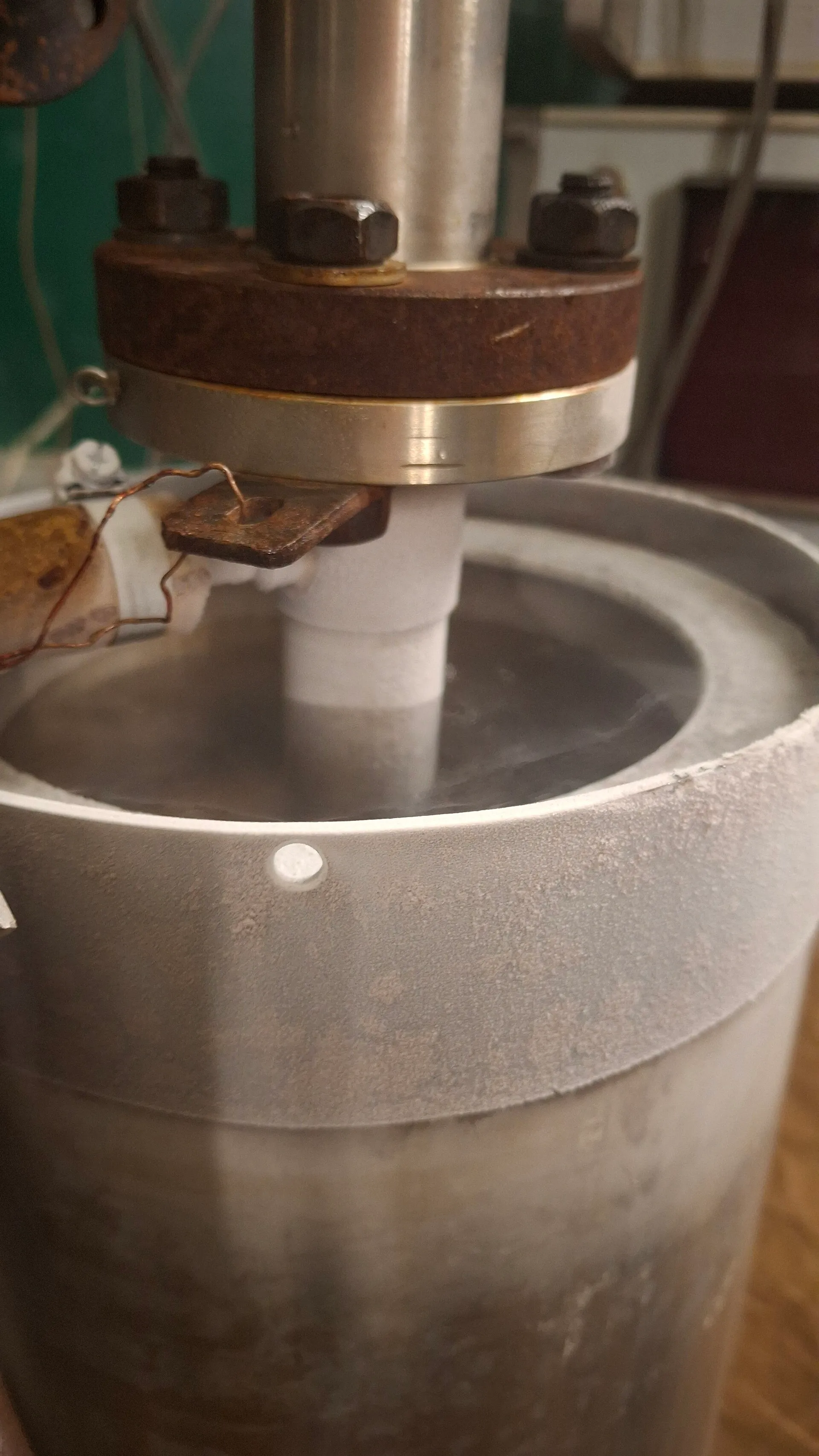
Ettore Fiorini and colleagues in Milan used a germanium diode as both source and detector to search for neutrinoless double beta decay of germanium-76. Because the source is the detector, a peak at the decay energy of 2039 keV would be recorded with excellent resolution. This 'source equals detector' approach became the basis of Heidelberg-Moscow, GERDA, the Majorana Demonstrator and LEGEND.
- Date
- 1967
- Kind of event
- Experiment
- People involved
- Ettore Fiorini
- Experiments
- Heidelberg–Moscow Experiment, GERDA, LEGEND
The situation before
Neutrinoless double beta decay can occur only if the neutrino is its own antiparticle, a Majorana particle. Wendell Furry had pointed this out in 1939, and searches began in the late 1940s. The early experiments used thin foils of an enriched isotope placed next to separate counters. The electrons lost energy leaving the foil, the energy resolution was poor, and a small peak at the decay energy was easily hidden in background.
What happened
At the University of Milan, Ettore Fiorini and his colleagues A. Pullia, G. Bertolini, F. Cappellani and G. Restelli realised that the newly developed lithium-drifted germanium detectors offered a way around this. Natural germanium contains about 7.8 percent germanium-76, a double beta emitter. A germanium crystal used as a radiation detector is therefore its own source: if a germanium-76 nucleus inside the crystal decays without neutrinos, the two electrons deposit their full energy, 2039 keV, inside the detector, and the excellent energy resolution of germanium would record a narrow line.
They operated a 17 cm³ Ge(Li) detector at sea level and found no line. Their result, published in Physics Letters B in 1967 under the title "A search for lepton non-conservation in double beta decay with a germanium detector", gave a lower limit on the half-life of about 3 × 10²⁰ years. In 1973 the group used a larger 68 cm³ detector in the Mont Blanc tunnel, under rock equivalent to about 4,200 m of water, and raised the limit to about 5 × 10²¹ years.
Reaction
The limits themselves were modest by later standards, but the method was recognised as a major advance. It combines a large source mass, high detection efficiency and the best energy resolution available, and the background can be reduced by going underground and by using radiopure materials. Fiorini later also pioneered cryogenic bolometers for the same purpose, which led to CUORE.
Why it matters
The "source equals detector" principle with germanium detectors became the backbone of a long line of experiments. The Heidelberg-Moscow experiment at Gran Sasso used about 11 kg of germanium enriched to 86 percent in germanium-76 and ran from 1990 to 2003; part of the collaboration claimed evidence for the decay in 2001, a claim later excluded. GERDA, with bare germanium detectors in liquid argon, reached a limit of 1.8 × 10²⁶ years in 2020, and the Majorana Demonstrator in South Dakota obtained comparable sensitivity. Their successor LEGEND aims at about 10²⁸ years, which would probe the range expected if neutrinos follow the inverted mass ordering. More than half a century after Milan, the design principle is unchanged.
Frequently asked questions
What did Fiorini's 1967 experiment do?
It used a germanium detector as both the source and the detector to search for neutrinoless double beta decay of germanium-76.
What result did it obtain?
No signal; a lower limit on the half-life of about 3 × 10²⁰ years.
Which experiments use the same method today?
GERDA, the Majorana Demonstrator and LEGEND.
Original papers
- First resultE. Fiorini, A. Pullia, G. Bertolini, F. Cappellani and G. Restelli, A search for lepton non-conservation in double beta decay with a germanium detector, Phys. Lett. B 25, 602 (1967)
Concepts
Mentioned in 1 page
Lessons 1
Last updated: · Editorial standard
Cite this page
Text
Neutrino Atlas (2026). “1967: Germanium detector searches for 0νββ”. Retrieved 22 November 2026, from https://neutrino-atlas.com/timeline/1967-fiorini-germanium/BibTeX
@misc{neutrinoatlas2026line1967fiorinigermanium,
  title        = {1967: Germanium detector searches for 0νββ},
  author       = {{Neutrino Atlas}},
  year         = {2026},
  url          = {https://neutrino-atlas.com/timeline/1967-fiorini-germanium/},
  note         = {Accessed 2026-11-22},
  language     = {english}
}