1969Theory
Oscillations proposed to explain the solar deficit
Vladimir Gribov and Bruno Pontecorvo showed that if electron neutrinos mix with muon neutrinos, part of the solar flux would arrive as muon neutrinos, which the chlorine detector cannot see. Their paper appeared just after the first Homestake result, and Pontecorvo had anticipated a deficit in 1967. It was the first quantitative oscillation explanation of the solar neutrino problem. SNO confirmed flavour conversion in 2001–2002, although matter effects turned out to be essential.
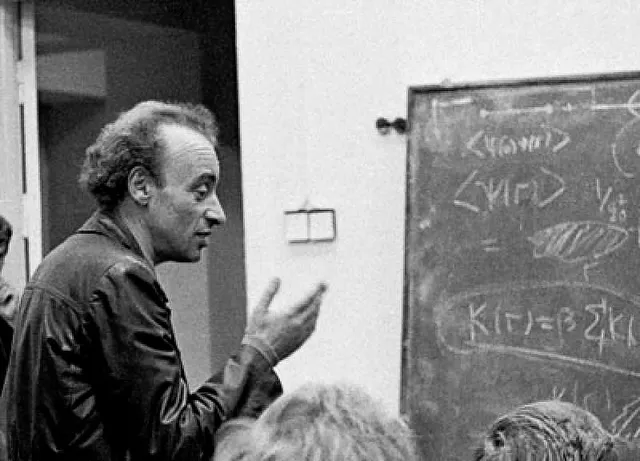
- Date
- 1969
- Kind of event
- Theory
- People involved
- Vladimir Naumovich Gribov, Bruno Pontecorvo
The situation before
In May 1968 the Homestake chlorine experiment of Raymond Davis Jr. reported that the Sun delivers fewer neutrinos than John Bahcall's solar model predicted. Most physicists suspected the experiment or the model. Bruno Pontecorvo, working at the Joint Institute for Nuclear Research in Dubna, had a different idea ready. In a paper written in 1967 and published in the Soviet journal JETP, he had argued that if lepton flavour is not exactly conserved, electron neutrinos produced in the Sun could turn into other neutrino states on the way to Earth. Since the chlorine detector responds only to electron neutrinos, it would then see a reduced flux, possibly by a factor of two. He had made this prediction before the first Homestake result was known.
What happened
Pontecorvo and the theorist Vladimir Gribov, of the Ioffe Institute in Leningrad, turned the idea into a concrete theory. Their paper "Neutrino astronomy and lepton charge" appeared in Physics Letters B in 1969. They considered a minimal scheme with only the electron and muon neutrino, allowing a small mass term that violates lepton charge and mixes the two flavours into two states with slightly different masses. They derived the probability that an electron neutrino stays an electron neutrino after travelling a given distance, which depends on the mass difference, the energy and the mixing angle: the formula for vacuum oscillations still used today in its two-flavour form.
Applied to the Sun, with its large distance and the spread of neutrino energies, the oscillations average out. For large mixing the chlorine experiment would then see roughly half of the expected flux. This was the first quantitative explanation of the solar neutrino problem in terms of neutrino properties rather than solar physics.
Reaction
For many years the explanation was treated as one possibility among many, and not the most popular. It required neutrinos to have mass, which the Standard Model did not provide, and the deficit measured at Homestake, about one third, did not obviously fit a factor of two. Most attention went to possible errors in the solar model. In the 1980s the idea was transformed when Lincoln Wolfenstein, Stanislav Mikheyev and Alexei Smirnov showed that matter inside the Sun can strongly enhance flavour conversion, the MSW effect.
Consequences
The Gribov–Pontecorvo paper set the direction for three decades of solar neutrino physics. Its central claim was confirmed in 2001–2002 when SNO showed that the total flux of all flavours agrees with the solar model while electron neutrinos are depleted, and KamLAND confirmed the same mixing parameters with reactor antineutrinos in 2002. The pure vacuum solution turned out not to be the answer for the Sun; the correct solution, with a large mixing angle, involves matter effects for the higher-energy neutrinos. But the basic picture, that neutrinos mix and change flavour on their way from the Sun, is the one Gribov and Pontecorvo proposed in 1969.
Frequently asked questions
What did Gribov and Pontecorvo propose?
That the solar neutrino deficit could be due to electron neutrinos oscillating into muon neutrinos, which the chlorine detector cannot see.
When was it published?
In Physics Letters B in 1969, shortly after the first Homestake result.
Was their explanation correct?
In principle yes: solar neutrinos do change flavour. But the precise mechanism involves matter effects in the Sun, the MSW effect, not only vacuum oscillations.
Original papers
- TheoryV. Gribov and B. Pontecorvo, Neutrino astronomy and lepton charge, Phys. Lett. B 28, 493 (1969)DOI 10.1016/0370-2693(69)90525-5
Concepts
Mentioned in 1 page
Lessons 1
Last updated: · Editorial standard
Cite this page
Text
Neutrino Atlas (2026). “1969: Oscillations proposed to explain the solar deficit”. Retrieved 22 November 2026, from https://neutrino-atlas.com/timeline/1969-gribov-pontecorvo/BibTeX
@misc{neutrinoatlas2026line1969gribovpontecorvo,
  title        = {1969: Oscillations proposed to explain the solar deficit},
  author       = {{Neutrino Atlas}},
  year         = {2026},
  url          = {https://neutrino-atlas.com/timeline/1969-gribov-pontecorvo/},
  note         = {Accessed 2026-11-22},
  language     = {english}
}