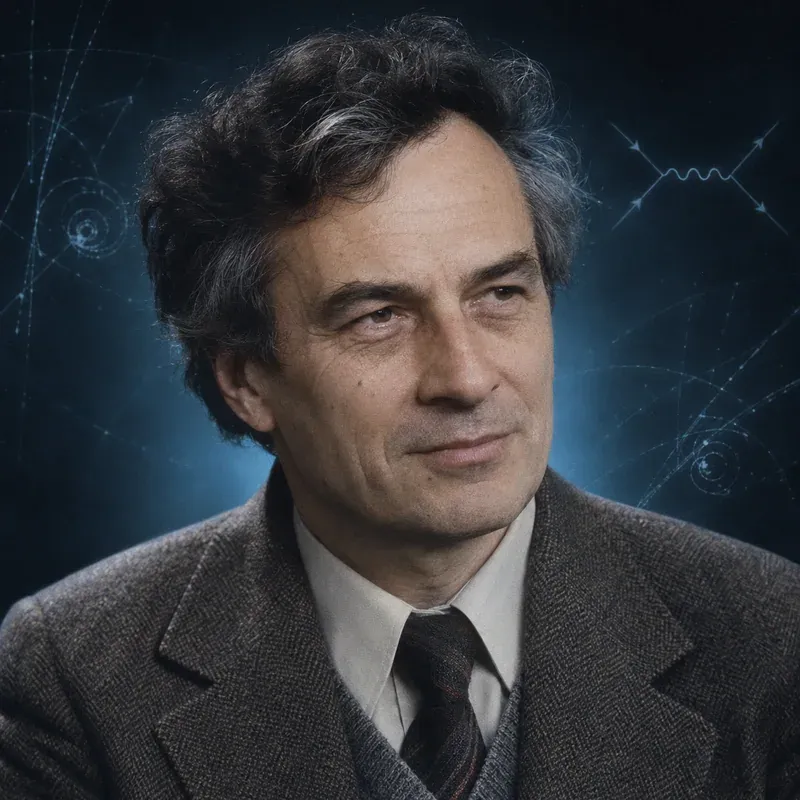
 Illustration
Stanislav Pavlovich Mikheyev
In 1985, with Alexei Smirnov, Mikheyev showed that Wolfenstein's matter potential leads to resonant enhancement of neutrino oscillations in matter of varying density and to adiabatic flavour conversion in the Sun. This MSW mechanism became the accepted explanation of the solar neutrino deficit, confirmed by SNO and KamLAND as the large-mixing-angle solution. He also worked on experiments at INR.
- Born
- 1940
USSR - Died
- 23 April 2011
- Nationality
- Russian (Soviet)
- Field
- Neutrino physics (phenomenology and experiment)
- Institutions
- Lebedev Physical Institute, Institute for Nuclear Research (INR), Moscow
Education and career
Stanislav Pavlovich Mikheyev was born in 1940 in the Soviet Union. He graduated from the Faculty of Physics of Moscow State University in 1965 and began his research career at the Lebedev Physical Institute in Moscow. In 1970 he moved to the newly founded Institute for Nuclear Research (INR) of the USSR Academy of Sciences, which became part of the Russian Academy of Sciences in 1991, and he remained there for the rest of his life. He received his doctorate (kandidat nauk) in 1983. Unusually for someone whose name is attached to a theoretical effect, much of his work was experimental.
Experimental work
At INR Mikheyev worked with the Baksan Underground Scintillation Telescope at the Baksan Neutrino Observatory in the North Caucasus. He led studies of upward-going muons, which are produced by atmospheric neutrinos that have crossed the Earth, and searches for superheavy magnetic monopoles. From 1991 to 1998 he took part in the MACRO detector at the Gran Sasso laboratory, which also measured upward-going muons and searched for monopoles. He was later involved in the Baikal neutrino telescope (see Baikal-GVD) and in INR’s participation in T2K.
Key contribution: the MSW effect
By the early 1980s the solar neutrino problem was well established: the Homestake chlorine experiment saw only about a third of the neutrinos predicted by the Standard Solar Model. Vacuum oscillations could explain the deficit only with finely tuned parameters. In 1978 Lincoln Wolfenstein had shown that neutrinos travelling through matter feel an extra potential: electron neutrinos can scatter on electrons through W exchange, which muon and tau neutrinos cannot, and this changes the effective mixing.
In 1985 Mikheyev and Alexei Smirnov studied what happens when the density changes along the path, as it does from the core of the Sun to its surface. They found a resonance: at a particular density the effective mixing angle in matter becomes maximal, 45 degrees, even if the mixing in vacuum is small. If the density changes slowly enough for the neutrino state to follow it, the adiabatic case, an electron neutrino created in the dense core leaves the Sun largely converted into another flavour. Unlike vacuum oscillations, this conversion does not average out and depends strongly on energy.
The result appeared in Soviet Journal of Nuclear Physics in 1985 and, in English, in Il Nuovo Cimento in 1986. It showed that the solar deficit could be a natural consequence of neutrino masses and mixing, and it turned solar neutrino detectors into tools for measuring these parameters, which the authors called solar neutrino spectroscopy. Together with Wolfenstein’s matter term, the mechanism is known as the MSW effect.
Several MSW solutions were viable for years. The question was settled in 2002, when SNO showed that the total flux of all flavours agrees with the solar model while only about a third arrives as electron neutrinos, and when KamLAND measured the same oscillation parameters with reactor antineutrinos. The data selected the large-mixing-angle solution: high-energy boron-8 neutrinos undergo adiabatic MSW conversion, while low-energy pp neutrinos behave almost as in vacuum. The transition between the two regimes has since been measured by Borexino. Matter effects in the Earth are now used by long-baseline experiments such as DUNE to determine the mass ordering.
Recognition
Mikheyev shared the 2005 Bruno Pontecorvo Prize with Smirnov and Wolfenstein for the prediction and study of matter effects on neutrino oscillations, and the 2008 J. J. Sakurai Prize for Theoretical Particle Physics with Smirnov. He died in April 2011.
Known for
- MSW resonant flavour conversion (with Smirnov)
- Solar neutrino problem solution
Chronology
- 1985Resonance enhancement of oscillations in matter (with Smirnov)
- 2005Bruno Pontecorvo Prize
- 2008Sakurai Prize (with Smirnov)
Original papers
- S. P. Mikheyev, A. Yu. Smirnov, Resonance enhancement of oscillations in matter and solar neutrino spectroscopy, Sov. J. Nucl. Phys. 42, 913 (1985)
- S. P. Mikheyev, A. Yu. Smirnov, Resonant amplification of ν oscillations in matter and solar-neutrino spectroscopy, Nuovo Cimento C 9, 17 (1986)
Experiments
Connected people
Frequently asked questions
What is the MSW effect?
The resonant enhancement of neutrino flavour conversion in matter of changing density, worked out by Mikheyev and Smirnov in 1985 on the basis of Wolfenstein’s matter potential. It explains the deficit of solar electron neutrinos; see MSW effect.
Was Mikheyev a theorist or an experimentalist?
Both. Besides the MSW work he spent most of his career on experiments at INR, especially the Baksan scintillation telescope and the MACRO detector.
Which prizes did Mikheyev receive?
The Bruno Pontecorvo Prize in 2005 (with Smirnov and Wolfenstein) and the J. J. Sakurai Prize in 2008 (with Smirnov).
On the timeline
Mentioned in 17 pages
Comparisons 1
Milestones 4
Last updated: · Editorial standard
Cite this page
Text
Neutrino Atlas (2026). “Stanislav Pavlovich Mikheyev”. Retrieved 22 November 2026, from https://neutrino-atlas.com/people/stanislav-mikheyev/BibTeX
@misc{neutrinoatlas2026peoplestanislavmikheyev,
  title        = {Stanislav Pavlovich Mikheyev},
  author       = {{Neutrino Atlas}},
  year         = {2026},
  url          = {https://neutrino-atlas.com/people/stanislav-mikheyev/},
  note         = {Accessed 2026-11-22},
  language     = {english}
}