Super-Kamiokande
The 50,000-tonne water Cherenkov detector that discovered atmospheric neutrino oscillation in 1998.
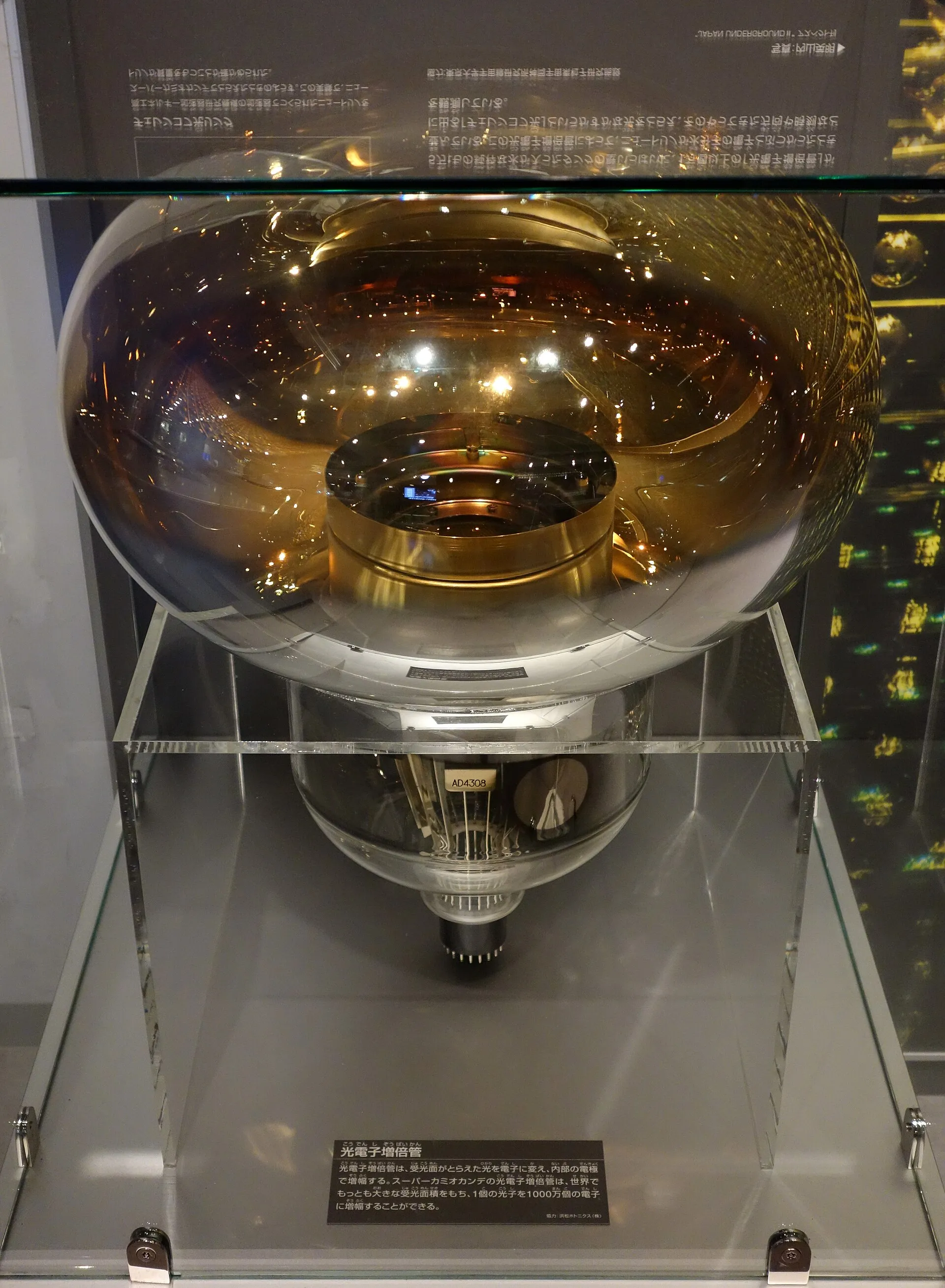
A cylindrical tank (39 m × 42 m) of ultra-pure water is viewed by 11,146 inward-facing 20-inch PMTs, with an outer veto. In 1998 the zenith-angle dependence of νµ events gave the first conclusive evidence for oscillation, earning Takaaki Kajita a share of the 2015 Nobel Prize. It also measures ⁸B solar neutrinos, serves as T2K's far detector, sets the world's best proton-decay limits and, since 2020, runs with gadolinium (SK-Gd).
Compare all experiments → · World map →
In plain words
Super-Kamiokande is a stainless-steel cylinder as tall as a 15-storey building, filled with 50,000 tonnes of ultra-pure water and lined with more than 11,000 large light sensors. When a neutrino strikes the water, the charged particle it creates emits a faint cone of blue Cherenkov light that forms a ring on the wall. From the shape, size and timing of that ring, physicists work out the particle's type, energy and direction.
How the detector works
The detector sits 1000 metres underground in the Kamioka mine, about 39 metres in diameter and 41 metres high. An inner detector viewed by about 11,100 20-inch photomultipliers, covering about 40 per cent of the wall, is surrounded by an outer veto layer with about 1900 smaller tubes. The central 22.5 kilotonnes form the fiducial volume. Sharp rings indicate muons, fuzzy rings electrons or photons.
Key results
- 1998: a deficit of upward-going muon neutrinos relative to downward-going ones, the first conclusive evidence for neutrino oscillation, announced at the Neutrino '98 conference in Takayama.
- Solar neutrinos: the most precise real-time measurement of the ⁸B flux, its energy spectrum and a small day–night asymmetry.
- Far detector for K2K (1999–2004) and T2K (since 2010), which observed electron-neutrino appearance and gives leading constraints on CP violation.
- Proton decay: the world's strongest limits, above 2.4 × 10³⁴ years for p → e⁺ π⁰.
- Atmospheric tau-neutrino appearance and indications on the mass ordering.
History and phases
Data taking started in April 1996 under Yoji Totsuka. In November 2001 a chain implosion destroyed more than half of the photomultipliers; the detector ran at half coverage from 2002 and was fully rebuilt in 2006. New electronics followed in 2008. In 2018 the tank was refurbished, and in August 2020 gadolinium sulphate was dissolved in the water to tag neutrons (gadolinium loading), with the concentration raised in 2022. SK-Gd aims at the first detection of the diffuse supernova neutrino background.
Why it matters for neutrino physics
Takaaki Kajita shared the 2015 Nobel Prize for the atmospheric oscillation discovery, and Super-K's solar, atmospheric and beam data are central inputs to global fits. It is a key member of SNEWS and would record thousands of events from a galactic supernova. Hyper-Kamiokande will be its successor.
Frequently asked questions
How pure is the water in Super-Kamiokande?
The water is continuously filtered and recirculated so that light travels on the order of 100 metres before being absorbed, and radon and other radioactive impurities are kept extremely low.
Why was gadolinium added?
Gadolinium captures neutrons efficiently and emits gamma rays totalling about 8 MeV. Tagging the neutron from inverse beta decay helps distinguish antineutrino events, such as those from distant supernovae, from backgrounds.
Original papers
- DiscoveryY. Fukuda et al. (Super-Kamiokande Collaboration), Evidence for oscillation of atmospheric neutrinos, Phys. Rev. Lett. 81, 1562 (1998)DOI 10.1103/PhysRevLett.81.1562
- ProposalS. Fukuda et al. (Super-Kamiokande Collaboration), The Super-Kamiokande detector, Nucl. Instrum. Meth. A 501, 418 (2003)DOI 10.1016/S0168-9002(03)00425-X
Go deeper
- 2001 PMT implosion accidentA chain-reaction implosion that destroyed more than 6,700 of Super-Kamiokande's photomultipliers in November 2001.
Related terms
- Gadolinium loading
- Cherenkov ring imaging (e-like vs µ-like)
- T2K
- Water Cherenkov detector
- Zenith angle
- Proton decay
People
- Alexei Yuryevich Smirnov
- Arthur B. McDonald
- Atsuto Suzuki
- Bruno Pontecorvo
- John Norris Bahcall
- Kam-Biu Luk
- Kōichirō Nishikawa
- Lincoln Wolfenstein
- Masatoshi Koshiba
- Stanislav Pavlovich Mikheyev
- Takaaki Kajita
- Wang Yifang
- Yoji Totsuka
- Eligio Lisi
- Georg G. Raffelt
- Gianluigi Fogli
Latest research on this topic
- 8B Solar Neutrino Measurements of Solar Core Size and Temperature from 5805 Days of Super-KamiokandeSuper-Kamiokande Collaboration · 13 November 2026
- Indication of Electron Antineutrinos from the Diffuse Supernova Neutrino BackgroundSuper-Kamiokande Collaboration · 26 October 2026
- First observation of electron antineutrinos from nuclear reactors at Super-KamiokandeSuper-Kamiokande Collaboration · 2 October 2026
- Search for the 16O(ppp) → 13C π+ π+ e+ Decay Mode in Super-Kamiokande Using Machine Learning TechniquesSuper-Kamiokande Collaboration · 22 September 2026
- Not so good νs for Higgsino dark matter as LZ excess: stringent limits from Super-Kamiokande and IceCubeBose, Debajit, Saha, Akash Kumar, Das, Deep Jyoti et al. · 7 September 2026
- Measurement of the branching ratio of 16N, 15C, 12B and 13B isotopes through the nuclear muon capture reaction in the Super-Kamiokande detectorMaekawa, Yuto, Nakano, Yuuki, Nishimura, Yasuhiro · 3 September 2026
On the timeline
- 1996Super-Kamiokande begins operation
- 1998Super-Kamiokande discovers neutrino oscillation
- 1999K2K starts the first long-baseline experiment
- 2001SNO shows solar neutrinos change flavour
- 2001Implosion chain destroys most Super-K photomultipliers
- 2004Super-K sees the oscillation dip in L/E
- 2011T2K finds hints of electron-neutrino appearance
- 2015Nobel Prize for neutrino oscillations
- 2015Breakthrough Prize honours five oscillation experiments
- 2020T2K constrains CP violation in neutrinos
- 2020Gadolinium is added to Super-Kamiokande
- 2026Super-Kamiokande sees a first hint of the supernova neutrino background
Mentioned in 239 pages
Lessons 16
FAQ 11
Comparisons 6
Milestones 38
- 1957 · Pontecorvo proposes neutrino oscillations
- 1962 · Maki, Nakagawa and Sakata introduce neutrino mixing
- 1965 · First detection of atmospheric neutrinos
- 1975 · Tau lepton discovery implies a third neutrino
- 1978 · Wolfenstein: matter changes neutrino oscillations
- 1979 · Seesaw mechanism developed and named
- 1983 · Large water Cherenkov detectors begin operation
- 1985 · Chen proposes a heavy-water solar detector
30 more
- 1986 · Fukugita and Yanagida propose leptogenesis
- 1987 · Neutrinos from supernova SN 1987A
- 1988 · Kamiokande finds an atmospheric neutrino anomaly
- 1989 · Kamiokande sees solar neutrinos in real time
- 1995 · Nobel Prize for neutrino detection
- 1996 · Super-Kamiokande begins operation
- 1998 · CHOOZ sees no reactor antineutrino disappearance
- 1998 · Homestake publishes its final solar result
- 1998 · Super-Kamiokande discovers neutrino oscillation
- 1999 · K2K starts the first long-baseline experiment
- 2000 · DONUT observes the tau neutrino
- 2001 · Implosion chain destroys most Super-K photomultipliers
- 2001 · SNO shows solar neutrinos change flavour
- 2002 · Nobel Prize for neutrino astrophysics
- 2002 · SNO measures the total solar neutrino flux
- 2004 · Super-K sees the oscillation dip in L/E
- 2006 · MINOS confirms muon-neutrino disappearance
- 2010 · OPERA sees the first tau from oscillation
- 2011 · T2K finds hints of electron-neutrino appearance
- 2015 · Breakthrough Prize honours five oscillation experiments
- 2015 · Nobel Prize for neutrino oscillations
- 2015 · OPERA establishes tau-neutrino appearance
- 2018 · MiniBooNE's excess grows to 4.8σ
- 2020 · Gadolinium is added to Super-Kamiokande
- 2020 · Hyper-Kamiokande construction is approved
- 2020 · T2K constrains CP violation in neutrinos
- 2025 · Hyper-Kamiokande cavern excavation completed
- 2025 · JUNO's first results set precision records
- 2025 · NOvA and T2K publish a joint analysis
- 2026 · Super-Kamiokande sees a first hint of the supernova neutrino background
People 41
- Alfred K. Mann
- Arthur B. McDonald
- Arthur Roberts
- Atsuto Suzuki
- Barry C. Barish
- Bruno Pontecorvo
- Ernst-Wilhelm Otten
- Evgeny Kh. Akhmedov
33 more
- Francesca Di Lodovico
- Georg G. Raffelt
- Hans-Thomas Janka
- Henry W. Sobel
- James Ricker Wilson
- John G. Learned
- John Norris Bahcall
- Kate Scholberg
- Kōichirō Nishikawa
- Kunio Inoue
- Lawrence R. Sulak
- Lincoln Wolfenstein
- M. Concepción (Concha) González-García
- Makoto Kobayashi
- Marc H. Pinsonneault
- Mark D. Messier
- Martin Lewis Perl
- Masami Nakagawa
- Masato Shiozawa
- Masatoshi Koshiba
- Masayuki Nakahata
- Raymond Davis Jr.
- Shoichi Sakata
- Soo-Bong Kim
- Stanley Wojcicki
- Takaaki Kajita
- Takashi Kobayashi
- Thomas K. Gaisser
- Tsuyoshi Nakaya
- Vernon Duane Barger
- Yōichirō Suzuki
- Yoji Totsuka
- Ziro Maki
Terms 127
- 2001 PMT implosion accident
- Accelerator Long-baseline experiments
- Accelerator neutrinos
- ANNIE
- Appearance measurement
- Appearance vs disappearance
- Atmospheric & Large water Cherenkov experiments
- Atmospheric mass splitting Δm²31
119 more
- Atmospheric neutrinos
- Background
- Baksan Underground Scintillation Telescope
- Baryon number
- Boron-8 neutrinos
- Calibration
- Case–Witwatersrand–Irvine (East Rand) experiment
- Charged-current interaction
- Cherenkov angle
- Cherenkov radiation
- Cherenkov radiation (detection)
- Cherenkov ring imaging (e-like vs µ-like)
- Cherenkov threshold
- CHOOZ
- Core-collapse supernova mechanism
- CPT theorem
- Day-night asymmetry
- Day-night asymmetry measurement
- Detection efficiency & acceptance
- Detector technologies
- Diffuse supernova neutrino background
- Disappearance measurement
- Discovery of neutrino oscillations
- Earth matter effects
- Elastic scattering (ES) channel
- Energy scale & nonlinearity
- Energy threshold
- Event reconstruction & identification
- Experiments & detectors
- Exposure
- Fiducial volume
- Fréjus detector
- Gadolinium loading
- Global fit
- Global oscillation fits
- Grand unification
- Grand unified neutrino spectrum
- HALO
- Heavy water (D₂O) detector
- Hyper-Kamiokande
- IMB (Irvine–Michigan–Brookhaven)
- INO-ICAL
- Inverse beta decay
- Inverse beta decay (IBD)
- Inverted ordering
- J-PARC Neutrino Beam
- K2K
- Kamioka Observatory
- Kamiokande
- L/E
- L/E (baseline over energy)
- Large mixing angle (LMA) MSW solution
- Lorentz and CPT violation in neutrinos
- LVD (Large Volume Detector)
- MACRO
- Major neutrino beamlines
- Mass-ordering sensitivity
- Maximum-likelihood fit
- Michel electron
- MINERvA
- Mixing angle θ12
- Mixing angle θ13
- Mixing angle θ23
- Monte Carlo simulation & event generators
- Muon neutrino
- Muon veto
- Near and far detectors
- Near-to-far extrapolation
- Neutrino astronomy
- Neutrino energy reconstruction
- Neutrino in the Standard Model
- Neutrino mass
- Neutrino mass models
- Neutrino mass ordering
- Neutrino oscillation physics
- Neutrino properties
- Neutrino-electron elastic scattering
- Neutrinos from dark matter annihilation
- Neutron-star mergers and neutrinos
- Non-standard interactions
- NUSEX
- Off-axis beam (facility)
- Open questions in oscillations
- OPERA
- Oscillation observables
- Oscillogram
- Photocathode coverage
- Photodetection
- Photomultiplier tube (PMT)
- PMNS unitarity tests
- Pre-supernova neutrinos
- Proton decay
- Quantum efficiency
- Quasi-elastic scattering
- Recoil energy
- Shielding
- SNEWS (SuperNova Early Warning System)
- SNO (Sudbury Neutrino Observatory)
- Solar mass splitting Δm²21
- Solar neutrino experiments
- Solar neutrino problem
- Solar neutrinos
- Soudan 2
- Supernova early warning
- Supernova neutrino detection
- Supernova neutrino signal phases
- Supernova neutrinos
- T2K
- Tau neutrino
- Tau neutrino appearance
- Theia
- Trigger & data acquisition
- Two-flavour approximation
- Underground laboratories
- Vacuum oscillations
- Vertex & direction reconstruction
- Water Cherenkov detector
- Wavelength shifter
- Zenith angle
Last updated: · Editorial standard
Cite this page
Text
Neutrino Atlas (2026). “Super-Kamiokande”. Retrieved 22 November 2026, from https://neutrino-atlas.com/terms/super-kamiokande/BibTeX
@misc{neutrinoatlas2026termssuperkamiokande,
  title        = {Super-Kamiokande},
  author       = {{Neutrino Atlas}},
  year         = {2026},
  url          = {https://neutrino-atlas.com/terms/super-kamiokande/},
  note         = {Accessed 2026-11-22},
  language     = {english}
}