Case–Witwatersrand–Irvine (East Rand) experiment
Deep-mine scintillator experiment in South Africa that recorded natural atmospheric neutrinos in 1965, at the same time as Kolar Gold Fields.
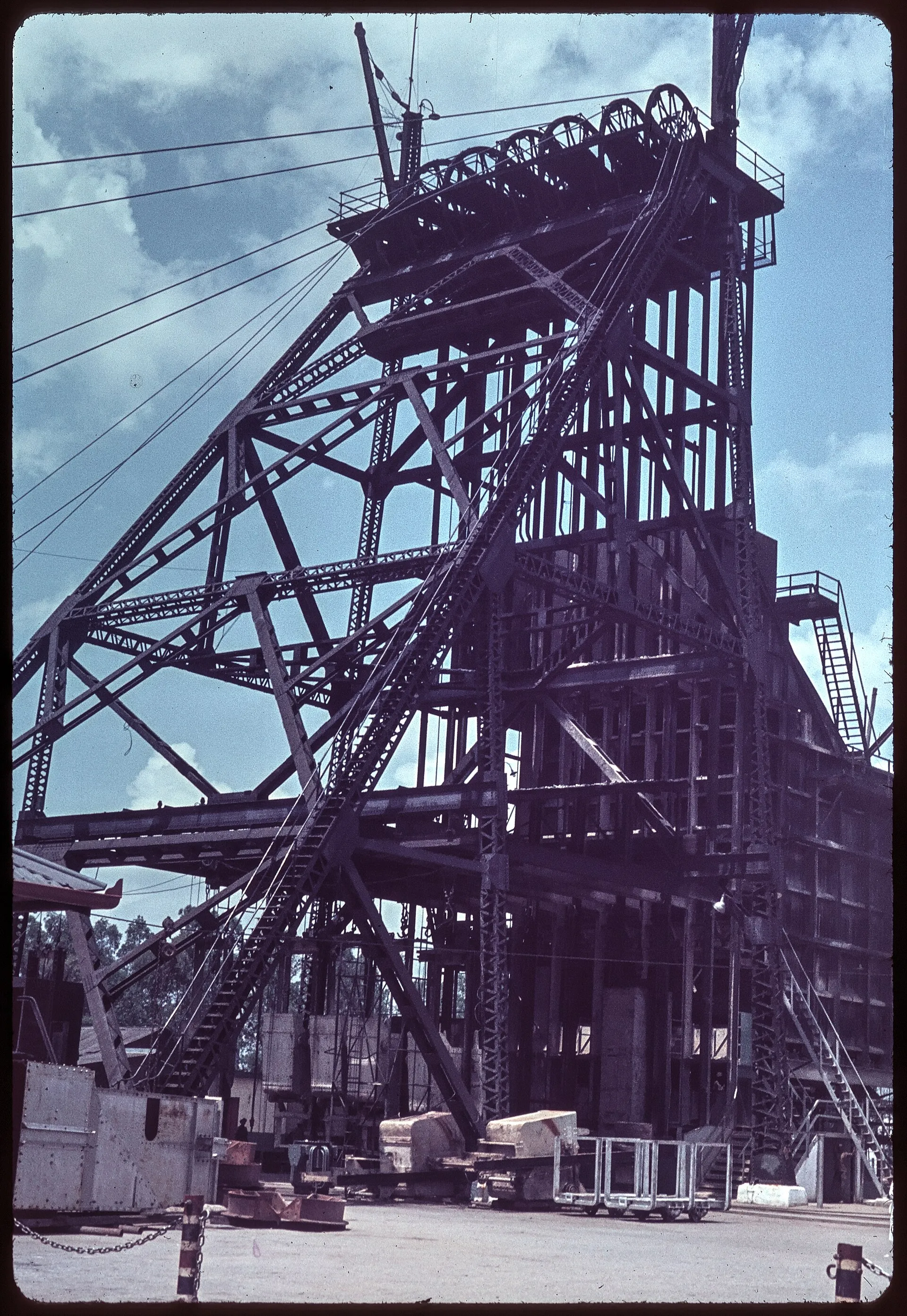
Built by Frederick Reines's group at Case Institute with Friedel Sellschop of the University of the Witwatersrand, the detector sat about 3.2 km deep (8,800 m water equivalent) in the East Rand Proprietary Mine. Walls of segmented liquid scintillator looked for horizontal muons, which rock overhead cannot let through. The first such event was recorded on 23 February 1965; seven were reported that August.
Compare all experiments → · World map →
In plain words
Cosmic-ray muons rain down from above, but even the most energetic of them are stopped by a few kilometres of rock. In one of the deepest mines in the world, a muon travelling sideways through the rock cannot be a cosmic-ray muon at all: the slant depth of rock in that direction is far too large. It can only have been made nearby by a neutrino that crossed the Earth. The East Rand experiment looked for exactly these horizontal muons.
How the detector worked
The group of Frederick Reines, then at Case Institute of Technology in Cleveland, teamed up with Friedel Sellschop of the University of the Witwatersrand in Johannesburg. In a cavern about 3.2 km underground in the East Rand Proprietary Mine they set up two vertical walls of segmented liquid scintillator, about 110 m² in total. A muon passing through both walls at a shallow angle gave a timed coincidence, and the segmentation showed its direction. At 8,800 metres water equivalent of overburden, the vertical cosmic muon flux was tiny, and the horizontal one effectively zero.
Key results
The first neutrino-induced muon was recorded on 23 February 1965. By July the experiment had seven horizontal tracks with less than one expected background event, and the paper appeared on 30 August 1965. The Bombay–Osaka–Durham group at Kolar Gold Fields in India saw its first candidate in April and published two weeks earlier, so formal priority went to KGF; historians usually credit both groups with the first observation of natural atmospheric neutrinos. Reines moved to the University of California, Irvine, in 1966, and the collaboration became Case–Witwatersrand–Irvine. Together the two experiments recorded close to 150 neutrino events in the following years, enough to compare the measured muon rate with flux calculations.
Why it matters for neutrino physics
After the reactor discovery by Cowan and Reines in 1956, this was the first time neutrinos from a natural source were seen. It started underground neutrino physics, the line that later led to IMB, Kamiokande and the discovery of atmospheric oscillations at Super-Kamiokande.
Frequently asked questions
Why look for horizontal muons?
Cosmic-ray muons arrive mainly from above. Horizontally the rock is so thick that only neutrino-produced muons can appear, which removes almost all background.
Who saw natural neutrinos first, East Rand or KGF?
East Rand recorded the first event, in February 1965, but KGF published first. Both are usually credited together.
Original papers
- DiscoveryF. Reines et al., Evidence for High-Energy Cosmic-Ray Neutrino Interactions, Phys. Rev. Lett. 15, 429 (1965)DOI 10.1103/PhysRevLett.15.429
Related terms
- Atmospheric neutrinos
- Kolar Gold Fields neutrino experiments
- Cowan–Reines Neutrino Experiment
- Underground depth & metres water equivalent
- Liquid scintillator detector
Latest research on this topic
- Topological signatures of criticality: the Ising caseChan, Tak-Shing, Dłotko, Paweł, Gulgowski, Jacek et al. · 17 November 2026
- The Curious Case of Anapole Dark Matter at LZ: Minimal, Elastic and TestableBera, Sourav, Maharana, Suvam, Mondal, Poulami · 11 November 2026
- AGN feedback destroying group cool cores --- a case study on IC 2476 with a remnant radio AGN and an exceptionally low abundanceLiu, Wenhao, Sun, Ming, Nulsen, Paul et al. · 10 November 2026
- Gravitational radiation from a particle in circular orbit around a wormhole: the nonrotating caseBiswas, Shauvik, Chakrabarti, Sayan · 10 November 2026
- XMM-Newton observations of the highest field polar AR UMa: An extreme case of soft-blobby accretionPradeep, Kala G., Schwope, Axel D. · 6 November 2026
- An Empirical Study on Clustering-based Quantum Approximate Optimization Algorithm for Regression Test Case SelectionTrovato, Antonio, Beseda, Martin, Di Nucci, Dario · 6 November 2026
Mentioned in 2 pages
Last updated: · Editorial standard
Cite this page
Text
Neutrino Atlas (2026). “Case–Witwatersrand–Irvine (East Rand) experiment”. Retrieved 22 November 2026, from https://neutrino-atlas.com/terms/east-rand-cwi/BibTeX
@misc{neutrinoatlas2026termseastrandcwi,
  title        = {Case–Witwatersrand–Irvine (East Rand) experiment},
  author       = {{Neutrino Atlas}},
  year         = {2026},
  url          = {https://neutrino-atlas.com/terms/east-rand-cwi/},
  note         = {Accessed 2026-11-22},
  language     = {english}
}