Soudan 2
A 963-tonne iron tracking calorimeter in a Minnesota mine that confirmed the atmospheric neutrino anomaly without water Cherenkov techniques.
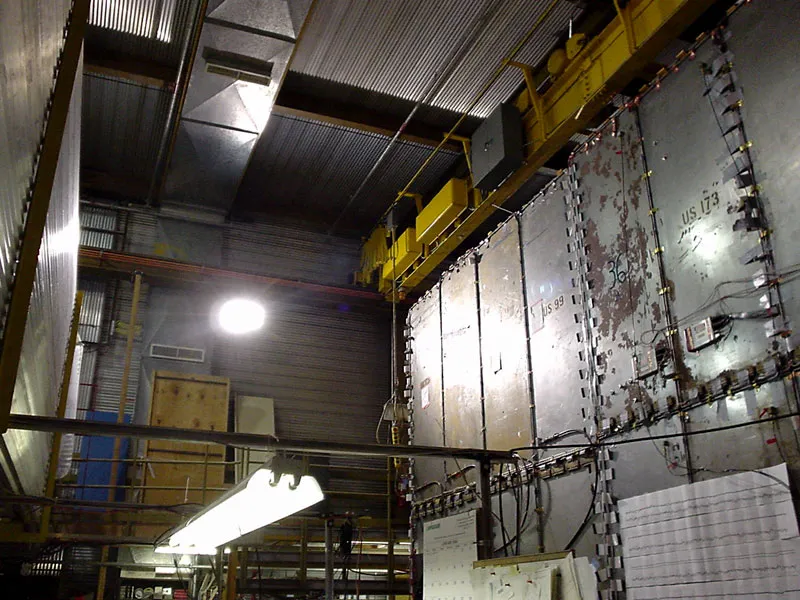
Soudan 2 ran from 1989 to 2001 at about 2,100 metres water equivalent in the Soudan iron mine. Its fine-grained iron and drift-tube calorimeter imaged contained neutrino events and separated muon from electron flavour. With 5.9 kiloton-years it measured a flavour ratio-of-ratios R = 0.69 ± 0.10 ± 0.06 and an oscillation-like dependence on L/E.
Compare all experiments → · World map →
In plain words
In the late 1980s the large water Cherenkov detectors Kamiokande and IMB found too few muon-type atmospheric neutrinos compared with electron-type ones. Critics asked whether water detectors simply mislabelled particles. Soudan 2 answered with a completely different instrument: a slab of iron and gas tubes that drew each event as a picture of tracks and showers.
How the detector works
Soudan 2 was built in the Soudan mine in northern Minnesota, about 700 m below ground. Thin corrugated steel sheets were stacked with plastic drift tubes; charged particles ionised the gas, and the charge drifted to the tube ends, giving a three-dimensional image with centimetre detail. The full detector weighed 963 tonnes and was assembled in modules, so data taking started in April 1989 with only part of the mass. A surrounding active shield of proportional tubes tagged cosmic-ray muons and the neutrons they produced in the cavern rock. Originally designed to search for proton decay, the tracking calorimeter could tell a long muon track from a fuzzy electron shower and even measure the recoil proton in quasi-elastic events, which improved the direction estimate.
Key results
An early analysis of 1.52 fiducial kiloton-years found R = 0.72 ± 0.19 (stat) for the ratio of observed to expected µ/e events, the so-called ratio-of-ratios, where 1 means no anomaly. The final analysis, with 5.90 kiloton-years collected until June 2001, gave R = 0.69 ± 0.10 ± 0.06. Its L/E distribution rejected the no-oscillation hypothesis with a probability of 5.8 × 10⁻⁴ and favoured Δm² of a few times 10⁻³ eV² with near-maximal mixing, consistent with Super-Kamiokande and MACRO.
Why it matters
Earlier iron detectors such as Fréjus and NUSEX had not seen a clear deficit, so the anomaly long looked like a water-specific effect. Soudan 2 showed that it was real for an iron calorimeter too. The cavern later hosted the far detector of MINOS, which continued the study of atmospheric neutrinos with a beam from Fermilab.
Frequently asked questions
What does the ratio-of-ratios measure?
It divides the observed ratio of muon-like to electron-like events by the ratio predicted without oscillation. Many flux uncertainties cancel. A value near 0.7 means that roughly a third of the expected muon neutrinos are missing.
Was Soudan 2 built for neutrinos?
No. It was designed to search for proton decay, which it never observed. Atmospheric neutrinos were its main background, and they became its most important physics result.
Original papers
- First resultW. W. M. Allison et al. (Soudan 2 Collaboration), Measurement of the atmospheric neutrino flavour composition in Soudan 2, Phys. Lett. B 391, 491 (1997)arXiv:hep-ex/9611007
- Final resultM. Sanchez et al. (Soudan 2 Collaboration), Measurement of the L/E distributions of atmospheric ν in Soudan 2 and their interpretation as neutrino oscillations, Phys. Rev. D 68, 113004 (2003)DOI 10.1103/PhysRevD.68.113004arXiv:hep-ex/0307069
Related terms
People
Mentioned in 8 pages
Last updated: · Editorial standard
Cite this page
Text
Neutrino Atlas (2026). “Soudan 2”. Retrieved 22 November 2026, from https://neutrino-atlas.com/terms/soudan-2/BibTeX
@misc{neutrinoatlas2026termssoudan2,
  title        = {Soudan 2},
  author       = {{Neutrino Atlas}},
  year         = {2026},
  url          = {https://neutrino-atlas.com/terms/soudan-2/},
  note         = {Accessed 2026-11-22},
  language     = {english}
}