Baksan Underground Scintillation Telescope
A large segmented scintillator detector at Baksan that recorded 5 neutrino events from SN1987A.
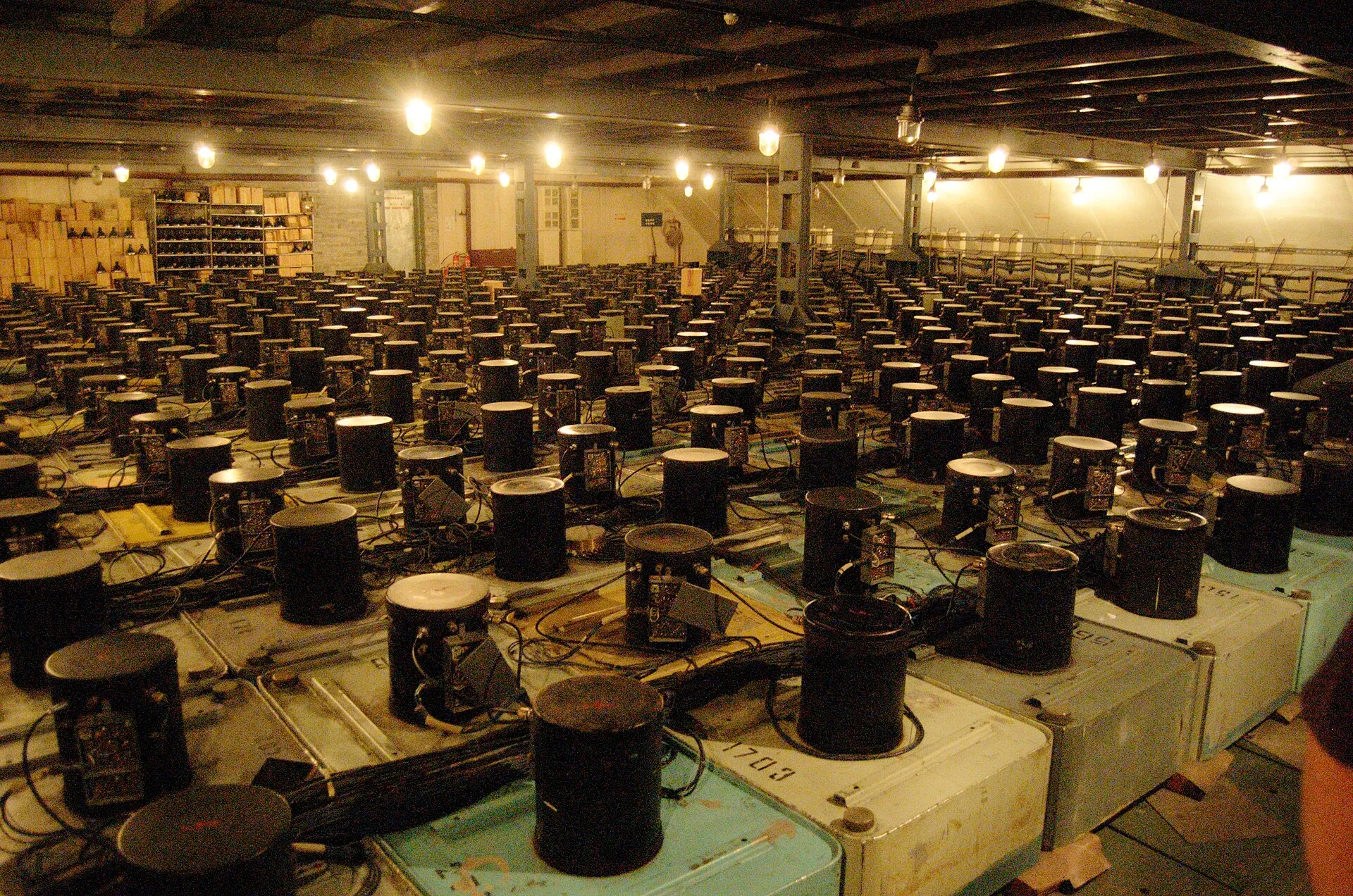
Built of about 3200 liquid-scintillator modules (about 330 t), the telescope has studied cosmic-ray muons, atmospheric neutrinos and dark matter annihilation signals, and it has run a continuous galactic supernova watch since 1980.
Compare all experiments → · World map →
In plain words
The Baksan telescope is a large box built from thousands of identical containers of liquid scintillator, stacked into walls and floors inside a mountain in the North Caucasus. It was designed to study cosmic-ray muons and neutrinos, but its most patient task has been to wait for a supernova in our galaxy. It has been listening for one continuously since 1980, longer than any other detector.
How the detector works
The telescope was the first experiment of the Baksan Neutrino Observatory, built under the leadership of Alexander Chudakov, and began operating in 1977. It sits about 300 metres under the rock of Mount Andyrchi, equivalent to about 850 metres of water, in a hall measuring about 17 × 17 × 11 metres. It consists of 3184 standard counters, each a tank of about 0.7 × 0.7 × 0.3 metres filled with liquid scintillator and viewed by one photomultiplier, arranged in eight planes: four horizontal layers and four vertical walls. In total it holds about 330 tonnes of scintillator. This segmented design measures where and when particles cross each plane, which makes it a tracking detector for muons. For supernova searches it relies on the inverse beta decay of electron antineutrinos on hydrogen, which produces a single positron in one counter.
Key results
- SN1987A: a later analysis found 5 events within a few seconds of the bursts seen by Kamiokande and IMB.
- Galactic supernova rate: no burst in more than 33 years of live time from June 1980 to the end of 2018, giving an upper limit of about 0.07 core-collapse supernovae per year in the Milky Way (90 % confidence).
- Upward-going muons from atmospheric neutrinos and searches for neutrinos from dark-matter annihilation in the Sun, Earth and galactic centre.
- Cosmic-ray muon studies, together with the Andyrchi air-shower array on the surface above.
Status today
The telescope still operates. An automated supernova warning system came into service in 2016, and Baksan contributes to the global supernova watch. Although its target is much smaller than Super-Kamiokande's, a supernova near the galactic centre would still produce a clear burst of inverse beta decay events.
Frequently asked questions
Is the Baksan telescope the same as SAGE?
No. Both are at the Baksan Neutrino Observatory, but SAGE is a radiochemical gallium detector for solar neutrinos in a separate, much deeper hall.
Why is the 1987 detection less cited than Kamiokande's?
Baksan recorded fewer events than Kamiokande and IMB, and they were identified in a later analysis of the data rather than in real time.
Original papers
- DiscoveryE. N. Alekseev, L. N. Alekseeva, V. I. Volchenko and I. V. Krivosheina, Possible detection of a neutrino signal on 23 February 1987 at the Baksan underground scintillation telescope of the Institute of Nuclear Research, JETP Lett. 45, 589 (1987)
Related terms
People
- Masatoshi Koshiba
- Lawrence R. Sulak
- Masayuki Nakahata
- Stirling Auchincloss Colgate
- Alexander Yevgenievich Chudakov
- Alfred K. Mann
- Henry W. Sobel
On the timeline
Mentioned in 12 pages
Lessons 1
Milestones 2
Last updated: · Editorial standard
Cite this page
Text
Neutrino Atlas (2026). “Baksan Underground Scintillation Telescope”. Retrieved 22 November 2026, from https://neutrino-atlas.com/terms/baksan-scintillation-telescope/BibTeX
@misc{neutrinoatlas2026anscintillationtelescope,
  title        = {Baksan Underground Scintillation Telescope},
  author       = {{Neutrino Atlas}},
  year         = {2026},
  url          = {https://neutrino-atlas.com/terms/baksan-scintillation-telescope/},
  note         = {Accessed 2026-11-22},
  language     = {english}
}