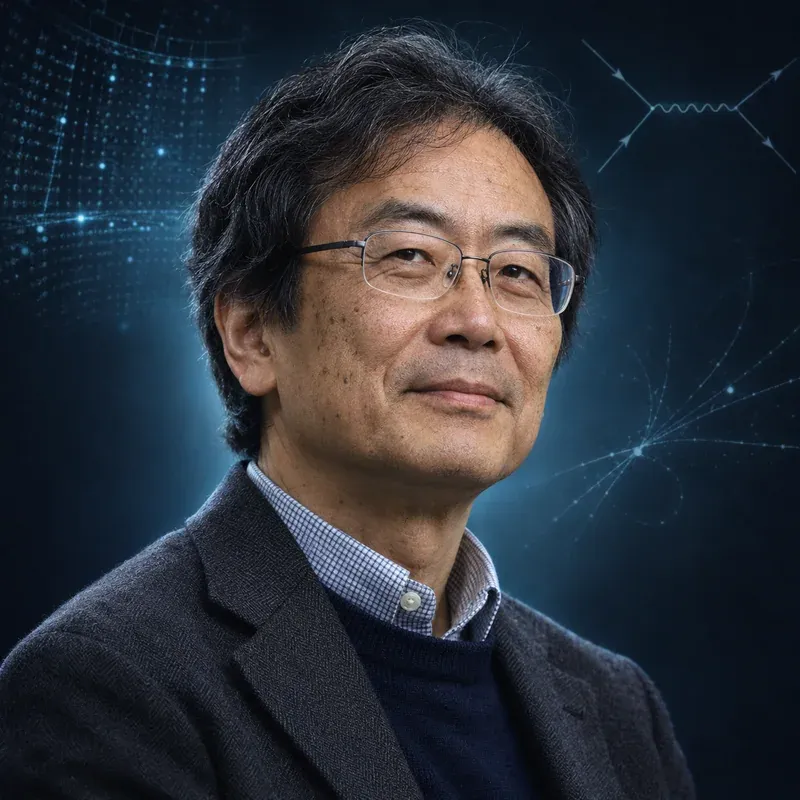
 Illustration
Masayuki Nakahata
As a young Kamiokande researcher, Nakahata was the first to examine the raw data around 23 February 1987 and found the roughly 10-second burst of events from SN 1987A, then checked the data to show it was unique. He went on to lead Super-Kamiokande, becoming Director of Kamioka Observatory in 2014, with work spanning solar, supernova and dark-matter physics.
- Born
- 1959
Matsumoto, Nagano, Japan - Nationality
- Japanese
- Field
- Neutrino astroparticle physics
- Institutions
- University of Tokyo, ICRR Kamioka Observatory, Kavli IPMU
Early life and education
Masayuki Nakahata was born in 1959 in Matsumoto, Nagano Prefecture. He began studying physical sciences at the University of Tokyo in 1978 and received his bachelor's degree in 1982. Around 1980 he joined the group of Masatoshi Koshiba, which was then building Kamiokande, a water Cherenkov detector in the Kamioka mine designed to detect proton decay. Koshiba had told his students that a proton-decay discovery could bring a Nobel Prize. Looking back, Nakahata said: “You only have one crack at life, and I decided to take a gamble with someone like Koshiba.”
Finding the supernova signal
Proton decay never appeared, and Koshiba's group upgraded the detector, as Kamiokande-II, to lower its energy threshold for neutrinos. On 23 February 1987 light from a supernova in the Large Magellanic Cloud reached Earth. Nakahata was the first to examine the raw data around that date. He found about ten seconds of unusually strong signals, a burst of events that came only three minutes after a two-minute gap in data taking caused by a recalibration.
Koshiba was travelling and could not be reached, so Nakahata reported the find the following week. Koshiba asked him to check all other Kamiokande data to make sure nothing similar had ever occurred. Nakahata spent about a week going through the tapes and showed that the burst was unique. The analysis became the 1987 Physical Review Letters paper reporting a neutrino burst from SN 1987A, with 11 events in Kamiokande-II and a further eight seen independently by IMB. These few dozen neutrinos confirmed that a collapsing stellar core releases most of its energy as supernova neutrinos, and they were part of the work for which Koshiba shared the 2002 Nobel Prize.
Solar neutrinos and Super-Kamiokande
In 1988 Kamiokande-II observed solar neutrinos in real time and showed that they came from the direction of the Sun, confirming with a different technique the deficit seen by the Homestake experiment. Nakahata's research stayed with this line of work in its successor, Super-Kamiokande, whose 1998 results established neutrino oscillations and whose precise measurement of boron-8 solar neutrinos became a central input to the solution of the solar neutrino problem. He credits Koshiba, Yoji Totsuka and Takaaki Kajita as his key mentors.
Leading Kamioka
Nakahata became a Principal Investigator at Kavli IPMU in 2007, Director of the Kamioka Observatory and of the Super-Kamiokande group of the Institute for Cosmic Ray Research in 2014, and deputy director of the institute in 2015. During his tenure Super-Kamiokande began its gadolinium phase: in 2020 gadolinium sulphate was dissolved in the water so that neutrons from inverse beta decay can be tagged by their capture on gadolinium. The main goal is a first detection of the diffuse supernova neutrino background, the faint glow of neutrinos from all past supernovae. Super-Kamiokande is also the reference point for its much larger successor, Hyper-Kamiokande, under construction nearby.
He has received the Nishina Memorial Prize, and in 2024 the Japanese government awarded him the Medal with Purple Ribbon for his contributions to neutrino physics, astrophysics and underground science.
Known for
- First to find the SN 1987A neutrino signal in Kamiokande data
- Director of Kamioka Observatory from 2014
- Super-Kamiokande solar and supernova neutrinos
- SK-Gd upgrade
Chronology
- 1987Identifies SN 1987A neutrino burst in Kamiokande data
- 2007Principal Investigator at Kavli IPMU
- 2014Director of Kamioka Observatory
- 2020Gadolinium loaded into Super-K
Original papers
- K. Hirata et al. (Kamiokande-II), Observation of a neutrino burst from the supernova SN1987A, Phys. Rev. Lett. 58, 1490 (1987)DOI 10.1103/PhysRevLett.58.1490
Experiments
Connected people
Frequently asked questions
Who first saw the SN 1987A neutrinos in Kamiokande data?
Masayuki Nakahata, then a young researcher in Koshiba's group, was the first to examine the raw data and find the ten-second burst. He then checked the entire data set to show that the signal was unique.
What is SK-Gd?
SK-Gd is the phase of Super-Kamiokande that began in 2020, with gadolinium dissolved in the water to tag neutrons. It improves the detection of antineutrinos, above all those from the diffuse supernova neutrino background.
Did Nakahata share in the Nobel Prize?
No. The 2002 Nobel Prize went to Masatoshi Koshiba, with Raymond Davis Jr. and Riccardo Giacconi. Nakahata has received the Nishina Memorial Prize and the Medal with Purple Ribbon.
On the timeline
Mentioned in 5 pages
Last updated: · Editorial standard
Cite this page
Text
Neutrino Atlas (2026). “Masayuki Nakahata”. Retrieved 22 November 2026, from https://neutrino-atlas.com/people/masayuki-nakahata/BibTeX
@misc{neutrinoatlas2026peoplemasayukinakahata,
  title        = {Masayuki Nakahata},
  author       = {{Neutrino Atlas}},
  year         = {2026},
  url          = {https://neutrino-atlas.com/people/masayuki-nakahata/},
  note         = {Accessed 2026-11-22},
  language     = {english}
}