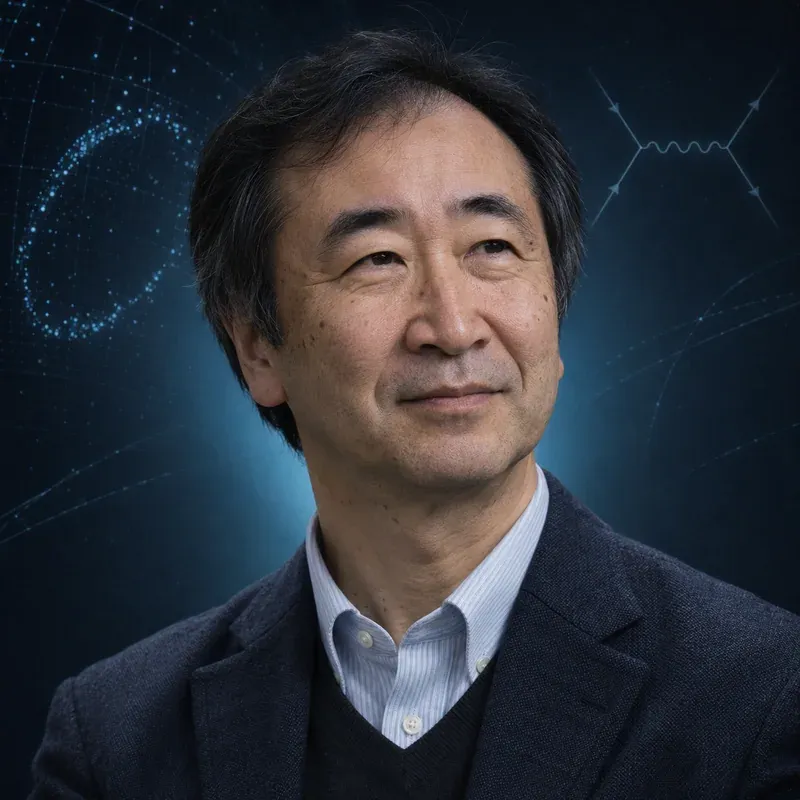
 Illustration
Takaaki Kajita
A member of Koshiba's group, Kajita analysed atmospheric neutrinos at Kamiokande, which showed a deficit of muon neutrinos relative to electron neutrinos. At Super-Kamiokande he led the analysis that in 1998 showed upward-going atmospheric muon neutrinos to be depleted compared with downward-going ones, the first compelling evidence for neutrino oscillation and hence for neutrino mass.
- Born
- 9 March 1959
Higashimatsuyama, Saitama, Japan - Nationality
- Japanese
- Field
- Experimental neutrino physics
- Nobel Prize
- Physics 2015 – for the discovery of neutrino oscillations, which shows that neutrinos have mass (shared with Arthur B. McDonald)
- Institutions
- Institute for Cosmic Ray Research (ICRR), University of Tokyo, Kavli IPMU
Early life and education
Takaaki Kajita was born in 1959 in Higashimatsuyama in Saitama Prefecture, Japan. He studied physics at Saitama University, graduating in 1981, and then entered the graduate school of the University of Tokyo, where he joined the research group of Masatoshi Koshiba. He received his doctorate in 1986 and in 1988 joined the Institute for Cosmic Ray Research (ICRR) of the University of Tokyo, which runs the Kamioka underground observatory.
Path to neutrino physics
Koshiba's group had built Kamiokande, a 3,000-tonne water Cherenkov detector in a zinc mine in Kamioka, to search for proton decay. Grand unified theories predicted that protons might decay with lifetimes just within experimental reach, and the most important background for such a search was the interactions of atmospheric neutrinos, produced when cosmic rays strike the upper atmosphere. Kajita's task as a young researcher was to understand these neutrino events in detail, so that they could be separated from a possible proton-decay signal.
No proton decay was found, but the background turned out to be interesting in its own right. Kajita developed methods to classify each event by its Cherenkov ring: a muon produces a sharp ring, an electron a fuzzy one because it starts a small electromagnetic shower. This made it possible to count muon neutrino and electron neutrino interactions separately.
Key contributions
The decay chain of pions and muons in the atmosphere should give roughly two muon neutrinos for every electron neutrino, and this ratio can be predicted far more reliably than the absolute flux. Kajita found that Kamiokande saw clearly fewer muon-like events than expected, while the electron-like events roughly matched the prediction. The collaboration published this ‘atmospheric neutrino anomaly’ in 1988. The IMB detector in the United States saw a similar effect, but some other experiments did not, and many physicists suspected a problem with the flux calculations or the event selection.
The decisive test came with Super-Kamiokande, a 50,000-tonne water Cherenkov detector that began operating in April 1996 under the leadership of Yoji Totsuka. Its size allowed a measurement of how the deficit depends on direction. Neutrinos coming from above have travelled about 15 kilometres through the atmosphere, while those coming from below have crossed the whole Earth, up to about 13,000 kilometres. Kajita led the analysis of the zenith-angle distribution. It showed that upward-going muon neutrinos were strongly depleted, while downward-going ones were not, and that electron neutrinos showed no such effect.
Such a pattern is exactly what neutrino oscillation predicts: muon neutrinos change into another flavour, most plausibly tau neutrinos, over distances of hundreds to thousands of kilometres at GeV energies. Kajita presented the result at the Neutrino '98 conference in Takayama in June 1998, and the paper ‘Evidence for oscillation of atmospheric neutrinos’ appeared in Physical Review Letters that August. The data pointed to a mass-squared difference of a few times 10⁻³ eV² and near-maximal mixing, described today by the angle θ23. Because oscillation requires neutrinos to have different masses, the result was the first compelling evidence that neutrinos are not massless, contrary to the original Standard Model.
Accelerator experiments soon confirmed the effect with controlled beams: K2K from KEK to Super-Kamiokande, then MINOS and T2K. Together with the solar results of SNO, the Super-Kamiokande measurement established the three-flavour oscillation picture described by the PMNS matrix.
Later work
Kajita became a professor at ICRR in 1999 and director of its Research Center for Cosmic Neutrinos. He later served as director of ICRR and as a principal investigator at the Kavli Institute for the Physics and Mathematics of the Universe. He also leads the KAGRA project, an underground cryogenic gravitational-wave detector in the Kamioka mine. From October 2020 he served as president of the Science Council of Japan, and from 2021 to 2024 he chaired the astroparticle physics commission of IUPAP.
In 2015 he shared the Nobel Prize in Physics with Arthur B. McDonald ‘for the discovery of neutrino oscillations, which shows that neutrinos have mass’. Earlier honours include the Panofsky Prize (2002, shared with Totsuka and Yoichiro Suzuki) and the Japan Academy Prize (2012); he was also named a Person of Cultural Merit in 2015.
Known for
- Atmospheric neutrino anomaly at Kamiokande
- Discovery of atmospheric neutrino oscillations (Super-K, 1998)
- Director of ICRR
- President of the Science Council of Japan
Chronology
- 1986PhD, University of Tokyo
- 1988Kamiokande atmospheric neutrino ratio anomaly; joins ICRR
- 1998Super-K evidence for atmospheric oscillation
- 2015Nobel Prize in Physics
Original papers
- K. S. Hirata et al. (Kamiokande), Experimental study of the atmospheric neutrino flux, Phys. Lett. B 205, 416 (1988)DOI 10.1016/0370-2693(88)91690-5
- Y. Fukuda et al. (Super-Kamiokande), Evidence for oscillation of atmospheric neutrinos, Phys. Rev. Lett. 81, 1562 (1998)DOI 10.1103/PhysRevLett.81.1562
Experiments
Connected people
- Masatoshi Koshiba
- Yōichirō Suzuki
- Yoji Totsuka
- Arthur B. McDonald
- Kōichirō Nishikawa
- Thomas K. Gaisser
- Mark D. Messier
- Masato Shiozawa
Frequently asked questions
What did Takaaki Kajita discover?
He led the Super-Kamiokande analysis that showed in 1998 that muon neutrinos produced in the atmosphere disappear depending on how far they have travelled. This was the first compelling evidence for neutrino oscillation and hence for neutrino mass.
Why was the up–down asymmetry so convincing?
The flux of atmospheric neutrinos from above and below should be nearly equal by symmetry. A deficit only in neutrinos that crossed the Earth cannot be explained by flux uncertainties, but follows naturally from oscillation over a long baseline.
Did Takaaki Kajita win a Nobel Prize?
Yes. He shared the 2015 Nobel Prize in Physics with Arthur B. McDonald of the SNO experiment.
On the timeline
- 1988Kamiokande finds an atmospheric neutrino anomaly
- 1998Super-Kamiokande discovers neutrino oscillation
- 2004Super-K sees the oscillation dip in L/E
- 2015Nobel Prize for neutrino oscillations
- 2015Breakthrough Prize honours five oscillation experiments
Mentioned in 45 pages
FAQ 5
Milestones 12
- 1957 · Pontecorvo proposes neutrino oscillations
- 1965 · First detection of atmospheric neutrinos
- 1988 · Kamiokande finds an atmospheric neutrino anomaly
- 1995 · Nobel Prize for neutrino detection
- 1998 · Super-Kamiokande discovers neutrino oscillation
- 2001 · SNO shows solar neutrinos change flavour
- 2002 · Nobel Prize for neutrino astrophysics
- 2002 · SNO measures the total solar neutrino flux
People 10
Terms 13
Last updated: · Editorial standard
Cite this page
Text
Neutrino Atlas (2026). “Takaaki Kajita”. Retrieved 22 November 2026, from https://neutrino-atlas.com/people/takaaki-kajita/BibTeX
@misc{neutrinoatlas2026peopletakaakikajita,
  title        = {Takaaki Kajita},
  author       = {{Neutrino Atlas}},
  year         = {2026},
  url          = {https://neutrino-atlas.com/people/takaaki-kajita/},
  note         = {Accessed 2026-11-22},
  language     = {english}
}