1965Discovery
First detection of atmospheric neutrinos
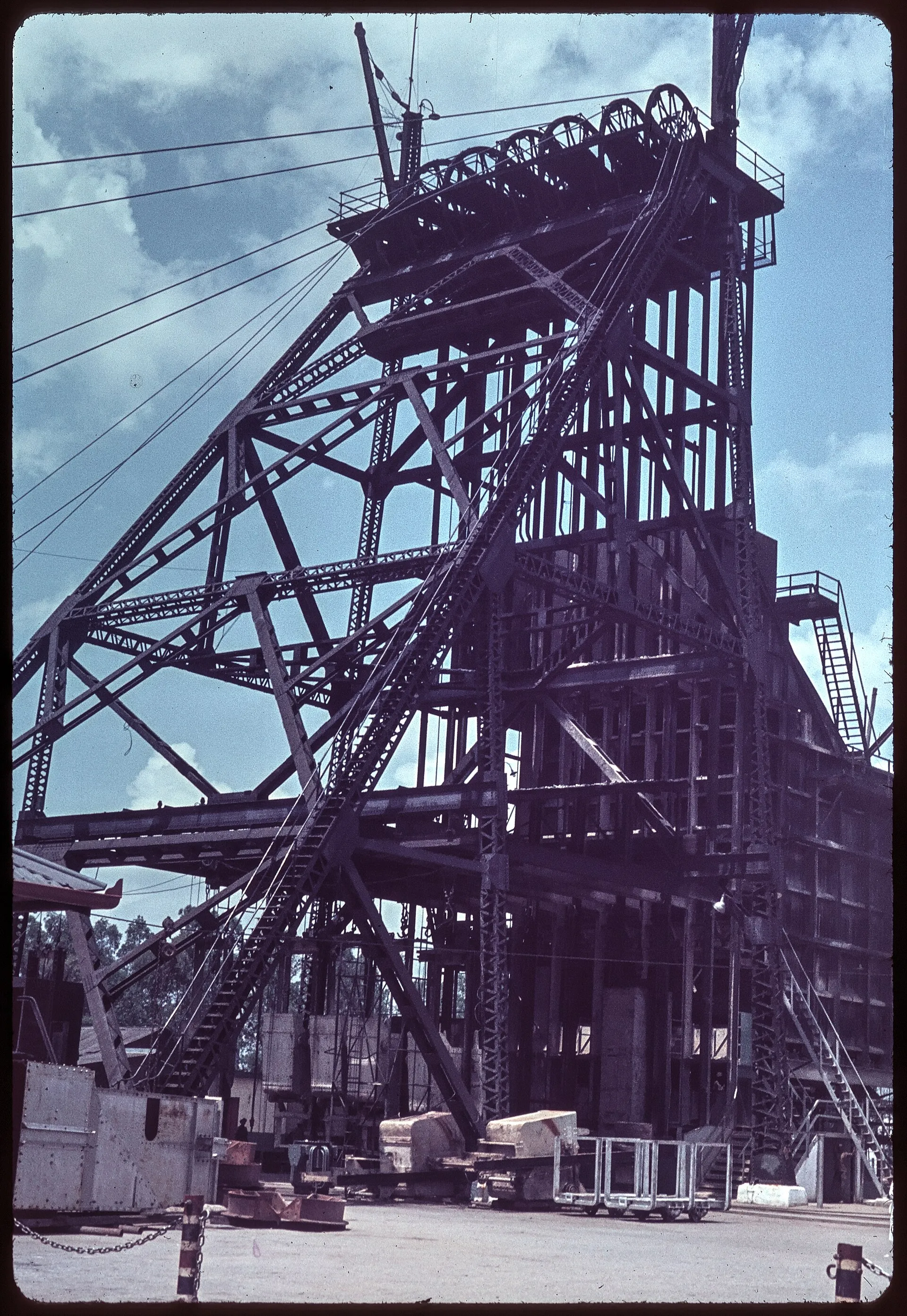
Frederick Reines's group in the East Rand gold mine near Johannesburg, about 3 km underground, and an Indian-Japanese-British team in the Kolar Gold Fields in India independently detected muons produced by neutrinos from cosmic-ray air showers. The great depth allowed horizontal neutrino-induced muons to be separated from downward cosmic-ray muons. These were the first natural neutrinos ever detected. Atmospheric neutrinos later provided the first convincing evidence for oscillations.
- Date
- 1965
- Kind of event
- Discovery
- People involved
- Frederick Reines
The situation before
By the early 1960s neutrinos had been detected only from a nuclear reactor and an accelerator. It was clear that nature produces them too. When cosmic-ray protons strike the upper atmosphere they create air showers full of pions and kaons, whose decays yield muons and neutrinos. These atmospheric neutrinos reach every point on Earth from all directions, with energies from about a GeV upward. Seeing them was difficult because the same showers produce a vastly larger number of muons that also penetrate deep into the ground.
The way out was depth. Cosmic-ray muons arrive mostly from above, and the rock overhead absorbs them. Neutrinos pass through the whole Earth and can produce muons in the rock around a detector coming from any direction, including horizontally and from below. At a depth of a few kilometres, almost any horizontal muon must have been made by a neutrino.
What happened
Two groups pursued this idea at the same time in the world's deepest mines. In South Africa, Frederick Reines of Case Institute of Technology, with Friedel Sellschop of the University of the Witwatersrand and others, installed walls of liquid scintillator at a depth of about 3.2 km in the East Rand Proprietary Mines near Johannesburg, equivalent to some 8,800 m of water. In India, a team from the Tata Institute of Fundamental Research in Bombay, Osaka City University and Durham University, including M. G. K. Menon, Saburo Miyake and Arnold Wolfendale, operated scintillators and neon flash tubes about 2.3 km underground in the Kolar Gold Fields.
Both groups recorded muon tracks at large zenith angles, near the horizontal, that could not be explained by cosmic-ray muons coming through the rock from above. The Kolar group reported its results in Physics Letters in August 1965; Reines's group published "Evidence for high-energy cosmic-ray neutrino interactions" in Physical Review Letters a few weeks later. The numbers were small, a handful of events in each detector over months, but the angular distribution made the case. The question of which group saw the first event has occasionally been debated; both are usually credited together.
Reaction
The detections were the first observations of neutrinos produced naturally, outside a reactor or an accelerator, and they were accepted without serious dispute. They confirmed that the atmospheric neutrino flux was roughly as calculated from cosmic-ray data. Reines's group went on to measure the flux and look for deviations; the Kolar laboratory remained one of the deepest underground sites for decades and was later used for proton-decay searches.
Why it matters
The 1965 results showed that underground depth could turn a mine into a neutrino observatory, a principle used by every large underground detector since. Atmospheric neutrinos at first looked like a background for proton-decay experiments such as Kamiokande and IMB in the 1980s. These experiments found that the ratio of muon to electron neutrinos was lower than expected, the atmospheric neutrino anomaly. In 1998 Super-Kamiokande, led by Yoji Totsuka and with Takaaki Kajita responsible for the key analysis, showed that upward-going muon neutrinos disappear on their way through the Earth. This was the first convincing evidence for neutrino oscillations, and it brought Kajita the 2015 Nobel Prize in Physics, shared with Arthur B. McDonald.
Reines himself received the 1995 Nobel Prize in Physics for the first detection of the neutrino at a reactor, but his work in South Africa had opened another road: the study of natural neutrinos, which leads from the deep mines of 1965 to today's neutrino telescopes.
Frequently asked questions
When were atmospheric neutrinos first detected?
In 1965, by groups in the East Rand mine in South Africa and the Kolar Gold Fields in India, who published their results within weeks of each other.
How could the detectors tell neutrino muons from cosmic-ray muons?
At depths of more than two kilometres, cosmic-ray muons arrive only from above. Muons travelling horizontally or upward must have been produced by neutrinos interacting in the nearby rock.
Why are atmospheric neutrinos important?
They provided the first convincing evidence for neutrino oscillations, at Super-Kamiokande in 1998.
Original papers
- DiscoveryF. Reines, M. F. Crouch, T. L. Jenkins, W. R. Kropp, H. S. Gurr, G. R. Smith, J. P. F. Sellschop and B. Meyer, Evidence for High-Energy Cosmic-Ray Neutrino Interactions, Phys. Rev. Lett. 15, 429 (1965)DOI 10.1103/PhysRevLett.15.429
- DiscoveryC. V. Achar et al., Detection of muons produced by cosmic ray neutrinos deep underground, Phys. Lett. 18, 196 (1965)DOI 10.1016/0031-9163(65)90712-2
Concepts
Mentioned in 1 page
Lessons 1
Last updated: · Editorial standard
Cite this page
Text
Neutrino Atlas (2026). “1965: First detection of atmospheric neutrinos”. Retrieved 22 November 2026, from https://neutrino-atlas.com/timeline/1965-first-atmospheric-neutrinos/BibTeX
@misc{neutrinoatlas2026irstatmosphericneutrinos,
  title        = {1965: First detection of atmospheric neutrinos},
  author       = {{Neutrino Atlas}},
  year         = {2026},
  url          = {https://neutrino-atlas.com/timeline/1965-first-atmospheric-neutrinos/},
  note         = {Accessed 2026-11-22},
  language     = {english}
}