1962Discovery
Brookhaven experiment discovers the muon neutrino
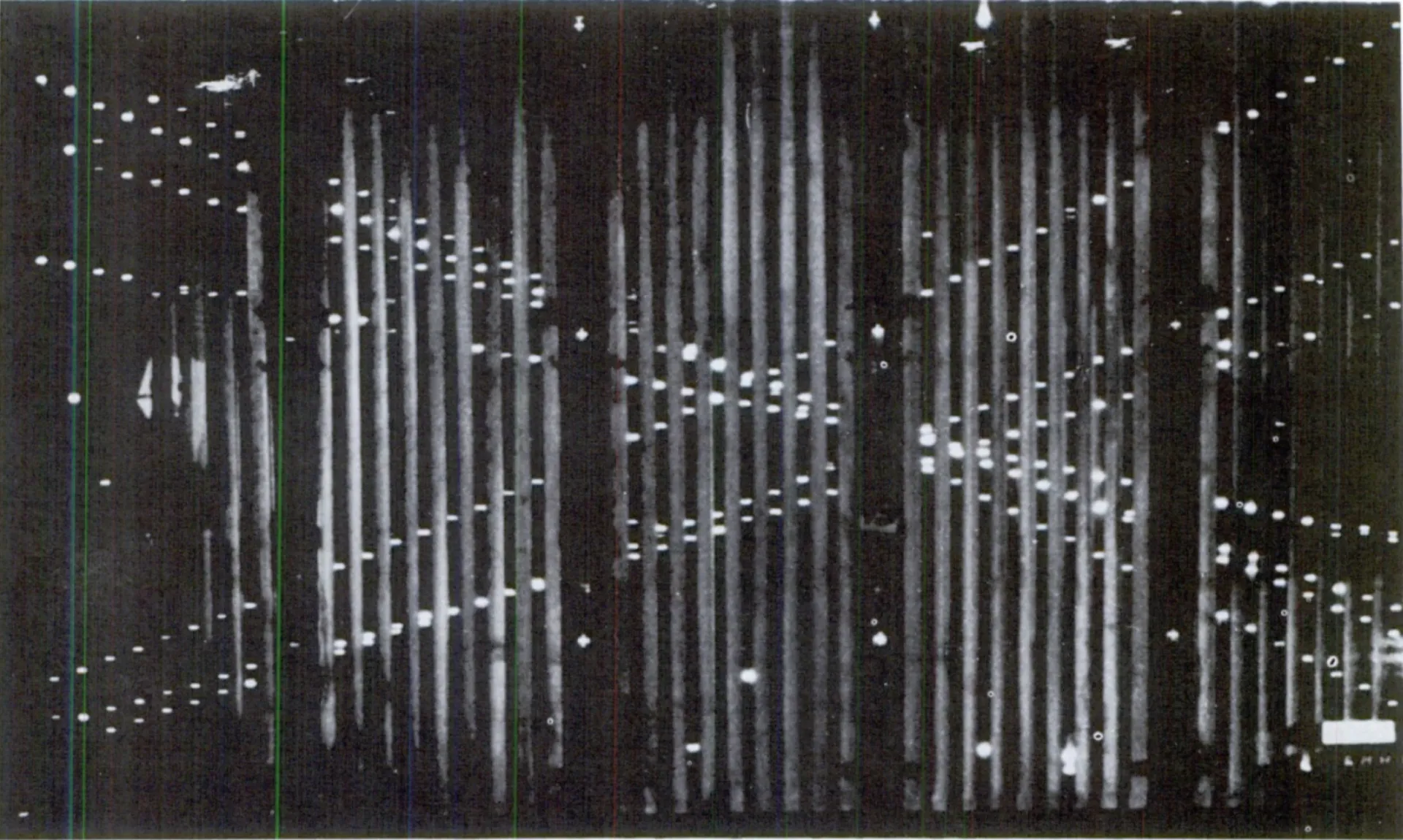
Leon Lederman, Melvin Schwartz and Jack Steinberger built the first accelerator neutrino beam at Brookhaven's Alternating Gradient Synchrotron, using pion decays and a 13.5 m steel shield. In a 10-ton spark chamber they recorded neutrino interactions that produced muons but essentially no electrons. Neutrinos from pion decay are therefore different from those in beta decay. The muon neutrino was discovered and the idea of lepton families established.
- Date
- 1 July 1962
- Kind of event
- Discovery
- People involved
- Leon M. Lederman, Melvin Schwartz, Jack Steinberger
- Experiments
- Brookhaven Two-Neutrino Experiment
The situation before
Around 1960 the neutrino was thought of as a single particle that appears together with an electron in beta decay and together with a muon in the decay of the pion. Nothing required the two to be the same, and one puzzle suggested they were not. If only one kind of neutrino existed, the muon should occasionally decay into an electron and a photon. Calculations predicted a rate that experiments had already excluded. A natural explanation was that the muon carries its own conserved quantum number and its own neutrino.
Bruno Pontecorvo in 1959 and Melvin Schwartz in 1960 had proposed a direct test: make a beam of neutrinos from pion decay at a proton accelerator and see whether they produce muons only, or electrons as well.
What happened
Schwartz, Leon Lederman and Jack Steinberger of Columbia University, with Gordon Danby, Jean-Marc Gaillard, Konstantin Goulianos and Nariman Mistry, carried out the experiment at the new Alternating Gradient Synchrotron at Brookhaven National Laboratory. Protons of 15 GeV struck a beryllium target. The resulting pions and kaons flew through about 21 m of open space, where some decayed into muons and neutrinos. A wall of iron 13.5 m thick, built in part from old battleship armour plate, then absorbed everything except the neutrinos.
Behind the wall stood a spark chamber of ten tons of aluminium plates, a then new detector technique that made charged-particle tracks visible as rows of sparks and could be photographed. Over many months of running, the team recorded several dozen events with a single long, penetrating track: muons produced by neutrinos. If the neutrinos from pion decay were the same as those of beta decay, they should have produced electron showers at a comparable rate. Only a handful of shower-like events appeared, consistent with background.
The result was published as "Observation of high-energy neutrino reactions and the existence of two kinds of neutrinos" in Physical Review Letters on 1 July 1962. The conclusion was clear: the neutrino produced with a muon is a different particle, the muon neutrino, distinct from the electron neutrino.
Reaction
The finding was accepted quickly. A larger experiment at CERN with a focused neutrino beam confirmed it in 1963–64. Beyond the discovery itself, physicists were struck by the method: the Brookhaven experiment was the first to use an artificial neutrino beam, opening high-energy neutrino physics as a field. Twenty-six years later Lederman, Schwartz and Steinberger received the 1988 Nobel Prize in Physics "for the neutrino beam method and the demonstration of the doublet structure of the leptons through the discovery of the muon neutrino".
Why it matters
The experiment established that leptons come in families. The electron and the electron neutrino form one doublet, the muon and the muon neutrino another, each with its own conserved lepton flavour number. This pattern of neutrino flavours matched the quark doublets that emerged in the following years and became a pillar of the Standard Model.
The existence of two kinds of neutrino also created the conditions for neutrino oscillations. Only months later, Ziro Maki, Masami Nakagawa and Shoichi Sakata suggested that the two flavours might be mixtures of states with definite mass, and Bruno Pontecorvo developed the idea of transitions between them. When the tau lepton was discovered in 1975, a third neutrino was expected at once; the tau neutrino was observed directly in 2000. The beam method itself is the ancestor of every accelerator neutrino experiment, from the CERN bubble chambers that found neutral currents to today's long-baseline programmes.
Frequently asked questions
When was the muon neutrino discovered?
The Brookhaven result was published on 1 July 1962 in Physical Review Letters.
Who discovered the muon neutrino?
Leon Lederman, Melvin Schwartz and Jack Steinberger, with Columbia colleagues Danby, Gaillard, Goulianos and Mistry. The three leaders shared the 1988 Nobel Prize in Physics.
How did they know the neutrinos were different?
The neutrinos from pion decay produced muon tracks in the spark chamber but essentially no electron showers. Identical neutrinos would have produced both at similar rates.
Original papers
- DiscoveryG. Danby, J.-M. Gaillard, K. Goulianos, L. M. Lederman, N. Mistry, M. Schwartz and J. Steinberger, Observation of High-Energy Neutrino Reactions and the Existence of Two Kinds of Neutrinos, Phys. Rev. Lett. 9, 36 (1962)DOI 10.1103/PhysRevLett.9.36
Concepts
Mentioned in 3 pages
Last updated: · Editorial standard
Cite this page
Text
Neutrino Atlas (2026). “1962: Brookhaven experiment discovers the muon neutrino”. Retrieved 22 November 2026, from https://neutrino-atlas.com/timeline/1962-two-neutrino-experiment/BibTeX
@misc{neutrinoatlas2026962twoneutrinoexperiment,
  title        = {1962: Brookhaven experiment discovers the muon neutrino},
  author       = {{Neutrino Atlas}},
  year         = {2026},
  url          = {https://neutrino-atlas.com/timeline/1962-two-neutrino-experiment/},
  note         = {Accessed 2026-11-22},
  language     = {english}
}