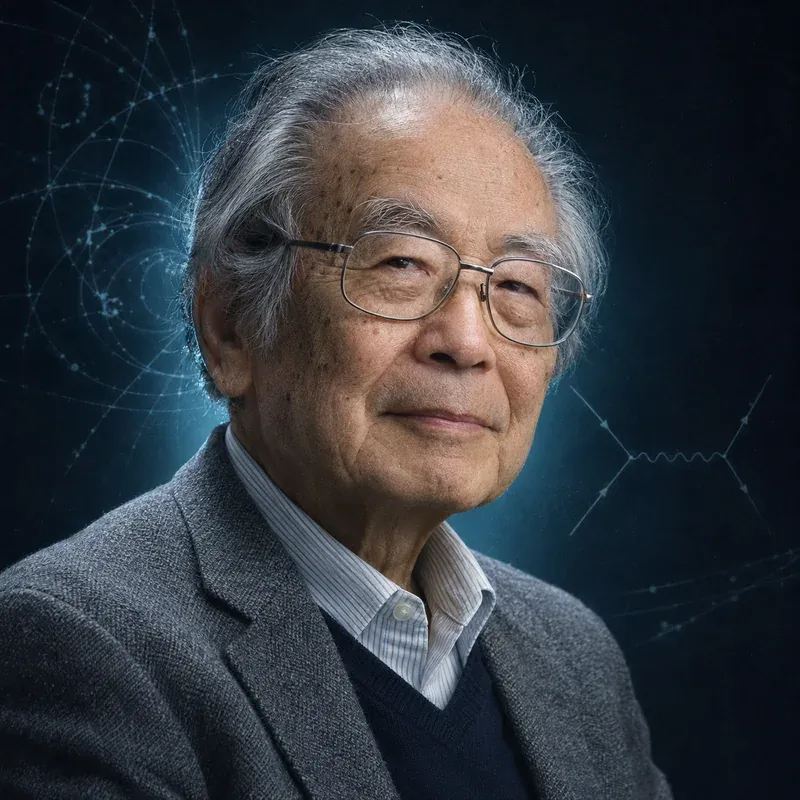
 Illustration
Ziro Maki
Together with Masami Nakagawa and Shoichi Sakata, Maki proposed in 1962 that the weak-interaction neutrinos (νe, νμ) are superpositions of 'true' neutrinos with definite masses, related by a mixing angle. This is the first formulation of two-flavour neutrino mixing and implies flavour transitions; the lepton mixing matrix is named after Pontecorvo, Maki, Nakagawa and Sakata (PMNS).
- Nationality
- Japanese
- Field
- Theoretical particle physics
- Institutions
- Nagoya University
Background
Ziro Maki was a Japanese theoretical physicist who belonged to the group of Shoichi Sakata at Nagoya University in the 1950s and 1960s. The Nagoya group was unusual for its time: it was organised on deliberately non-hierarchical lines, and it pursued a single long-term programme, the idea that the known particles are built from a small number of more fundamental constituents. Maki’s name is now attached to every measurement of neutrino oscillations, because he is the M in the PMNS matrix. Few personal details about him are documented in English-language sources, so this page concentrates on his work and its context.
The Nagoya model
In 1956 Sakata had proposed that the proton, the neutron and the lambda hyperon are the basic building blocks of the strongly interacting particles. Members of the group noticed that these three baryons resemble the three light leptons then known, the neutrino, the electron and the muon, which carry the same pattern of electric charges. In 1960 Maki, Masami Nakagawa, Yoshio Ohnuki and Sakata turned this observation into the Nagoya model: the baryons were pictured as leptons bound to a hypothetical ‘B-matter’, so that each baryon had a lepton partner.
Key contribution: neutrino mixing (1962)
In 1962 the experiment of Leon Lederman, Melvin Schwartz and Jack Steinberger at Brookhaven showed that the neutrino emitted together with a muon is a different particle from the one emitted with an electron (see two-neutrino experiment). With four leptons, the Nagoya correspondence now required four basic baryons. In ‘Remarks on the unified model of elementary particles’, published in Progress of Theoretical Physics in 1962, Maki, Nakagawa and Sakata adapted the model to this situation.
Their key step was to separate two kinds of neutrino states. The ‘weak neutrinos’ νe and νμ are the particles that appear in the weak current together with the electron and the muon. The ‘true neutrinos’ ν1 and ν2 are the states with definite masses, which in their model were bound inside the baryons. The two sets are related by a rotation through a mixing angle θ. This is exactly the modern distinction between flavour states and mass eigenstates, and it is the first published formulation of two-flavour neutrino mixing.
From the time-of-flight of neutrinos in the Brookhaven beam and from anomalies in nuclear beta-decay data, the authors even estimated a mass for the second neutrino near 1 MeV and a value of sin θ between about 0.16 and 0.25, and they pointed out that a beam of muon neutrinos would then contain a small admixture of electron-neutrino events. These numbers turned out to be wrong, but the structure was right: if the mass states differ in mass, a neutrino produced with one flavour can be detected with another, which is what oscillation experiments measure today.
The idea arose independently of Bruno Pontecorvo, who had reached oscillations by analogy with neutral kaons. When the three-flavour mixing matrix became central to particle physics after the discoveries of Super-Kamiokande in 1998 and SNO in 2001–2002, it was named after Pontecorvo, Maki, Nakagawa and Sakata.
Later work
The fourth baryon of the revised Nagoya model, called X in the papers, had no known counterpart. In 1971 Maki and his colleague Ogawa interpreted an unusual short-lived particle seen in cosmic-ray emulsion data by Kiyoshi Niu’s group as this fourth constituent. In modern language it is identified with a particle carrying charm, the quark discovered in 1974. Maki also served as director of the Research Institute for Fundamental Physics at Kyoto University, today’s Yukawa Institute for Theoretical Physics. He succeeded Hideki Yukawa in 1970, held the post until 1976 and returned as director from 1980 to 1986.
Known for
- Maki–Nakagawa–Sakata (MNS/PMNS) lepton mixing matrix
- Nagoya model of elementary particles
Chronology
- 1960Co-author of the Nagoya model with Sakata, Nakagawa and Ohnuki
- 1962Maki–Nakagawa–Sakata paper introducing neutrino mixing
Original papers
- Z. Maki, M. Nakagawa, S. Sakata, Remarks on the unified model of elementary particles, Prog. Theor. Phys. 28, 870 (1962)DOI 10.1143/PTP.28.870
Connected people
Frequently asked questions
What did Ziro Maki discover?
Together with Nakagawa and Sakata he proposed in 1962 that the electron and muon neutrinos are mixtures of two neutrinos with definite masses. This was the first formulation of neutrino mixing.
What does the M in PMNS stand for?
Maki. The PMNS matrix is named after Pontecorvo, Maki, Nakagawa and Sakata.
Where did Maki work?
At Nagoya University in Sakata’s group, and later at Kyoto University, where he twice directed the Research Institute for Fundamental Physics (1970–76 and 1980–86).
On the timeline
Mentioned in 19 pages
Milestones 4
People 6
Last updated: · Editorial standard
Cite this page
Text
Neutrino Atlas (2026). “Ziro Maki”. Retrieved 22 November 2026, from https://neutrino-atlas.com/people/ziro-maki/BibTeX
@misc{neutrinoatlas2026peopleziromaki,
  title        = {Ziro Maki},
  author       = {{Neutrino Atlas}},
  year         = {2026},
  url          = {https://neutrino-atlas.com/people/ziro-maki/},
  note         = {Accessed 2026-11-22},
  language     = {english}
}