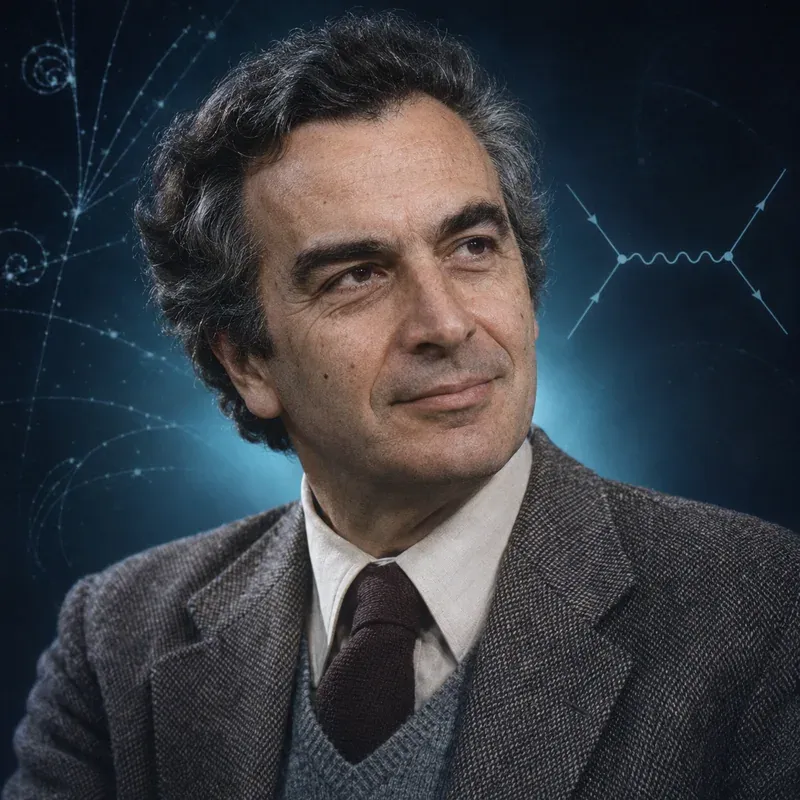
 Illustration
Nicola Cabibbo
Cabibbo's 1963 quark mixing angle was the hadronic counterpart of the lepton mixing introduced by Maki, Nakagawa and Sakata. In 1978 he pointed out that, with three neutrino flavours, a complex phase in the lepton mixing matrix produces CP and T violation in neutrino oscillations, the effect now searched for by T2K, NOvA, DUNE and Hyper-Kamiokande.
- Born
- 10 April 1935
Rome, Italy - Died
- 16 August 2010
Rome, Italy - Nationality
- Italian
- Field
- Theoretical particle physics
- Institutions
- Sapienza University of Rome, INFN (president 1983–1992), Laboratori Nazionali di Frascati, CERN
Early life and education
Nicola Cabibbo was born in Rome in 1935 and studied physics at Sapienza University of Rome, graduating in 1958. His thesis on the weak interaction and muon decay was supervised by Bruno Touschek. After a period with the Rome division of INFN he became, in 1960, the first theoretical physicist at the Frascati National Laboratories.
The Cabibbo angle
In 1963, working at CERN, Cabibbo solved a puzzle of the weak decays of strange particles: they occurred noticeably more slowly than decays without strangeness, seemingly contradicting a universal weak strength. In 'Unitary symmetry and leptonic decays' (Phys. Rev. Lett. 10, 531) he proposed that the weak force couples to a rotated combination of the strange and non-strange states, governed by a single mixing angle of about 13 degrees. Kobayashi and Maskawa later extended this picture to three quark generations, producing the CKM matrix and its CP-violating phase; their work was recognised with half of the 2008 Nobel Prize in Physics, and many physicists felt that Cabibbo's foundational role had been overlooked.
Lepton mixing and CP violation in oscillations
The lepton counterpart of Cabibbo's quark mixing had been written down in 1962 by Ziro Maki, Masami Nakagawa and Shoichi Sakata and is now called the PMNS matrix (compare CKM versus PMNS). In 'Time reversal violation in neutrino oscillation' (Phys. Lett. B 72, 333, 1978), Cabibbo pointed out that with three neutrino flavours, a complex phase in the lepton mixing matrix makes oscillation probabilities differ between neutrinos and antineutrinos and between a process and its time-reversed version. This phase is today's δCP, and leptonic CP violation is a central goal of T2K, NOvA, DUNE and Hyper-Kamiokande.
Later work and legacy
Cabibbo returned to Rome in 1967 to teach theoretical physics. As president of INFN from 1983 to 1992 he oversaw the period in which the Gran Sasso laboratory opened. He then presided over the Italian energy agency ENEA (1993–1998) and the Pontifical Academy of Sciences (from 1993 until his death). His honours include the Sakurai Prize (1989), the EPS High Energy and Particle Physics Prize (1991), the Matteucci Medal (2002) and the ICTP Dirac Medal (2010). He died in Rome in August 2010.
Known for
- Cabibbo angle and universality of weak interactions (1963)
- Precursor of the CKM matrix
- CP/T violation in three-flavour neutrino oscillations (1978)
Chronology
- 1963Cabibbo angle
- 1978T violation in neutrino oscillations
- 1989Sakurai Prize
- 2010ICTP Dirac Medal
Original papers
- N. Cabibbo, Unitary symmetry and leptonic decays, Phys. Rev. Lett. 10, 531 (1963)DOI 10.1103/PhysRevLett.10.531
- N. Cabibbo, Time reversal violation in neutrino oscillation, Phys. Lett. B 72, 333 (1978)DOI 10.1016/0370-2693(78)90132-6
Experiments
Connected people
- Samoil Mikhelevich Bilenky
- Serguey Todorov Petcov
- Ziro Maki
- Guido Altarelli
- Luciano Maiani
- Toshihide Maskawa
Frequently asked questions
What is the Cabibbo angle?
It is the angle, about 13 degrees, that describes how the weak force mixes down and strange quarks. It explained why strange particles decay more slowly via the weak force while keeping a universal weak coupling.
Did Nicola Cabibbo win a Nobel Prize?
No. The 2008 Nobel Prize went in part to Kobayashi and Maskawa for extending his mixing to three generations, which many physicists regarded as an omission of Cabibbo.
Mentioned in 10 pages
Last updated: · Editorial standard
Cite this page
Text
Neutrino Atlas (2026). “Nicola Cabibbo”. Retrieved 22 November 2026, from https://neutrino-atlas.com/people/nicola-cabibbo/BibTeX
@misc{neutrinoatlas2026peoplenicolacabibbo,
  title        = {Nicola Cabibbo},
  author       = {{Neutrino Atlas}},
  year         = {2026},
  url          = {https://neutrino-atlas.com/people/nicola-cabibbo/},
  note         = {Accessed 2026-11-22},
  language     = {english}
}