NOvA
Fermilab's off-axis long-baseline experiment with a 14-kilotonne liquid scintillator far detector in Minnesota.
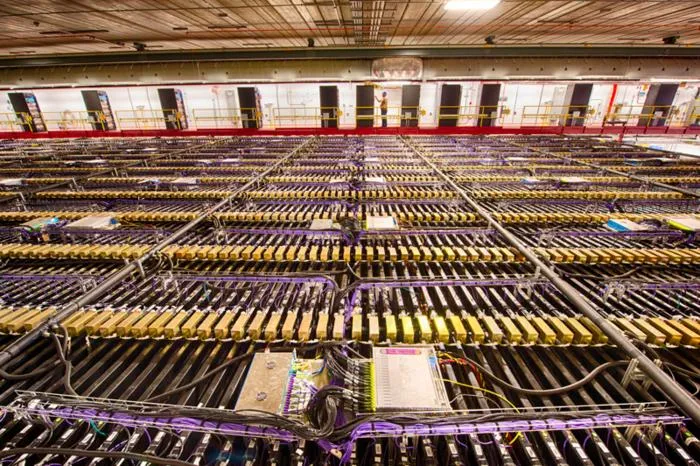
NOvA places its far detector 810 km away at Ash River, 14 mrad off the NuMI axis, giving a narrow beam near 2 GeV. Its fully active PVC cells filled with liquid scintillator measure νe and ν̄e appearance and νµ disappearance. The longer baseline gives more matter-effect sensitivity to the mass ordering than T2K. A joint T2K–NOvA analysis was published in 2025.
Compare all experiments → · World map →
In plain words
NOvA is a giant, finely divided tank of liquid scintillator in northern Minnesota that watches neutrinos from Fermilab, 810 km away. It looks mainly for muon neutrinos that have turned into electron neutrinos. Because its beam crosses more of the Earth than T2K's, the surrounding matter changes the oscillation more strongly, which makes NOvA sensitive to whether the third neutrino mass is the heaviest.
How the detector works
The 14-kilotonne far detector at Ash River is about 60 m long and 15.6 m high and wide. It consists of 344,064 rectangular PVC cells, each roughly 4 by 6 cm in cross-section and 15.5 m long, filled with mineral-oil-based liquid scintillator. A looped wavelength-shifting fibre in each cell carries the light to an avalanche photodiode. Planes alternate between vertical and horizontal cells, giving two views of every track. About two thirds of the mass is active scintillator, so electron showers are sampled finely enough to be told apart from muons and from photons produced by π⁰ decays. A 300-tonne near detector of the same design sits underground at Fermilab. The far detector lies 14 milliradians off the NuMI axis, giving a narrow off-axis beam peaked near 2 GeV. It is close to the surface, with only a few metres of overburden, so precise beam timing is essential to reject cosmic rays.
Key results
- Precise measurements of θ₂₃ and |Δm²₃₂| from muon-neutrino disappearance.
- 2019: evidence for electron-antineutrino appearance at more than 4σ.
- Constraints on δCP and the mass ordering, in mild tension with T2K for the normal ordering.
- October 2025: the first joint analysis with T2K, published in Nature.
Status today
NOvA continues to take data and is expected to run until about 2027, ahead of DUNE. Gary Feldman and Mark Messier served as its long-time co-spokespersons.
Frequently asked questions
Why is NOvA not underground?
Placing a 14-kilotonne detector deep underground at 810 km would have been far more expensive. Its beam arrives in microsecond pulses, so most cosmic rays can be rejected by timing alone.
How do NOvA and T2K complement each other?
T2K has a shorter baseline and weaker matter effects, so it mainly measures δCP. NOvA's stronger matter effect mixes δCP with the mass ordering. Combining them helps disentangle the two.
Original papers
- First resultP. Adamson et al. (NOvA Collaboration), First measurement of electron neutrino appearance in NOvA, Phys. Rev. Lett. 116, 151806 (2016)DOI 10.1103/PhysRevLett.116.151806arXiv:1601.05022
- MeasurementM. A. Acero et al. (NOvA Collaboration), First Measurement of Neutrino Oscillation Parameters using Neutrinos and Antineutrinos by NOvA, Phys. Rev. Lett. 123, 151803 (2019)DOI 10.1103/PhysRevLett.123.151803arXiv:1906.04907
Related terms
People
- Boris J. Kayser
- Gary J. Feldman
- M. Concepción (Concha) González-García
- Vernon Duane Barger
- Stephen J. Parke
- Mark D. Messier
- Nicola Cabibbo
- Takashi Kobayashi
- Thomas Schwetz
- Patricia (Tricia) Vahle
Latest research on this topic
- The light curve modeling of eclipsing cataclysmic variables: from period bouncers to nova-likesZharikov, Sergey · 1 November 2026
- Cryogenic performance of Silicon Photo-Multipliers at LN2 temperature and at 3 K in the RES-NOVA cryostatRossini, Riccardo, Rossella, Massimo, Clemenza, Massimiliano et al. · 1 November 2026
- Nova V1674 Her as a fast magnetic rotatorLuna, G.J.M., Orio, M., Dobrotka, A. et al. · 30 October 2026
- Evidence for a nova super-remnant surrounding the recurrent nova V745 Scorpii using eROSITAHealy-Kalesh, Michael W., Saeedi, Sara, Sasaki, Manami et al. · 27 October 2026
- Late Epoch Infrared Spectroscopy and Two-Component 3D Photoionization Modeling of Classical Nova V5668 SgrTaft, Sarah H., Woodward, Charles E., Santos, Bruno C. et al. · 24 October 2026
- Far Ultraviolet Variability on Timescales of a Few hours in the Recurrent Nova M31N 2008-12a: Origin and ImplicationsBasu, Judhajeet, Barway, Sudhanshu, Anupama, G.C. et al. · 24 October 2026
On the timeline
Mentioned in 102 pages
Lessons 7
Milestones 13
- 1960 · Proposals for accelerator neutrino beams
- 1962 · Maki, Nakagawa and Sakata introduce neutrino mixing
- 1978 · Wolfenstein: matter changes neutrino oscillations
- 1986 · Fukugita and Yanagida propose leptogenesis
- 1988 · Nobel Prize for the muon neutrino
- 2006 · MINOS confirms muon-neutrino disappearance
- 2012 · RENO confirms θ₁₃
- 2015 · Breakthrough Prize honours five oscillation experiments
People 18
Terms 59
- Accelerator Long-baseline experiments
- Accelerator neutrino beams
- Accelerator neutrinos
- Antiparticle
- Appearance measurement
- Appearance vs disappearance
- Atmospheric mass splitting Δm²31
- Baseline
51 more
- Beta beam
- Charge conjugation
- Conventional neutrino beam
- CP violation
- CP-Violating phase δCP
- CP-Violation sensitivity (δCP)
- Cross sections
- Daya Bay
- DeepCore & IceCube upgrade
- Earth matter effects
- Electronvolt
- Event reconstruction & identification
- Experiments & detectors
- Exposure
- Feldman–Cousins method
- GeV scale
- Global fit
- L/E (baseline over energy)
- Lepton generation
- Leptonic CP violation
- Major neutrino beamlines
- Mass-ordering sensitivity
- Matter-antimatter asymmetry
- Maximum-likelihood fit
- MINERvA
- MINOS / MINOS+
- Mixing angle θ23
- Muon neutrino
- Near and far detectors
- Near-to-far extrapolation
- Neutrino energy reconstruction
- Neutrino kinetic energy
- Neutrino mass ordering
- Neutrino vs antineutrino mode
- Neutrino-nucleus scattering regimes
- Non-standard interactions
- Nuclear models for neutrino scattering
- NuMI Beam
- Off-axis beam
- Off-axis beam (facility)
- Oscillation observables
- Oscillation parameter degeneracies
- Particle identification (PID)
- Resonance production
- Segmented scintillator tracking calorimeter
- Symmetries and their violation
- T violation in oscillations
- T2K
- Underground depth & metres water equivalent
- Wavelength shifter
- θ23 octant
Last updated: · Editorial standard
Cite this page
Text
Neutrino Atlas (2026). “NOvA”. Retrieved 22 November 2026, from https://neutrino-atlas.com/terms/nova/BibTeX
@misc{neutrinoatlas2026termsnova,
  title        = {NOvA},
  author       = {{Neutrino Atlas}},
  year         = {2026},
  url          = {https://neutrino-atlas.com/terms/nova/},
  note         = {Accessed 2026-11-22},
  language     = {english}
}